
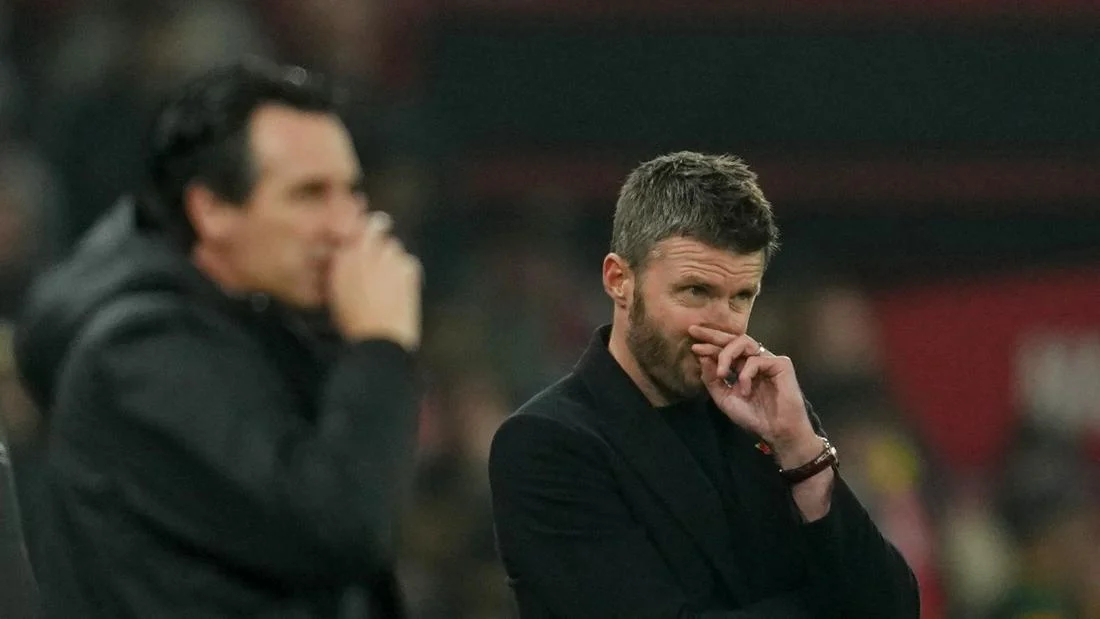
The future of Manchester United manager Michael Carrick has secured a temporary reprieve, with the club hierarchy opting against a managerial dismissal during the November international break. Despite overseeing a turbulent start to the Premier League campaign that has left the 20-time English champions languishing in the relegation zone, the Old Trafford leadership has chosen stability over a knee-jerk reaction.
This decision comes in the wake of a chaotic 4-4 draw against Aston Villa at Old Trafford, a match that once again exposed the defensive frailties and tactical inconsistencies plaguing the squad under Carrick’s stewardship. While Manchester United demonstrated remarkable resilience to claw back a two-goal deficit twice—reminiscent of their dramatic 3-2 European comeback against AS Roma days prior—the overarching narrative of their domestic season remains bleak. The stalemate extended United’s winless run in the Premier League to eight consecutive matches, plunging the club into 18th place in the league table with a meager eight points from their opening fixtures and just a single victory to their name.
Consequently, Manchester United face the sobering reality of spending the international fortnight occupying a spot in the relegation zone. For a club of United’s global stature, financial might, and historical pedigree, this predicament represents an unprecedented crisis, drawing inevitable comparisons to the dark days of 1986 when Ron Atkinson was relieved of his duties following a similarly disastrous start to the season. Yet, despite mounting pressure from the fanbase and media pundits alike, the INEOS-led sporting department has signaled a deliberate shift in strategy, prioritizing long-term structural patience over reactive measures.
A Chronology of Crisis: The Road to Old Trafford’s Turmoil
The current predicament at Manchester United is not an isolated incident born of a single match, but rather the culmination of a protracted period of underperformance that spans multiple managerial tenures. The early stages of the 2026/27 Premier League campaign promised optimism following summer investments, but the reality on the pitch quickly soured.
The campaign began with erratic form, characterized by an inability to convert possession and dominance into clinical victories. As September bled into October, the defensive structural integrity that Carrick had initially attempted to instill began to fracture. A series of damaging defeats against mid-table opposition sapped the squad’s confidence, while injuries to key personnel exposed a lack of depth across the roster.
The breaking point for many supporters appeared to arrive on a damp Sunday evening at Old Trafford on November 8, 2026. Facing an ambitious Aston Villa side, Manchester United found themselves chasing the game after defensive lapses gifted their opponents a two-goal cushion. Though Carrick’s tactical tweaks and substitutions injected urgency into the side—culminating in a frantic late equalizer that salvaged a 4-4 draw—the defensive vulnerabilities were glaring.
The draw extended a winless domestic sequence that has baffled analysts and exasperated supporters. Having failed to secure three points in eight successive league outings, United’s accumulation of a mere eight points from their opening block of games pushed them below the dotted line into 18th place. It marks a historic nadir for the club in the modern era, invoking memories of the 1986/87 season under Ron Atkinson, which ultimately paved the way for the Sir Alex Ferguson revolution. However, unlike the swift administrative axing witnessed nearly four decades ago, the modern footballing landscape under INEOS operates with a different philosophical framework.
The INEOS Stance: Moving Away from the Managerial Merry-Go-Round
According to reports from authoritative journalistic sources close to the club, including insights shared by journalist Laurie Whitwell of The Athletic, the INEOS group—which holds minority ownership and exercises operational control over footballing matters—remains steadfast in its backing of Carrick.
Internal discussions among the club’s key decision-makers during the opening days of the international break yielded a consensus: hasty dismissals have historically proven counterproductive for Manchester United. In the post-Sir Alex Ferguson era, the club has cycled through numerous permanent and interim managers, each accompanied by substantial squad overhauls, yet sustainable success has remained elusive. The current board is acutely aware of the reputational and financial costs associated with constant managerial churn.
Consequently, the directive from the top is one of calculated patience. Sources indicate that the hierarchy is eager to break the cycle of short-termism, choosing instead to evaluate Carrick’s performance over an extended horizon rather than reacting to week-by-week results.
"They want to give Michael Carrick the necessary time and space to stabilize the current environment," reports from club insiders suggest. While speculation was rampant across sports media outlets that the international break would serve as the logical juncture for a high-profile sacking, direct communications with senior club executives have debunked those theories. The message emanating from the executive offices is clear: no knee-jerk reactions, and no panic-driven appointments.
As a result, Carrick’s position is secure for the immediate future. More importantly, he will remain in the dugout for one of the most daunting fixtures on the English football calendar: a trip to Anfield to face fierce rivals Liverpool on November 22.
Statistical Reality and the Relegation Zone Conundrum
To fully understand the gravity of Manchester United’s situation, one must examine the cold metrics underpinning their league position. Sitting 18th in the Premier League table after a double-digit number of matches is uncharted territory for a club that has historically resided in the upper echelons of English football.
| Metric | Current Status (November 2026) | Historical Context (Man Utd Standard) |
|---|---|---|
| League Position | 18th (Relegation Zone) | Typically Top 4 Contenders |
| Points Accumulated | 8 points | Usually 20+ points at this stage |
| Wins Recorded | 1 victory | Minimum 6-7 victories |
| Winless Streak | 8 consecutive matches | Extremely rare occurrence |
| Goal Difference | Negative (-6 or lower) | Traditionally heavily positive |
The underlying defensive data is particularly alarming. Conceding four goals at home against Aston Villa—following closely on the heels of conceding multiple goals against European and domestic opponents—highlights a systemic imbalance in the team’s tactical setup. While the attacking unit, bolstered by moments of individual brilliance, managed to net four goals of their own against Villa and three against AS Roma, the inability to shut down games has transformed potential victories into frustrating draws or outright defeats.
Furthermore, the psychological toll of inhabiting the relegation zone cannot be understated. Professional athletes at this level are unaccustomed to battling for survival at the wrong end of the table. The weight of expectation, combined with hostile media scrutiny and restless supporters, creates a toxic microclimate that can paralyze performance. For Carrick, the challenge extends far beyond tactical adjustments on the training pitch; it is an exercise in crisis management and psychological rehabilitation.
Broader Implications for the Club and the Anfield Test
The decision to retain Michael Carrick through the international break carries profound implications for the remainder of the season. By offering a vote of confidence, INEOS is effectively staking its own operational credibility on Carrick’s capacity to turn the tide. If the team responds positively and begins climbing out of the relegation zone, the board will be vindicated for resisting external pressures. Conversely, if results continue to spiral downwards, the scrutiny will inevitably shift from the dugout to the executive suite.
The immediate horizon presents a trial by fire. The fixture list has afforded no gentle re-entry into competitive action, culminating in the high-stakes clash against Liverpool at Anfield on November 22. Matches against Liverpool are historically fraught with tension, regardless of league standings. To travel to Merseyside while mired in the relegation zone adds an unprecedented layer of jeopardy to an already ferocious rivalry.
For Carrick, the two-week international hiatus represents a vital window for internal reflection, tactical refinement, and physical recovery. With a depleted squad largely remaining at Carrington due to international call-ups and injury rehabilitations, the coaching staff must utilize every available minute to shore up a leaky defense and instill a resilient collective mindset.
Ultimately, Manchester United’s current crisis is a symptom of deeper, structural challenges that have plagued the institution for over a decade. Whether Michael Carrick is the architect of the club’s renaissance or merely a transitional figure navigating a stormy passage remains to be seen. For now, the leadership has chosen the path of continuity. As the football world turns its attention toward the resumption of domestic hostilities at Anfield, all eyes will be locked on the Manchester United dugout, where a beleaguered manager fights not just for his own professional future, but for the pride of English football’s most decorated institution.
