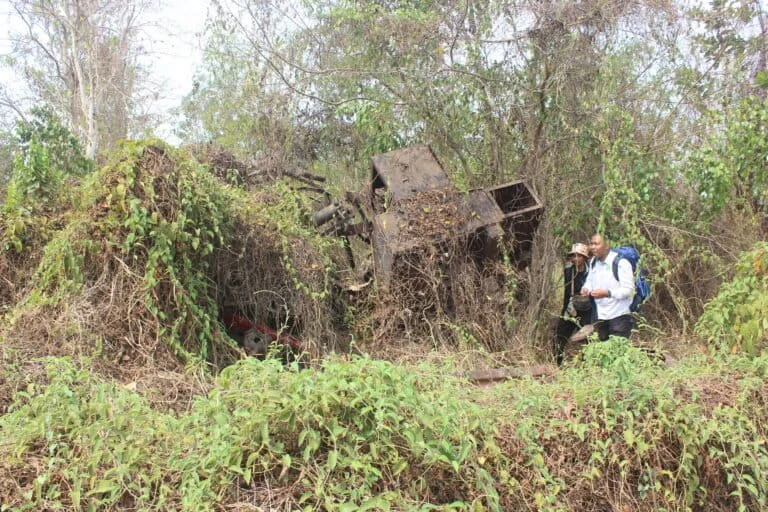
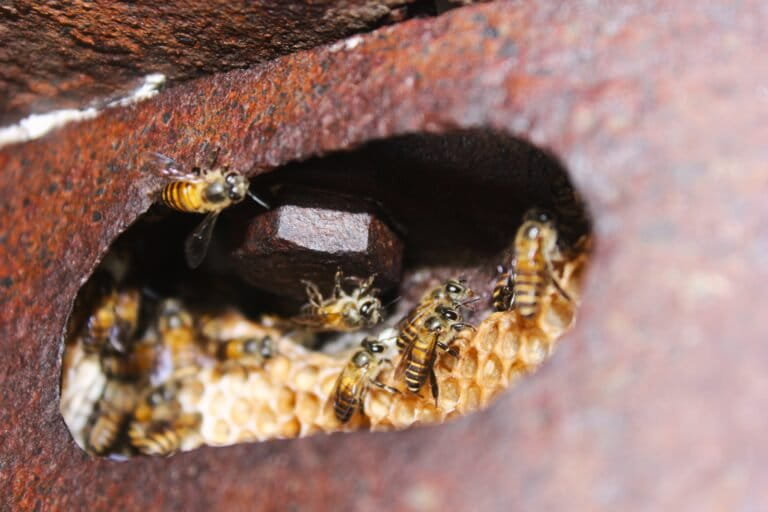
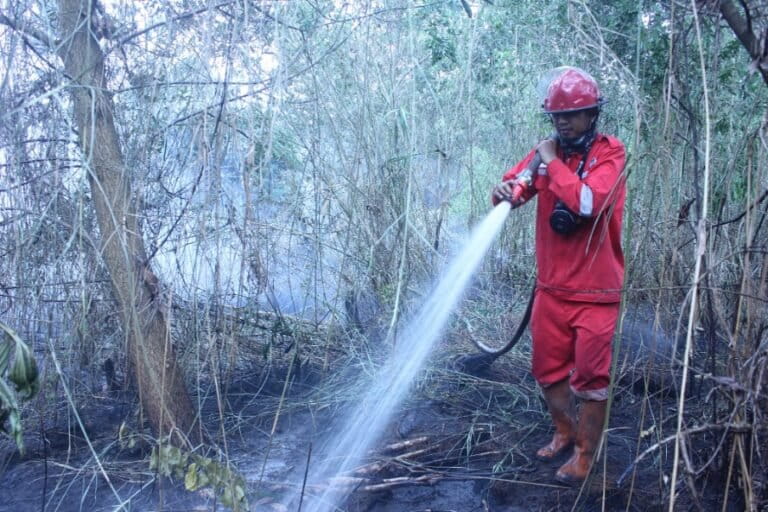
The persistent forest and land fires (karhutla) ravaging South Kalimantan have extended their destructive reach beyond vegetation and carbon stocks, triggering a silent yet profound ecological crisis involving the region’s essential pollinators. As of October 14, 2026, local disaster management agencies have recorded 4,926 fire incidents across the province, resulting in 27,202 hectares of land scorched since the beginning of the year. Amidst this haze-choked landscape, local observers have documented a disturbing behavioral shift among native Eastern honeybees (Apis cerana), which are increasingly abandoning their natural habitats to seek refuge in the hollow cavities of abandoned, rusted heavy machinery in the Liang Anggang district of Banjarbaru.
A Chronology of Environmental Distress
The 2026 fire season in South Kalimantan has been characterized by an unusually prolonged dry spell. Data from the Meteorology, Climatology, and Geophysics Agency (BMKG) highlights a critical period of drought, with several areas experiencing no rainfall for over 100 days. Tamban, in the Barito Kuala Regency, recorded the most severe dry spell at 118 consecutive days without rain. This extreme desiccation has created a tinderbox environment, allowing small ignition points to escalate rapidly into large-scale landscape fires.
The impact on local wildlife, particularly insect populations, has been cumulative. By August, the intensity of the smoke began to alter the micro-climates of forested areas. By September, professional honey hunters noted that colonies typically found in high-canopy trees were migrating toward lower-altitude shrubs and, eventually, man-made structures. This migration is not a matter of choice, but a desperate survival response to the loss of thermal regulation in their natural homes and the disappearance of local nectar sources.
The Anatomy of a Displaced Colony
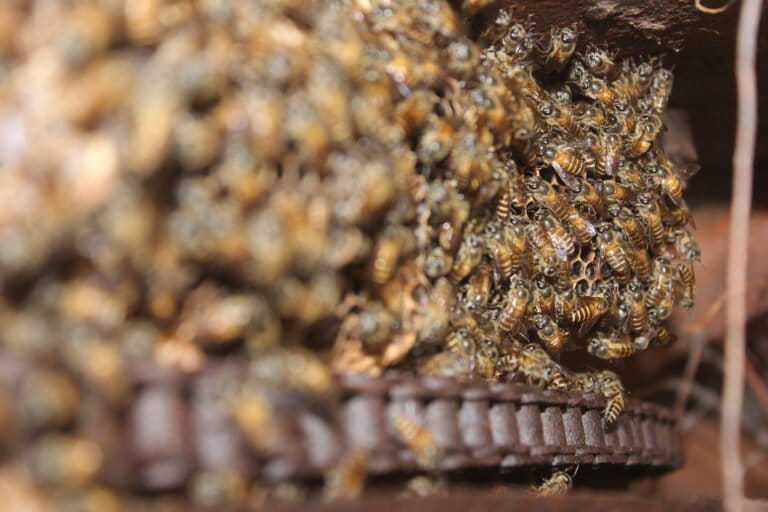
Field observations by Husni Naparin and Ismu, researchers and practitioners from the Madu Hutan Kaum collective, reveal the extent of this adaptation. In the Liang Anggang area, colonies have moved into the corroded housings of construction equipment. Upon inspection, these improvised hives contain multiple layers of comb, indicating that despite the stress, the bees are attempting to maintain their reproductive cycles.
However, the quality of these hives remains precarious. Naparin notes that while these colonies are producing honey, the speed of production is significantly hampered by the lack of local forage. Eastern honeybees typically require one to four weeks to produce a harvestable amount of nectar, a timeline that is currently being stretched by the widespread destruction of native flowering plants. Unlike the larger Giant Honeybee (Apis dorsata), which has a more robust anatomy and higher foraging capacity, the smaller Apis cerana is struggling to bridge the gap between their displaced nesting sites and the increasingly distant patches of viable flora, such as the hardy Mimosa pudica (putri malu).
Meteorological Context and Transboundary Implications
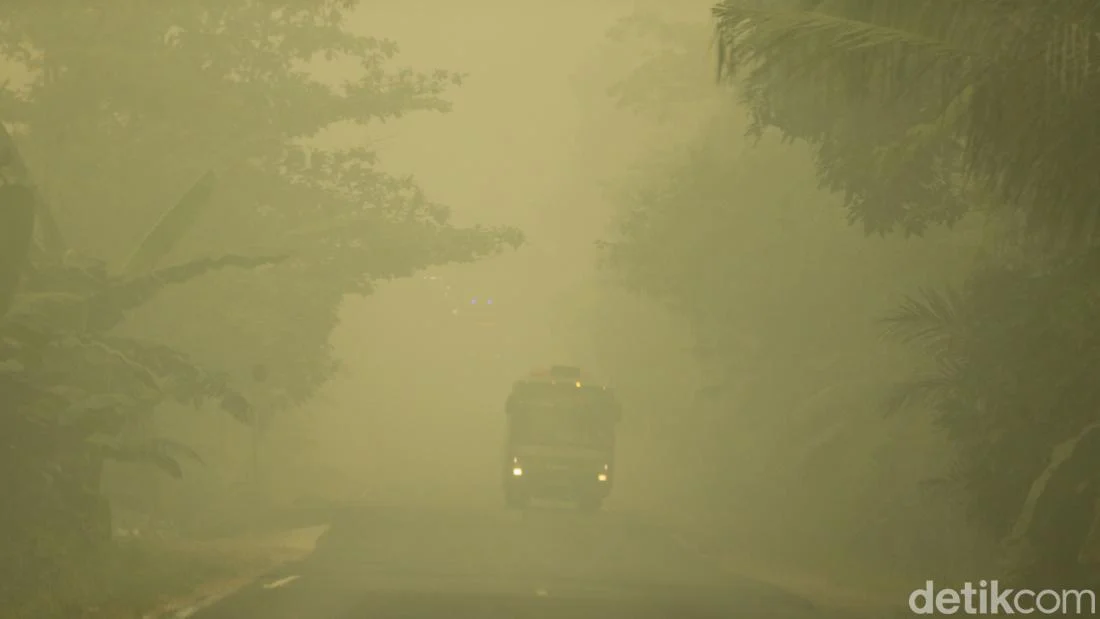
The environmental degradation in South Kalimantan is being exacerbated by the broader climatic patterns of the Southern ASEAN region. The ASEAN Specialised Meteorological Centre (ASMC) has maintained an Alert Level 3—the highest level of concern—due to the transboundary movement of smoke and haze. Concentrations of fine particulate matter (PM2.5) in the region have reached hazardous levels, with peaks hitting 353.8 micrograms per cubic meter during the morning hours of mid-October.
This toxic atmosphere is not only detrimental to human health but also interferes with the biological navigation systems of bees. Entomologists explain that bees rely on polarized light patterns from the sky to navigate; the heavy, persistent haze creates a "navigation blackout," leading to disorientation, colony abandonment, and high mortality rates among foragers who fail to find their way back to their hives.
The Cascading Effect on Food Security
The migration of these pollinators is not merely an isolated wildlife story; it is a warning sign for the region’s agricultural stability. Dr. Trisnu Satriadi, a senior researcher in non-timber forest products at Lambung Mangkurat University, emphasizes that the decline in pollinator density will have a direct, long-term impact on local food production.
"Bees are the silent engine of our ecosystem," Dr. Satriadi states. "When their populations crash or they are forced to migrate, the rate of plant pollination slows down significantly. For crops that depend on insect pollination, this means a lower success rate in fruit and seed development."
The implications are severe for both smallholder farmers and large-scale plantations in South Kalimantan. As the fires destroy the buffer zones of wild habitat that these bees inhabit, the agricultural sectors that rely on "free" pollination services will likely see a decline in yield. If the habitat loss is not addressed through restorative reforestation and fire prevention, the loss of these ecosystem services could lead to increased reliance on artificial or expensive hand-pollination methods, effectively raising the cost of food production and threatening the regional food supply chain.
Scientific Consensus on Habitat Loss
Ramadhani Eka Putra, an entomologist from the Bandung Institute of Technology, notes that the impact of fire is twofold: direct mortality from heat and the long-term starvation caused by the destruction of the floral landscape. "The bees are essentially homeless," says Dr. Putra. "When their nests are burned, they are forced into sub-optimal environments where they are more vulnerable to predators and weather extremes. Even if they migrate, there is no guarantee they will find an environment that can support their nutritional needs, especially during a drought of this magnitude."
The recovery of these populations is entirely contingent upon the speed at which the landscape can be rehabilitated. Experts warn that simply stopping the fires is not enough; the restoration of indigenous flowering plants and the protection of old-growth trees are essential for the bees to return. As long as the land remains charred and the smoke persists, the pollinators will remain in a state of flux, shifting further into human-dominated landscapes or retreating to higher, potentially less resource-rich elevations like the Meratus Mountains.
Moving Forward: The Need for National Intervention
The scale of the 2026 fires has prompted widespread calls from civil society and environmental organizations to declare the situation a national disaster. With the BMKG forecasting that the dry season will persist well into November, and only a gradual return to normal rainfall patterns expected by December, the immediate outlook remains grim.
The government’s response has focused heavily on fire suppression and disaster management; however, there is a growing consensus that the policy must shift toward proactive landscape restoration. The case of the bees in the rusted machinery serves as a potent metaphor for the broader state of the Kalimantan ecosystem: resilient, yet pushed to the absolute limits of its biological capacity by systemic human-induced environmental pressure.
As the province prepares for the transition to the rainy season, the priority must be to prevent further fragmentation of the remaining forest patches. Without concerted efforts to protect the remaining habitats, the "flight" of the pollinators may become permanent, leading to a loss of biodiversity that will be felt by the human population long after the smoke has finally cleared. The survival of the Eastern honeybee is inextricably linked to the survival of the forest, and by extension, the economic and food security of the people of South Kalimantan. The 2026 fire season stands as a stark reminder that the collapse of a single, small species can herald a much larger, more difficult challenge for the regional environment.






![Cerita Lika Liku Para Pengemudi Becak Listrik di Malioboro [1]](https://indomgb.s3.amazonaws.com/wp-content/uploads/2026/10/25231939/becak-listrik-oliv-5-768x512.jpg)
![Cerita Lika Liku Para Pengemudi Becak Listrik di Malioboro [1]](https://indomgb.s3.amazonaws.com/wp-content/uploads/2026/10/25231325/becak-listrik-Oliv-4-768x512.jpg)
![Cerita Lika Liku Para Pengemudi Becak Listrik di Malioboro [1]](https://indomgb.s3.amazonaws.com/wp-content/uploads/2026/10/25231653/becak-listrik-Oliv-3-768x512.jpg)