
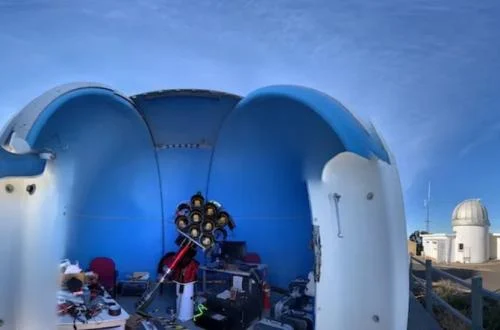
Astronomers at Macquarie University in Australia have announced a significant technological leap in the field of observational astronomy, successfully demonstrating a technique that allows for the precise measurement of stars, satellites, and other celestial targets during broad daylight. Utilizing the innovative Huntsman Telescope, a multi-lens array originally designed for ultra-sensitive night-sky surveys, the research team has effectively bypassed the long-standing limitation that has confined optical astronomy to the hours of darkness. This development, published in the Publications of the Astronomical Society of Australia on May 20, 2024, marks a pivotal shift in how researchers monitor the rapidly crowding orbital environment of Earth and the volatile behavior of nearby stars.
The Huntsman Telescope, situated at the Siding Spring Observatory near Coonabarabran, New South Wales, represents a departure from traditional monolithic mirror designs. Instead of a single large primary mirror, the array consists of ten high-performance Canon 400mm f/2.8 L-series lenses, coupled with specialized astronomical cameras and astro-mechanical focusing equipment. By orienting these lenses to work in parallel, the system can capture high-cadence, short-exposure images that are subsequently processed to reveal objects normally drowned out by the scattering of sunlight in the Earth’s atmosphere.
The Challenge of Solar Interference in Optical Astronomy
For centuries, the primary obstacle to daylight astronomy has been Rayleigh scattering—the phenomenon where sunlight interacts with the Earth’s atmosphere, scattering shorter blue wavelengths and creating the brilliant blue sky that overwhelms the faint light of distant stars. While radio and infrared telescopes can operate during the day, optical telescopes have traditionally been rendered "blind" once the sun rises.
Sarah Caddy, a doctoral researcher at Macquarie University and the lead architect of the Huntsman Telescope’s daylight capabilities, noted that the difficulty lies in the signal-to-noise ratio. During the day, the "noise" of the sky’s brightness is millions of times stronger than the "signal" from a star or a satellite. However, the Macquarie team discovered that by using specific broadband light filters and high-speed sensor technology, they could isolate the specific wavelengths of light emitted by celestial bodies while blocking a significant portion of the solar background.
The team’s breakthrough involved months of rigorous testing using a "mini-Huntsman" pathfinder—a single-lens version of the larger array. This testing phase allowed researchers to calibrate exposure times, account for atmospheric turbulence (scintillation), and refine the tracking algorithms necessary to keep a telescope locked onto a target as the atmosphere shifts and shimmers under solar heating.
Technical Specifications and the "Fly’s Eye" Design
The Huntsman Telescope is modeled after the "Dragonfly Telephoto Array" concept, often referred to as a "fly’s eye" design. The use of multiple lenses provides several advantages over a single large mirror. Firstly, the specialized coatings on Canon’s professional-grade lenses are exceptionally effective at reducing internal reflections and "ghosting," which is critical when trying to observe faint objects near a bright source like the sun.
Each of the ten lenses is equipped with a CMOS (Complementary Metal-Oxide-Semiconductor) detector capable of capturing thousands of short-exposure frames per second. These short exposures are vital because they allow astronomers to "freeze" the atmospheric turbulence. When these thousands of images are stacked and processed, the resulting data achieves a level of precision and sensitivity that rivals much larger, more expensive installations.
The recent tests confirmed that the Huntsman could achieve "extraordinary results" during daylight hours, providing a continuous stream of data that was previously impossible to obtain from a ground-based optical site. This capability effectively doubles the operational utility of the observatory, transforming it into a 24-hour facility.
Monitoring the "Great Dimming" and Stellar Volatility
One of the primary scientific motivations for daylight astronomy is the continuous monitoring of transient stellar events. A key target for the Huntsman team is Betelgeuse, a red supergiant star located approximately 650 light-years away in the constellation of Orion.
Betelgeuse captured global headlines in late 2019 and early 2020 during the "Great Dimming," an event where the star’s luminosity dropped by more than 60%. While initial theories suggested the star was on the verge of a supernova explosion, later analysis indicated that Betelgeuse had ejected a massive cloud of surface material, which cooled into dust and temporarily obscured its light.
Because Betelgeuse is a variable star, its behavior can change rapidly. However, because of its position relative to the Sun, it often becomes "unobservable" for several months of the year for night-time telescopes. By enabling daylight observations, the Huntsman Telescope ensures that astronomers do not miss the critical early stages of a supernova or other massive mass ejection events. Continuous monitoring allows for a more complete light curve, providing deeper insights into the internal physics of aging stars.
Addressing the Crisis of Space Situational Awareness
Beyond pure astrophysics, the Huntsman’s daylight capability addresses a pressing logistical challenge in the modern space age: Space Situational Awareness (SSA). As of 2024, there are approximately 10,000 active satellites in orbit, but this number is expected to skyrocket. With the rise of "mega-constellations" like SpaceX’s Starlink and Amazon’s Project Kuiper, current projections suggest that an additional 50,000 satellites could be launched into Low Earth Orbit (LEO) within the next decade.
This congestion increases the risk of collisions, which can lead to the "Kessler Syndrome"—a theoretical scenario where a single collision creates a cloud of debris that triggers a chain reaction of further destruction, eventually rendering certain orbits unusable.
Currently, tracking these objects is a fragmented process. Radar can track them, but optical tracking provides more precise data on the orientation and condition of a satellite. Until now, optical tracking was limited to "terminator hours"—the brief periods at dawn and dusk when the ground is dark but the satellite, high above, is still illuminated by the sun.
"With tens of thousands of satellites planned for launch, there is a clear need for dedicated day-and-night telescope networks," Sarah Caddy stated. The ability to track satellites and space debris in the middle of the day provides a 24-hour safety net for orbital assets. It allows operators to refine collision-avoidance maneuvers with real-time data, regardless of the time of day.
Chronology of the Huntsman Project
The development of the Huntsman Telescope has followed a multi-year trajectory:
- 2019-2020: Conceptualization and initial assembly of the multi-lens array at Macquarie University.
- 2021: Installation at the Siding Spring Observatory, chosen for its dark skies and high number of clear nights.
- 2022: Initial "First Light" observations focusing on low-surface-brightness galaxies during the night.
- 2023: Development of the "Mini-Huntsman" pathfinder to test the feasibility of daylight filters and high-cadence imaging.
- Early 2024: Successful demonstration of daylight tracking of Betelgeuse and LEO satellites.
- May 20, 2024: Formal publication of the findings, detailing the effectiveness of the filter techniques and sensor precision.
Broader Implications and Future Outlook
The success of the Huntsman project suggests a new paradigm for ground-based observatories. As camera sensors and filter technologies continue to advance, the distinction between "daytime" and "nighttime" astronomy may continue to blur.
For the scientific community, this means a massive increase in the volume of data available for study. For the burgeoning commercial space industry, it means enhanced security for multi-billion-dollar satellite constellations. The Macquarie team’s work also offers a cost-effective blueprint for other nations and institutions; by using off-the-shelf high-end photography lenses rather than custom-built mirrors, the Huntsman approach lowers the barrier to entry for high-precision astronomical research.
As Sarah Caddy noted, daylight astronomy is an "exciting field" that is only just beginning to realize its potential. With the Huntsman Telescope leading the way, the sky is no longer a limit—at any hour of the day. The team now plans to expand the array and further refine their algorithms to track even smaller pieces of space debris, contributing to a safer and more transparent orbital environment for all of humanity.

