
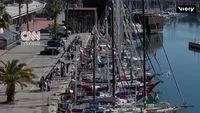
A coalition of ships departed from Barcelona, Spain, on Wednesday, April 15, embarking on a high-stakes mission to challenge the Israeli blockade of the Gaza Strip. This ambitious undertaking, spearheaded by the Global Sumud Flotilla, represents the latest in a series of international efforts to deliver humanitarian aid and draw global attention to the dire conditions in the besieged Palestinian enclave. The fleet, comprising approximately 70 vessels and carrying an estimated 1,000 activists and partners from over 70 nations, has entered its final departure phase from the Spanish port, signaling a determined push against a blockade that has been in place for nearly two decades. Among the vessels, a Palestinian-flagged ship reportedly made a symbolic stop in the harbor before joining the larger convoy. This current endeavor builds upon previous attempts to breach the blockade, with organizers emphasizing a commitment to non-violent direct action, even as the historical context of such missions suggests a high potential for confrontation. The international community, humanitarian organizations, and diplomatic observers are closely monitoring the flotilla’s progress, aware of the significant political, legal, and humanitarian ramifications that could arise from its journey towards the shores of Gaza.
The Blockade’s Enduring Legacy: A Humanitarian Crisis
The Gaza Strip, a narrow coastal territory home to over two million Palestinians, has been under an Israeli and Egyptian blockade since 2007, following Hamas’s takeover of the area. Israel asserts that the blockade is a necessary security measure to prevent Hamas, which it designates as a terrorist organization, from importing weapons and dual-use materials that could be employed for military purposes against Israeli civilians. However, critics, including numerous international bodies and human rights organizations, contend that the blockade constitutes collective punishment, severely restricting the movement of people and goods, and exacerbating an already acute humanitarian crisis.
The long-term effects of the blockade are stark. The United Nations and other humanitarian agencies have consistently reported on the catastrophic decline in living standards, the collapse of Gaza’s economy, and the severe limitations on access to essential services. Unemployment rates are among the highest in the world, particularly among youth, often exceeding 60%. Over 80% of Gaza’s population relies on humanitarian aid for survival. Access to clean water is severely constrained, with 97% of the water from the coastal aquifer deemed unfit for human consumption, forcing reliance on expensive and often unreliable desalination plants. The healthcare system is perpetually on the brink of collapse, lacking critical medicines, equipment, and electricity to power hospitals. Furthermore, restrictions on the entry of construction materials have hampered reconstruction efforts following repeated conflicts, leaving thousands displaced and living in substandard conditions for years. The blockade also limits the freedom of movement for Palestinians in Gaza, isolating them from the West Bank, East Jerusalem, and the wider world, stifling educational, economic, and social opportunities. These conditions form the core motivation for the Global Sumud Flotilla and similar initiatives, which aim to highlight the blockade’s impact and demand its immediate lifting.
A History of Confrontation: Previous Flotilla Attempts
The concept of challenging the Gaza blockade by sea is not new. The most prominent and often cited precedent is the 2010 Gaza Freedom Flotilla, organized by the Free Gaza Movement and the Turkish Foundation for Human Rights and Freedoms and Humanitarian Relief (IHH). That flotilla consisted of six civilian ships, carrying approximately 700 activists and thousands of tons of humanitarian aid. On May 31, 2010, Israeli commandos intercepted the lead ship, the Mavi Marmara, in international waters. The confrontation turned violent, resulting in the deaths of ten Turkish activists and numerous injuries. The incident sparked widespread international condemnation, strained diplomatic relations between Israel and Turkey, and led to a UN-commissioned report (the Palmer Report) which concluded that Israel’s naval blockade of Gaza was legal, but that the force used by Israel to board the Mavi Marmara was excessive.
Despite the tragic outcome of the Mavi Marmara incident, subsequent attempts to break the blockade have continued, albeit on a smaller scale. These have included efforts like the "Women’s Boat to Gaza" in 2016, which was intercepted by the Israeli Navy without violence, and other smaller boats that have tried to sail directly to Gaza. Each attempt, regardless of its success in reaching Gaza, has served to reignite debate over the legality and morality of the blockade and to keep the humanitarian plight of Palestinians in Gaza in the international spotlight. The organizers of the Global Sumud Flotilla are acutely aware of this history and have likely factored in potential Israeli responses into their planning, emphasizing their commitment to non-violence as a key principle. The "previous attempt" mentioned in the source material, though ambiguously dated as "October 2025," likely refers to the spirit of these past efforts, particularly the significant challenges and failures to ultimately break the blockade’s hold.
The "Global Sumud Flotilla": Genesis and Preparation
The Global Sumud Flotilla, "Sumud" meaning "steadfastness" or "resilience" in Arabic, has been years in the making. It represents a broad international coalition, drawing support from a diverse array of human rights organizations, peace activists, solidarity groups, and individuals across more than 70 countries. The organizational efforts have been extensive, involving significant fundraising campaigns to acquire and outfit the vessels, logistical planning for the journey, and the recruitment and training of activists. Participants, ranging from veteran human rights advocates and journalists to medical professionals and ordinary citizens, share a common goal: to deliver aid and peacefully challenge what they view as an illegal and inhumane blockade.
Barcelona, a city with a strong history of solidarity movements, was chosen as the primary departure point for its strategic location and supportive local environment. The presence of a Palestinian-flagged ship among the fleet is particularly symbolic, aiming to underscore the Palestinian right to freedom of movement and access to the sea. The activists aboard are reportedly prepared for potential interception by Israeli forces, having undergone non-violence training and established clear protocols for engagement. Their strategy hinges on maintaining a united front and using digital platforms to broadcast their journey and any interactions in real-time, hoping to leverage international public opinion to pressure Israel. The sheer scale of this flotilla, with 70 ships, represents one of the largest coordinated efforts since the 2010 incident, indicating a renewed and robust commitment from the global solidarity movement.
On the High Seas: The Journey Commences
Following meticulous preparations and a series of public events in Barcelona designed to garner support and attention, the Global Sumud Flotilla commenced its voyage on April 15. The departure was marked by a mix of anticipation and apprehension, with activists expressing both hope for success and awareness of the risks involved. The initial leg of the journey involves navigating through the Mediterranean Sea, a route that will eventually lead them towards the eastern Mediterranean, in the direction of Gaza’s territorial waters. The exact route and projected duration of the journey remain subject to maritime conditions and potential geopolitical developments.
The ships are reportedly laden with various forms of humanitarian aid, although the primary stated objective extends beyond mere cargo delivery. Organizers view the act of sailing towards Gaza as a symbolic assertion of international law, particularly the principle of freedom of navigation, and a direct challenge to the legitimacy of the blockade. The presence of a diverse group of international citizens aboard, including elected officials, academics, and renowned activists, is intended to heighten the diplomatic stakes and ensure maximum global visibility should any confrontation occur. As the fleet moves further into international waters, communication channels are expected to remain open with international media and monitoring organizations, ensuring that the world can follow its progress and any potential developments in real-time.
Voices from the Flotilla and International Reactions
Activists aboard the Global Sumud Flotilla have consistently articulated their motivations, emphasizing humanitarian imperatives and a commitment to justice. Statements from organizers typically highlight the urgent need for medical supplies, food, and building materials in Gaza, but fundamentally frame the mission as an act of resistance against oppression. "We are sailing not just with aid, but with the hope of humanity, to break a siege that has choked Gaza for too long," one anonymous organizer was quoted as saying during the departure ceremonies. "Our mission is peaceful, our resolve is unwavering, and our message is clear: Gaza must be free." Participants have also stressed their adherence to international law and called upon all parties to respect the rights of civilians and humanitarian actors.
Internationally, reactions to the flotilla are varied. Humanitarian organizations like Doctors Without Borders and Amnesty International, while not directly involved in the flotilla, have consistently called for the lifting of the Gaza blockade, citing its devastating impact on civilians. They would likely express support for any peaceful initiative aimed at alleviating the humanitarian crisis. European Union officials and some member states, while typically maintaining a nuanced position regarding the blockade’s legality, often express concern over the humanitarian situation in Gaza and advocate for unimpeded humanitarian access. They would likely issue calls for restraint from all sides and emphasize the importance of avoiding escalation. The United Nations Secretary-General’s office would also likely reiterate its long-standing calls for humanitarian access and a peaceful resolution to the Israeli-Palestinian conflict, urging all parties to respect international law and ensure the safety of civilians.
Israel’s Stance and Anticipated Response
The Israeli government has consistently maintained that its naval blockade of Gaza is legal and necessary for its national security. Officials frequently cite the need to prevent Hamas from rearming and to counter threats posed by the group. In response to previous flotillas, Israel has issued stern warnings, declaring its intention to prevent any vessel from breaching the blockade. The standard Israeli protocol involves intercepting ships in international waters, informing them of the blockade, and offering to divert them to an Israeli port (typically Ashdod), where their cargo can be inspected and then transferred to Gaza via land crossings, provided it meets security clearances. Passengers are usually offered deportation.
Given the size and international composition of the Global Sumud Flotilla, Israel’s response is expected to be firm but carefully calibrated to avoid a repeat of the 2010 Mavi Marmara incident. The Israeli Navy is likely to be deployed to monitor the flotilla’s progress and prepare for interception. Statements from Israeli officials, while not yet explicit regarding this specific flotilla, would typically emphasize Israel’s sovereign right to defend its borders and maintain its security protocols. They would likely accuse the flotilla organizers of provocative actions and of serving Hamas’s agenda, irrespective of stated humanitarian goals. The Israeli Ministry of Foreign Affairs would likely prepare diplomatic responses to counter potential international criticism, reiterating the legality of the blockade and the existence of established land routes for humanitarian aid. The primary objective for Israel will be to prevent the ships from reaching Gaza while minimizing any confrontation that could lead to casualties or significant diplomatic fallout.
Navigating the Legal and Diplomatic Minefield
The journey of the Global Sumud Flotilla takes place within a complex legal and diplomatic landscape. International maritime law generally upholds the right to freedom of navigation in international waters. However, the legality of a naval blockade in times of armed conflict is also recognized, provided it meets specific criteria, including proportionality and non-discrimination. The key legal contention surrounding the Gaza blockade revolves around whether it constitutes an international armed conflict and whether the blockade’s humanitarian impact is disproportionate. The Palmer Report, while affirming the legality of Israel’s naval blockade, also criticized the excessive force used in the Mavi Marmara incident, highlighting the fine line between legitimate security measures and violations of international humanitarian law.
Diplomatically, the flotilla presents a challenge for all involved parties. For Israel, it necessitates a delicate balance between asserting its security interests and avoiding international condemnation. For the international community, it reignites debates about the two-state solution, the future of Gaza, and the effectiveness of current diplomatic efforts. The United States, Israel’s closest ally, typically supports Israel’s security concerns while also advocating for improved humanitarian conditions in Gaza. Its response would likely involve private diplomatic engagement to de-escalate tensions and public statements urging all parties to act responsibly. The sheer number of countries represented by the activists could also lead to a cascade of bilateral diplomatic issues if any confrontation arises, putting pressure on respective governments to respond.
Implications and the Road Ahead
The Global Sumud Flotilla’s mission carries multifaceted implications, regardless of whether it successfully reaches Gaza. From a humanitarian perspective, even if the aid cargo is eventually delivered through Israeli channels, the primary impact is symbolic: to draw renewed international attention to the humanitarian crisis in Gaza and to pressure for a permanent lifting of the blockade. The volume of aid carried by the flotilla, while significant, is a fraction of what Gaza requires daily, making the political statement the more potent aspect.
Politically, the flotilla serves as a powerful reminder of the enduring international solidarity with Palestinians and a direct challenge to the status quo. It could galvanize further grassroots activism and potentially influence public opinion in countries whose citizens are participating. For the Israeli government, a peaceful interception would be a diplomatic win, demonstrating control and adherence to protocols. However, any confrontation, especially one involving casualties or significant force, would likely lead to severe international criticism, potentially escalating tensions in the region and complicating Israel’s diplomatic relations.
Security implications are paramount. The risk of miscalculation or unintended escalation is ever-present in such high-stakes encounters. Both sides will be under intense scrutiny to act with restraint. The outcome of this flotilla could also set precedents for future attempts to breach blockades or for humanitarian interventions in conflict zones. In the long term, the Global Sumud Flotilla’s journey will undoubtedly contribute to the ongoing narrative surrounding the Israeli-Palestinian conflict, influencing how the international community perceives the blockade, the humanitarian situation in Gaza, and the broader struggle for Palestinian rights. The world watches, waiting to see if this latest act of "sumud" will pave a new path or merely add another chapter to a history of defiance and confrontation.

