
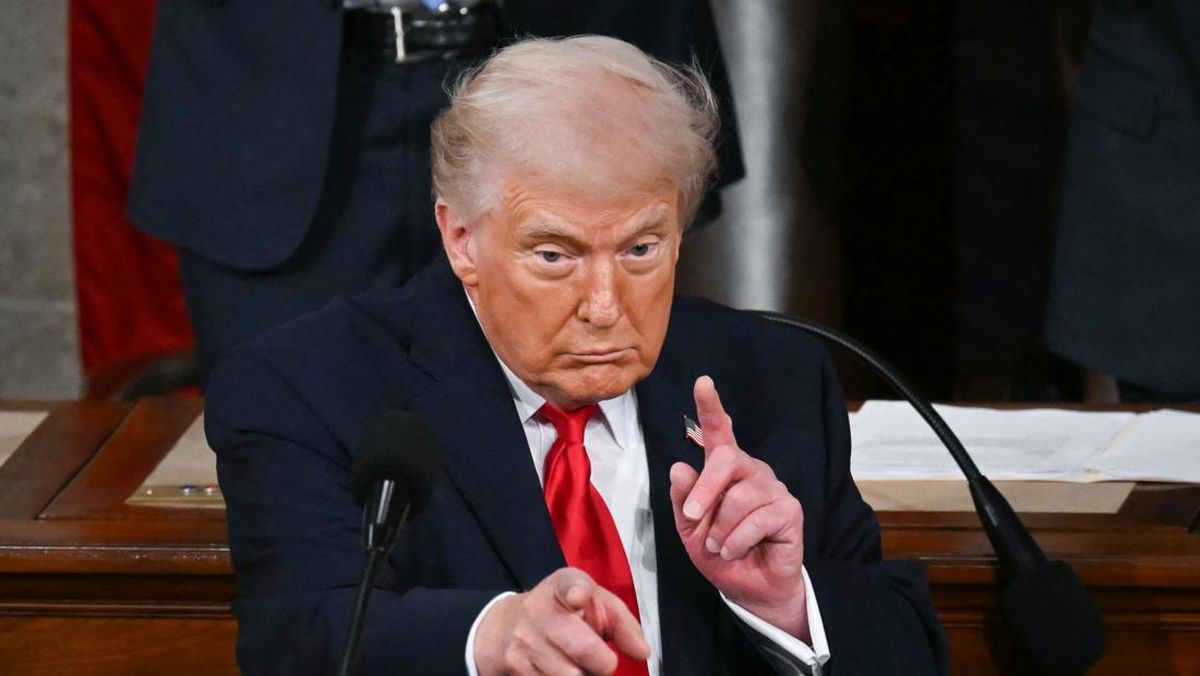
United States President Donald Trump announced an indefinite extension of a ceasefire with Iran, yet simultaneously affirmed the continuation of a stringent military blockade of the strategically vital Strait of Hormuz and an intensification of economic sanctions. This paradoxical move, communicated via his Truth Social platform on Wednesday, April 22, underscores the deeply complex and volatile nature of US-Iran relations, drawing a swift and defiant rebuke from Tehran, which dismissed the gesture as a deceptive ploy.
Trump’s Dual Message: Diplomacy and Deterrence
In his social media post, President Trump revealed that the decision to extend the ceasefire came after a request from Iranian leaders and their representatives to delay any military action, allowing them time to formulate a "unified proposal." Despite this apparent diplomatic opening, Trump’s directive to the US military was unambiguous: "I have instructed our Military to continue the blockade and, in all other respects, remain ready and capable." This statement signaled a clear intention to maintain military pressure in the region, particularly around the Strait of Hormuz, a crucial choke point for global oil shipments. The US military’s continued presence and readiness in the strait are designed to enforce a policy of deterrence and to ensure the free flow of international commerce, while simultaneously asserting leverage over Iran. The initial two-week ceasefire, which began on April 7, had expired on April 21, prompting concerns about a potential return to hostilities before Pakistan’s mediation led to this latest, albeit precarious, extension.
Intensifying Economic "Fury"
The military posture was immediately reinforced by an aggressive escalation of economic measures. Treasury Secretary Scott Bessent, echoing President Trump’s stance, confirmed the freezing of Iranian assets and outlined a strategy of "Economic Fury" designed to systematically cripple Tehran’s financial capabilities. In a statement posted on X, Bessent articulated the Treasury Department’s objective: "The U.S. Department of the Treasury will continue to apply maximum pressure through Economic Fury to systematically degrade Tehran’s ability to generate, move, and repatriate funds."
Bessent detailed specific targets of this economic campaign, highlighting the imminent saturation of oil storage facilities on Kharg Island, Iran’s primary oil export terminal. He warned that this would inevitably lead to the closure of Iranian oil wells, effectively strangling a major lifeline of the Iranian economy. The restrictions on Iran’s maritime trade are a direct assault on the nation’s principal revenue streams, which are heavily reliant on oil exports. The Treasury Secretary further cautioned that any entity or vessel found facilitating the flow of these funds through illicit trade and covert financing would face severe US sanctions, extending the reach of the "maximum pressure" campaign to international actors. This multifaceted approach aims to isolate Iran financially and force it to reconsider its regional and nuclear policies by depriving it of the resources necessary to fund them.
Iran’s Defiant Stance and Heightened Readiness
Tehran’s response to the US announcement was one of outright skepticism and defiance. Iranian officials dismissed the extended ceasefire as a mere facade, a "trick" designed by the US to buy time for a sudden, surprise attack. Ebrahim Zolfaghari, spokesperson for Iran’s Khatam al-Anbiya Central Headquarters, a key military command center, asserted Iran’s unwavering vigilance: "Our capable and strong forces have long been on 100 percent alert and are ready and prepared to act." This statement underscored Iran’s deep distrust of US intentions and its commitment to maintaining a robust defensive posture.
Further exacerbating tensions, Mahdi Mohammadi, an advisor to the Chairman of the Iranian Parliament, equated the continued naval blockade and the seizure of ships by the US with an act of war, despite the nominal ceasefire extension. In a post on X, Mohammadi declared, "The losing party cannot dictate terms. The continuation of the siege is no different from bombing and must be met with a military response." This strong rhetoric highlights Iran’s view that the economic and military pressures are fundamentally hostile acts that necessitate a firm counter-response, rejecting any notion that the ceasefire implies a reduction in overall aggression. Iran’s leadership perceives the US strategy as an attempt to negotiate from a position of overwhelming strength, which it finds unacceptable.
Chronology of a Fragile Ceasefire
The current situation is the latest development in a series of delicate maneuvers. The first ceasefire, a two-week agreement, commenced on April 7 and was set to expire on April 21. This initial truce was a direct result of diplomatic efforts, reportedly mediated by Pakistan, which has historically played a role in bridging communication gaps between Washington and Tehran. The extension, announced by President Trump, was stated to be for an "indefinite" period, a term that adds to the uncertainty, as it lacks a clear end date or specific conditions for its continuation. Furthermore, Trump’s announcement did not specify when this extended ceasefire would officially begin, leaving room for ambiguity regarding its immediate practical implications on the ground and at sea. This lack of precise detail only fueled Iran’s suspicion that the extension was less about genuine de-escalation and more about tactical maneuvering.
Background Context: A History of Escalation
The current tensions are deeply rooted in a protracted history of animosity and strategic competition between the United States and Iran, particularly following the US withdrawal from the Joint Comprehensive Plan of Action (JCPOA), or the Iran nuclear deal, in 2018 under the Trump administration. This withdrawal reinstated and intensified a broad array of sanctions against Iran, initiating a "maximum pressure" campaign aimed at compelling Tehran to renegotiate a more comprehensive agreement addressing its nuclear program, ballistic missile development, and regional proxy activities.
Since 2018, the region has witnessed several flashpoints:
- Tanker Attacks (2019): A series of attacks on oil tankers in the Gulf of Oman, which the US attributed to Iran, significantly raised alarm bells about maritime security.
- Drone Shootdown (2019): Iran shot down a US surveillance drone over the Strait of Hormuz, claiming it had violated Iranian airspace, nearly leading to a direct military confrontation.
- Attack on Saudi Oil Facilities (2019): Major drone and missile attacks on Saudi Aramco oil processing facilities were blamed on Iran, causing a temporary spike in global oil prices.
- Assassination of Qassem Soleimani (2020): A US drone strike killed Major General Qassem Soleimani, commander of the Quds Force of Iran’s Islamic Revolutionary Guard Corps, in Baghdad, triggering widespread outrage in Iran and retaliatory missile strikes against US bases in Iraq.
- Nuclear Program Expansion: In response to US sanctions, Iran has progressively scaled back its commitments under the JCPOA, increasing its uranium enrichment levels and expanding its nuclear research activities, bringing it closer to weapons-grade material, according to international monitors.
These events have collectively pushed US-Iran relations to the brink, creating a climate of mistrust where any diplomatic overture, such as a ceasefire, is viewed through the lens of potential strategic advantage or deception by either side. The Strait of Hormuz, through which approximately one-fifth of the world’s total oil consumption passes, remains a critical flashpoint, any disruption of which could have severe global economic repercussions.
Geopolitical Implications and Analysis
The simultaneous announcement of a ceasefire extension and the continuation of a military blockade, coupled with intensified economic sanctions, presents a complex and potentially dangerous geopolitical paradox. Analysts suggest that President Trump’s strategy aims to project an image of measured diplomacy while simultaneously maintaining maximum leverage through military and economic coercion. The request from Iranian leaders for a delay in attacks could be interpreted as a sign that the "maximum pressure" campaign is indeed inflicting significant pain on the Iranian regime, pushing them towards a negotiating table, albeit on terms unfavorable to them. However, it also suggests a deep reluctance from Iran to engage in direct military confrontation, despite its public bravado.
Conversely, Iran’s defiant stance indicates that it perceives this US approach as an attempt to dictate terms rather than genuinely de-escalate. The Iranian leadership, acutely aware of its domestic legitimacy concerns and regional influence, is unlikely to be seen capitulating under pressure. Their rhetoric about readiness for a surprise attack and equating the blockade to an act of war serves multiple purposes: to reassure a domestic audience, to deter US aggression, and to signal to regional allies and adversaries that Iran will not be easily intimidated.
The implications for regional stability are profound. The presence of US naval forces in the Strait of Hormuz, enforcing a blockade, alongside Iran’s explicit declaration of 100% military readiness, creates a highly combustible environment. Any miscalculation, accidental encounter, or provocative act could swiftly escalate into a broader conflict, potentially drawing in other regional and international actors. The "Economic Fury" campaign, while aimed at weakening the Iranian regime, also risks further destabilizing an already fragile Iranian economy, which could lead to internal unrest and unpredictable external actions.
International stakeholders, including European allies and the United Nations, have consistently called for de-escalation and a return to diplomacy based on mutual respect. However, the current US approach, characterized by a blend of conditional engagement and unrelenting pressure, makes such a pathway extremely challenging. The indefinite nature of the ceasefire and the absence of clear conditions for its continuation only add to the uncertainty, leaving the door open for rapid shifts in policy or military posture from either side.
Looking Ahead: A Precarious Balance
The situation in the Persian Gulf remains on a razor’s edge. President Trump’s extension of the ceasefire, while ostensibly a move towards de-escalation, is fundamentally undermined by the unwavering military blockade and the relentless economic sanctions. Iran’s categorical rejection of the ceasefire’s sincerity and its declared military readiness ensure that the region will continue to be marked by a precarious balance of deterrence and defiance. The coming weeks will likely reveal whether this latest diplomatic maneuver can pave the way for genuine dialogue or if it merely serves as another chapter in the long-running saga of US-Iran confrontation, with the Strait of Hormuz remaining a critical barometer of regional stability and global energy security. The path forward remains fraught with peril, demanding cautious navigation from all parties involved to prevent a further slide into open conflict.

