
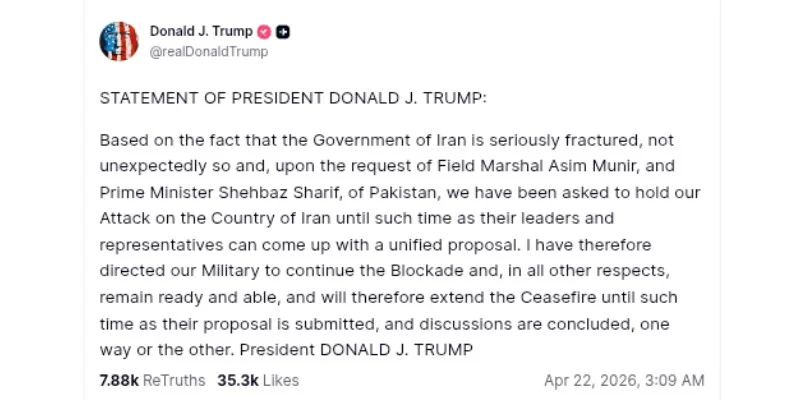
In a sudden and unexpected shift in policy, the United States, under President Donald Trump, has announced a temporary halt to planned military action against Iran. The decision, communicated on Wednesday, April 22, 2026, aims to provide Tehran with additional time to formulate a comprehensive and unified proposal to resolve the protracted conflict plaguing the region. Despite this deferral of kinetic operations, President Trump emphatically stated that the broader pressure campaign against Iran would not be relinquished, with existing punitive measures and military readiness remaining firmly in place.
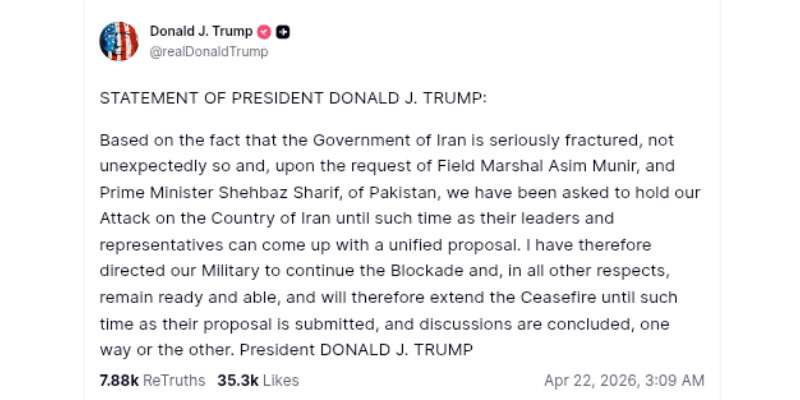
"Therefore, I have instructed our military to continue the blockade and remain prepared in every respect," President Trump declared on social media, as reported by Al-Jazeera. This statement underscores a strategic duality: offering a diplomatic opening while maintaining a robust coercive posture. The ongoing naval blockade, which has significantly constrained Iran’s economic lifelines and access to international markets, remains a cornerstone of the US pressure strategy.
The Genesis of the Diplomatic Delay
The decision to delay military action was reportedly made at the specific request of Pakistan, which has been actively engaged in a mediation role between Washington and Tehran. Pakistan’s Prime Minister, Shehbaz Sharif, promptly welcomed the development, expressing optimism that the reprieve would facilitate constructive dialogue. Sharif articulated hopes for a peaceful resolution during subsequent negotiations anticipated to take place in Islamabad, signaling Pakistan’s commitment to de-escalation and regional stability.
However, the path to diplomacy remains fraught with uncertainty. As of the latest reports, Iran has yet to issue an official response to the US decision. This silence could indicate internal deliberations within the Iranian leadership, a strategic pause to assess the implications of Trump’s offer, or a continued adherence to its previously stated positions. Earlier, Iran’s Foreign Minister, Abbas Araghchi, had vehemently condemned the US blockade, characterizing it as an aggressive act that violated international norms. "Iran knows how to neutralize restrictions and protect its interests," Araghchi had asserted, a statement that reflects Tehran’s long-standing resolve to resist external pressures.
A Surprising Reversal Amidst Heightened Tensions
The US administration’s pivot is particularly striking given the immediate preceding events. Only hours prior to this announcement, President Trump had reportedly rejected any extension of a ceasefire and issued stern warnings of a major military offensive if Iran failed to take immediate steps towards de-escalation. This dramatic reversal highlights the volatile and unpredictable nature of the US-Iran relationship, often characterized by rapid shifts between confrontational rhetoric and cautious diplomatic overtures. Analysts suggest that the Pakistani intervention, coupled with a potential re-evaluation of tactical risks, may have played a critical role in influencing Washington’s change of heart.
Contextualizing the US-Iran Standoff: A Decade of Escalation
The current "conflict" between the United States and Iran is not an isolated incident but the culmination of decades of strained relations, significantly exacerbated in recent years. The historical backdrop includes the 1979 Iranian Revolution, the hostage crisis, and subsequent decades of US sanctions aimed at isolating the Islamic Republic. A period of relative détente emerged with the 2015 Joint Comprehensive Plan of Action (JCPOA), or Iran nuclear deal, which saw Iran agree to curb its nuclear program in exchange for sanctions relief.
However, this agreement began to unravel in May 2018 when then-President Trump unilaterally withdrew the US from the JCPOA, re-imposing and expanding a comprehensive sanctions regime. This move, which Iran termed "economic terrorism," marked a significant escalation. In response, Iran gradually reduced its compliance with the nuclear deal’s restrictions, increasing uranium enrichment levels and expanding its centrifuge capacity, arguing it was entitled to do so under the agreement’s dispute resolution mechanism.
The period leading up to 2026 has been punctuated by numerous flashpoints. These include attacks on oil tankers in the Persian Gulf, drone incidents, seizures of commercial vessels in the Strait of Hormuz (a critical global chokepoint for oil shipments), and proxy conflicts across the Middle East, particularly in Yemen, Syria, and Iraq. The assassination of high-ranking Iranian military officials, including General Qasem Soleimani in early 2020, further heightened tensions, pushing the two nations to the brink of direct military confrontation on multiple occasions. The "blockade" mentioned by President Trump refers to a sustained naval presence and enforcement of stringent economic sanctions designed to cripple Iran’s oil exports and financial transactions, effectively cutting it off from the global economy.
The Enduring Nuclear Impasse
At the core of the conflict lies the intractable dispute over Iran’s nuclear program. The United States and its allies, including Israel and Saudi Arabia, demand a complete cessation of Iran’s uranium enrichment activities and the dismantling of its advanced nuclear infrastructure, fearing its potential diversion to weaponization. They point to Iran’s past covert nuclear activities and its ballistic missile program as evidence of malign intent.
Conversely, Iran consistently asserts its sovereign right to pursue a peaceful nuclear energy program for civilian purposes, citing its obligations and rights under the Nuclear Non-Proliferation Treaty (NPT). Tehran has steadfastly refused to surrender its enriched uranium stockpiles or cease its enrichment activities, which it deems essential for energy independence and medical isotope production. The International Atomic Energy Agency (IAEA) has maintained a monitoring presence in Iran, though its access has at times been restricted amidst the escalating tensions. This fundamental divergence in demands—total disarmament versus sovereign rights to civilian nuclear technology—remains the primary obstacle to any lasting diplomatic resolution.
Reactions and Regional Dynamics
The US decision has elicited a mixed bag of reactions from various regional and international actors, underscoring the complex web of interests at play.
-
Iran’s Strategic Calculus: While Foreign Minister Araghchi’s earlier statements highlighted Iran’s defiance against the blockade, the lack of an immediate official response to the delay in military action suggests a period of internal deliberation. Tehran’s leadership, now under Mojtaba Khamenei, who succeeded his father Ali Khamenei, faces immense pressure. The reported deaths of several high-ranking Iranian officials, including the former Supreme Leader, mark a significant internal political transition. While President Trump’s administration has often claimed that internal divisions plague the Iranian leadership, many independent analysts contend that the succession of Mojtaba Khamenei signals a continuation of the established ideological line, maintaining a solid front against external pressures. The new leadership will likely weigh the benefits of a diplomatic opening against the perceived humiliation of negotiating under duress and the precedent it might set for future US demands. Their response will be crucial in determining whether this window for diplomacy expands or shuts.
-
Pakistan’s Mediation Role: Pakistan’s active role as a mediator is rooted in its geopolitical position and historical ties with both the US and Iran. As a significant Muslim-majority nation with a strategic location, Pakistan has often sought to play a constructive role in de-escalating regional conflicts. Prime Minister Shehbaz Sharif’s swift welcome of the US decision reinforces Pakistan’s commitment to facilitating dialogue and preventing a wider conflict that could destabilize its own borders and the broader South Asian region. Pakistan’s economic stability is also indirectly tied to regional peace, as conflict in the Middle East can disrupt global energy markets and trade routes.
-
Global Stakeholders’ Perspectives: The international community, particularly the European Union, Russia, and China, has consistently advocated for a diplomatic resolution to the US-Iran standoff. These powers, all signatories to the original JCPOA, have expressed concerns over the instability caused by the US withdrawal and the subsequent escalation.
- European Union: The EU has sought to preserve the JCPOA and encourage de-escalation, often attempting to create financial mechanisms to circumvent US sanctions and maintain trade with Iran, albeit with limited success. They would likely view this diplomatic delay as a positive, albeit fragile, step towards renewed negotiations.
- Russia and China: Both nations, strategic partners of Iran, have consistently opposed US sanctions and military threats, viewing them as destabilizing unilateral actions. They would likely welcome the delay as an opportunity to push for a more comprehensive, multilateral approach to regional security, potentially leveraging their influence with Tehran to encourage engagement.
- Regional Adversaries: Countries like Saudi Arabia and Israel, deeply wary of Iran’s regional influence and nuclear ambitions, would likely view any diplomatic concession to Iran with skepticism. While they might tacitly support de-escalation, their primary concern remains the complete dismantling of Iran’s nuclear program and its retreat from regional proxy conflicts. They will closely monitor the terms of any potential agreement to ensure their security interests are not compromised.
The Path Forward: Challenges and Opportunities
The extension of the ceasefire, while offering a glimmer of hope, does not guarantee a breakthrough. The underlying issues remain deeply entrenched, and the chasm between US and Iranian demands is significant.
-
Economic and Security Implications: The continued US naval blockade exerts immense economic pressure on Iran, impacting its ability to export oil, which is vital for its national budget. This economic strangulation has led to internal hardships, currency devaluation, and social unrest, potentially influencing Tehran’s willingness to negotiate. However, it also fuels anti-American sentiment and reinforces the narrative of resistance. For global energy markets, any sustained military conflict in the Persian Gulf would trigger massive oil price spikes and disrupt supply chains, with severe repercussions for the global economy. The current diplomatic pause offers temporary relief from this immediate threat.
-
Prospects for Diplomacy: For negotiations in Islamabad to succeed, both sides will need to demonstrate significant flexibility. The US demand for a "unified proposal" suggests it seeks a comprehensive deal that addresses not only the nuclear program but potentially also Iran’s ballistic missile capabilities and its regional activities. Iran, on the other hand, will likely insist on the immediate and verifiable lifting of all US sanctions as a prerequisite for any substantial concessions on its nuclear program. The role of Pakistan as a mediator will be crucial in bridging these gaps, building trust, and framing proposals that can be mutually acceptable. The death of Ali Khamenei and the succession of Mojtaba Khamenei also introduce an element of the unknown regarding the new Supreme Leader’s negotiating style and ultimate willingness to compromise. While analysts largely see the new leadership as maintaining continuity, a fresh perspective could also open unexpected avenues.
In conclusion, President Trump’s decision to delay military action against Iran represents a precarious moment in the enduring US-Iran conflict. It is a strategic gamble that balances the threat of force with the allure of diplomacy, providing a narrow window for de-escalation facilitated by Pakistani mediation. Yet, the deep-seated mistrust, the profound differences in national interests, and the ongoing pressure of the naval blockade mean that the path to a lasting peace remains highly uncertain and fraught with formidable challenges. The coming weeks will reveal whether this diplomatic opening can truly pave the way for a breakthrough or if it merely delays an inevitable confrontation.

