
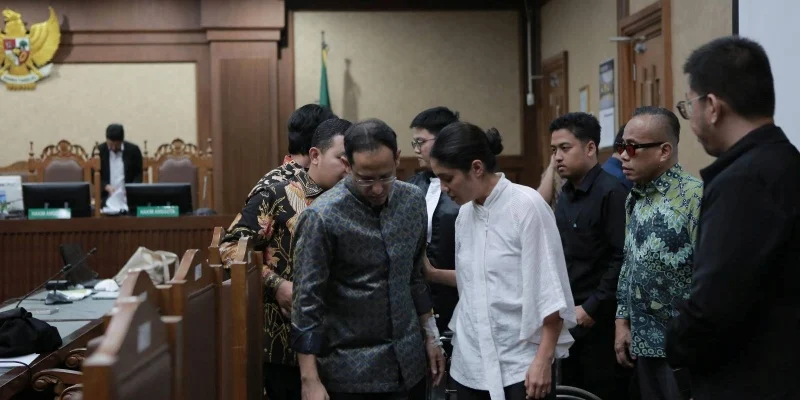
In a significant development that could profoundly impact the ongoing corruption trial of former Minister of Education, Culture, Research, and Technology, Nadiem Makarim, Professor Romli, a distinguished Professor of Criminal Law and a key member of the drafting team for Indonesia’s Anti-Corruption Law (UU Tipikor), delivered testimony widely perceived as substantially weakening the prosecution’s arguments. His expert insights, focusing on fundamental principles of criminal law and administrative governance, suggest that the charges against Makarim may fall outside the purview of corruption and instead belong to the realm of administrative discretion and responsibility.
The Core of the Expert’s Argument: State Loss as Consequence, Not Cause
During his cross-examination, Professor Romli unequivocally asserted that the mere existence of state financial loss does not, by itself, constitute proof of a criminal act of corruption. He emphasized a crucial legal distinction: "If the prosecutor claims there is a loss, I argue that the loss is a consequence, not a cause. If the loss cannot be proven, then corruption cannot possibly exist. There must be an acquittal. If there is doubt in the indictment, the prosecutor’s indictment, then in dubio pro reo (when in doubt, for the accused) must apply, and the defendant must be acquitted." This statement challenges a common prosecutorial approach in Indonesia, where the calculation of state loss often forms the primary basis for corruption charges, sometimes overshadowing the requirement to prove criminal intent or specific unlawful acts.
Professor Romli’s testimony underscores that for an act to be categorized as corruption, it must first be established that an unlawful act, committed with criminal intent (mens rea), directly caused the state loss. Without this foundational causal link and the presence of criminal intent, any financial discrepancy, even if resulting in a loss to the state, might be better addressed through administrative or civil mechanisms rather than criminal prosecution. This distinction is vital in preventing the criminalization of policy decisions or administrative errors that lack malicious intent.
Ultimum Remedium: Criminal Law as a Last Resort
A cornerstone of Professor Romli’s testimony revolved around the principle of ultimum remedium, which dictates that criminal law should be employed only as a last resort. He argued vehemently that in cases pertaining to policy decisions or administrative actions, administrative law should take precedence. "The principle of ultima ratio or ultimum remedium is non-negotiable," he stated, emphasizing that if a matter falls within the administrative domain, it must be resolved administratively. He warned against using criminal law as a primary tool (primum remedium) to address losses arising from administrative steps.
This principle is particularly relevant in cases involving public officials whose duties inherently involve making policy choices that carry financial implications. Missteps, inefficiencies, or even poor judgment in policy implementation, if devoid of criminal intent or direct illicit gain, should ideally be met with administrative sanctions, disciplinary actions, or civil remedies, rather than immediate criminal prosecution. Professor Romli further elaborated that administrative sanctions should be applied irrespective of the monetary value of the loss, aligning with Article 32 Paragraph 1 of Law No. 31/1999 concerning the Eradication of Corruption. This article stipulates that if investigators cannot find sufficient preliminary evidence for a criminal offense despite a state loss, they are obliged to refer the case to the State Attorney for civil compensation claims. This legal provision explicitly provides an alternative pathway for addressing state losses without resorting to criminal charges, highlighting the legislative intent for ultimum remedium.
Hierarchical Responsibility: Distinguishing Ministerial and Directorate-General Roles
Another critical aspect of the expert’s testimony addressed the issue of hierarchical responsibility within government structures. Professor Romli asserted that in cases of procedural violations, the direct responsibility often lies with the Director-General (Dirjen), not necessarily the Minister. He cited the historical Sisminbakum (Legal Entity Administration System) case, where the Director-General was the defendant, while the then-Minister, Yusril Ihza Mahendra, was not.
"The Director-General must be held accountable. If the Director-General violates procedures, then the Director-General is responsible, not the Minister," Romli explained. He clarified that a Minister would only bear direct criminal responsibility if they explicitly ordered the violation of procedures, saying, "’Just violate the procedure, I’ll take responsibility.’ That would be different. But if the Minister did not say such a thing, then each person is responsible for their own actions." This distinction is crucial for delineating individual accountability within complex bureaucratic systems and preventing the blanket criminalization of top officials for actions taken by their subordinates without their direct, malicious instruction. It reinforces the idea that criminal liability is personal and requires direct involvement or malicious intent.
PPATK’s Exclusive Authority on Fund Origin
Professor Romli also highlighted the specific mandate of the Financial Transaction Reports and Analysis Centre (PPATK). He stated unequivocally that PPATK is the sole institution authorized to determine whether funds in an account are indicative of criminal activity. Other parties, including tax officials, lack this authority, as the function of tracing and establishing the origin of funds falls exclusively under PPATK’s jurisdiction. This point underscores the importance of adhering to institutional mandates and expertise in complex financial investigations, ensuring that only specialized bodies make definitive pronouncements on the criminal nature of financial flows.
Nadiem Makarim’s Response: Lack of Mens Rea and Causality
Following Professor Romli’s testimony, Nadiem Makarim expressed his conviction that the expert’s insights had effectively "collapsed" the prosecution’s indictment. Makarim particularly emphasized the absence of mens rea (criminal intent) in the context of the Chromebook procurement case, which forms the basis of the charges against him.
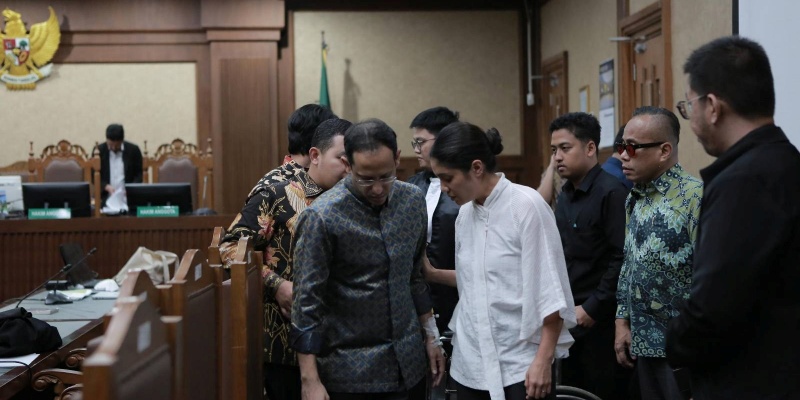
"Professor Romli stated that mens rea, or malicious intent, must be proven. It is not sufficient to simply assume malicious intent from normal meetings. Therefore, if there is no evidence of malicious intent, whether through electronic chats or meetings, mens rea cannot be established," Nadiem explained. He argued that the prosecution’s case lacked any concrete evidence – such as specific communications or clandestine meetings – that would demonstrate a deliberate plan to commit corruption. Without direct proof of intent, merely participating in regular official meetings, even if they discuss policy that later results in issues, cannot be construed as criminal conspiracy.
Furthermore, Nadiem pointed out the prosecution’s failure to establish a clear causal link between his actions and the alleged state loss. He specifically challenged the assertion that choosing a free operating system was connected to the allegedly inflated price of laptops. "In the indictment, that causality collapses. There is no connection between choosing a free operating system and the inflated price of laptops. Even laypeople understand that these are two unrelated matters," Nadiem asserted. He reiterated Professor Romli’s point that if one action does not cause another, it cannot be considered criminal corruption.
Nadiem concluded that the elements of criminal offense were entirely absent in his case. "At worst, this should fall under the realm of state administration because there was no flow of funds whatsoever, no mens rea, and no evidence of conspiracy," he stated. He vehemently denied any "evil conspiracy" with his two subordinate Directors, noting that he did not even know or communicate with them before meeting them in court, further undermining the prosecution’s claim of a coordinated scheme.
Legal Counsel’s Conclusion: Criminalization of Administrative Action
Nadiem’s legal counsel, Dodi S. Abdulkadir, echoed his client’s sentiments, concluding that the charges against Makarim represent a clear "criminalization of actions that entirely fall within the scope of administrative government law." Abdulkadir firmly stated, "Therefore, it does not fall within the qualification of a criminal act of corruption. It is clear that the prosecutor was going in circles; the expert testimony on criminal acts of corruption explicitly stated that this is within the scope of government administration, not the scope of corruption." This perspective highlights a growing concern among legal practitioners and public officials about the potential misuse of anti-corruption laws to prosecute policy decisions or administrative errors, thereby stifling innovation and good governance.
Background and Chronology of the Case
The case against Nadiem Makarim stems from allegations related to the procurement of Chromebook laptops for educational purposes during his tenure as Minister of Education, Culture, Research, and Technology. Nadiem, a prominent figure in Indonesia’s tech startup scene as the founder of Gojek, was appointed to the ministerial post in October 2019 by President Joko Widodo. His appointment was widely seen as a move to modernize and digitalize Indonesia’s education system.
The procurement program, initiated under his leadership, aimed to provide digital learning tools, including Chromebooks, to schools across the archipelago, particularly to support remote learning during the COVID-19 pandemic and to bridge the digital divide in education. The specific allegations against Makarim involve alleged irregularities and inflated pricing in the procurement process of these devices. While the exact timeline of the investigation is not fully public, the charges suggest a focus on decisions and actions taken during the planning and execution phases of this large-scale procurement. Prof. Romli’s testimony came at a crucial stage in the trial, as the court evaluates the evidence and expert opinions presented by both the prosecution and the defense.
Broader Implications for Governance and Anti-Corruption Efforts
Professor Romli’s testimony carries significant implications not just for Nadiem Makarim’s trial but also for the broader landscape of anti-corruption efforts and public administration in Indonesia.
Firstly, it serves as a powerful reminder of the fundamental principles of criminal law that must be upheld, particularly the stringent requirements for proving mens rea and causality in corruption cases. In complex government procurement or policy implementation scenarios, distinguishing between genuine criminal intent, negligence, administrative inefficiency, or even legitimate policy discretion can be challenging. An overzealous application of anti-corruption laws without robust proof of criminal elements risks deterring public officials from making bold, potentially transformative, policy decisions for fear of future criminalization.
Secondly, the emphasis on ultimum remedium reinforces the idea that not every instance of state loss or procedural irregularity warrants criminal prosecution. A healthy administrative legal framework, complete with clear accountability mechanisms, internal audit processes, and administrative sanctions, is crucial for addressing issues that fall short of criminal misconduct. By diverting such cases to administrative or civil courts, the criminal justice system can focus its resources on genuine acts of corruption involving clear intent to enrich oneself or others illicitly. This also helps prevent the overcrowding of criminal courts with cases that could be resolved more appropriately elsewhere.
Thirdly, the expert’s distinction between ministerial and director-general responsibility is vital for maintaining a functional bureaucracy. Holding top officials accountable for the actions of their subordinates without direct involvement or explicit instruction can create an atmosphere of fear and paralysis, hindering effective governance. It underscores the need for prosecutors to meticulously trace criminal intent and direct involvement rather than relying solely on hierarchical positions.
Finally, the case sparks an ongoing national debate about the "criminalization of policy" – a phenomenon where legitimate government policies, especially those involving large budgets or innovative approaches, become targets for criminal investigation when outcomes are not as expected or when procedural missteps occur, even in the absence of malicious intent. Balancing the imperative to combat corruption with the need to foster an environment where public officials can innovate and make decisions without undue fear of criminal prosecution is a delicate act. Prof. Romli’s testimony, drawing on his expertise as a drafter of the very law under scrutiny, offers a nuanced perspective that could encourage a more principled and proportionate application of anti-corruption legislation.
The outcome of the Nadiem Makarim trial will be closely watched, as it could set an important precedent for how cases involving high-ranking public officials and complex policy decisions are handled within Indonesia’s legal system, potentially shaping the future landscape of governance and anti-corruption enforcement.

