
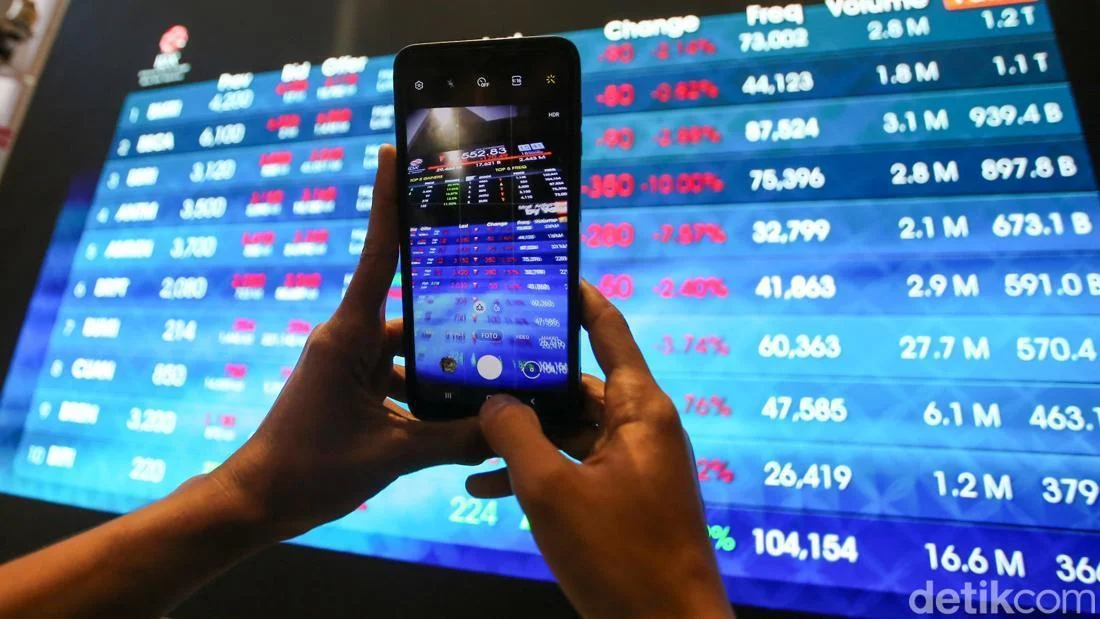
Jakarta, Indonesia – The Jakarta Composite Index (IHSG) concluded trading on Wednesday, July 22, 2026, in negative territory, registering a modest decline that saw the benchmark index close at 6,334.47. Despite the downturn, the IHSG demonstrated resilience by maintaining its position above the crucial 6,300-point psychological threshold, signaling a degree of stability amidst a day characterized by cautious trading and mixed performances across broader Asian markets. The slight dip of 5.54 points, translating to a 0.09% decrease, reflected a day where selling pressure incrementally outweighed buying interest, yet without triggering a significant market correction.
A Day of Modest Fluctuations: The Trading Chronology
The trading session commenced with the IHSG opening at 6,366.01, indicating an initial positive sentiment or a carry-over from previous day’s late momentum. However, this early optimism proved fleeting. Throughout the day, the index experienced a range of fluctuations, reaching an intraday high of 6,394.68 before encountering resistance and gradually retreating. The lowest point of the day was recorded at 6,284.88, a dip that briefly pushed the index below the 6,300 mark, potentially triggering concerns among short-term traders. Nevertheless, a late-session recovery effort helped pare some of the losses, allowing the IHSG to settle above the critical level by the closing bell. This intraday movement underscored the dynamic interplay between various market forces, including profit-taking activities, institutional rebalancing, and reactions to both domestic and international economic indicators. The ability to recover from the intraday low and close above 6,300 is often interpreted by analysts as a sign of underlying support and investor confidence in the longer-term prospects of the Indonesian market, even on a day of overall decline.
Detailed Market Activity and Supporting Data
The trading activity on July 22, 2026, showcased significant liquidity and investor engagement. The total volume of transactions reached an impressive 46.42 billion shares, highlighting robust participation from both retail and institutional investors. This high volume, when juxtaposed with the modest price movement, suggests active trading across a wide array of stocks without a concentrated directional bias. The total turnover for the day amounted to Rp 18.55 trillion, a substantial figure that indicates considerable capital flow within the market. This level of turnover is generally considered healthy, reflecting a liquid market where investors can readily enter and exit positions. Furthermore, the frequency of transactions was recorded at 2,733,273 times, underscoring the high level of trading activity and the engagement of a broad base of market participants.
A deeper dive into the breadth of the market reveals a mixed picture. While the IHSG itself registered a decline, 272 individual stocks managed to strengthen, indicating pockets of optimism and sector-specific positive catalysts. This suggests that certain companies or industries might be benefiting from specific news, earnings expectations, or thematic investment trends, even as the broader index faced headwinds. Conversely, 340 stocks experienced a decline, signifying broader selling pressure affecting a larger segment of the market. An additional 184 stocks remained unchanged, reflecting either a lack of significant trading interest or a balanced equilibrium between buyers and sellers for those particular securities. This distribution of advancing, declining, and unchanged stocks paints a picture of a nuanced market, where individual stock performance can diverge significantly from the headline index movement.
Regional Context: Mixed Signals from Asian Bourses
The IHSG’s performance on July 22, 2026, was not isolated but rather occurred within a broader regional context of mixed market sentiments. Across Asia, major indices displayed varied trajectories, reflecting a complex interplay of global economic concerns, country-specific catalysts, and varying investor appetites for risk. The Hang Seng Index in Hong Kong registered a notable decline of 0.95%, indicating significant bearish sentiment potentially driven by concerns over China’s economic outlook, geopolitical tensions, or specific regulatory developments impacting Hong Kong-listed companies. Similarly, Japan’s Nikkei 225 also trended downwards, albeit more modestly, with a 0.18% decrease. This slight dip in the Nikkei could be attributed to a strengthening yen, global growth concerns impacting export-oriented Japanese companies, or a reaction to specific domestic economic data.
In contrast, mainland China’s Shanghai Composite Index managed to eke out a gain, rising by 0.07%. This slight uptick suggests that investors in China might have been reacting to positive domestic policy signals, robust industrial data, or a belief in the resilience of the Chinese economy despite global uncertainties. The divergence in performance among these major Asian indices underscores the fragmented nature of global markets, where localized factors often play as significant a role as overarching international trends. For the IHSG, this mixed regional backdrop meant that there wasn’t a clear, uniform direction from its peers, leaving domestic factors and investor interpretations of global cues to exert a more dominant influence on its daily movements.
Broader Background and Influencing Factors
The backdrop to the IHSG’s performance on this day involved a confluence of global and domestic factors. Globally, investors were likely weighing ongoing concerns about inflation, the trajectory of interest rate hikes by major central banks (such as the US Federal Reserve and the European Central Bank), and the potential for a global economic slowdown. Any indications of persistent inflation or more aggressive monetary tightening would typically dampen investor sentiment towards riskier assets, including emerging market equities like those in Indonesia. Furthermore, geopolitical developments, such as ongoing conflicts or trade disputes, could also contribute to market volatility by creating uncertainty and impacting global supply chains.
Domestically, the Indonesian economy in mid-2026 would likely be navigating its own set of challenges and opportunities. Key economic indicators such as inflation rates, GDP growth projections, and the state of the country’s trade balance would be under constant scrutiny. For instance, if inflation remained elevated, Bank Indonesia might be compelled to maintain a hawkish stance on interest rates, which could temper corporate earnings expectations and make fixed-income investments more attractive relative to equities. Conversely, robust GDP growth figures, fueled by strong domestic consumption and government infrastructure spending, could provide a strong underlying support for the stock market.
The performance of the Indonesian Rupiah (IDR) against the US Dollar (USD) also plays a critical role. A weakening Rupiah can make Indonesian assets less attractive to foreign investors and increase the cost of imports, potentially impacting companies reliant on imported raw materials. Conversely, a stable or strengthening Rupiah can attract foreign capital and alleviate inflationary pressures. On July 22, 2026, the Rupiah’s stability or volatility would have directly influenced foreign investor sentiment and their net buying or selling activity on the IHSG.
Analysis of Implications and Investor Sentiment
The IHSG’s modest decline, coupled with its ability to hold above the 6,300 level, offers several implications for investors and market observers. From a technical analysis perspective, the 6,300 mark is often considered a significant psychological and technical support level. The fact that the index did not decisively breach this level on a sustained basis suggests that there is still underlying buying interest and confidence preventing a steeper fall. This could indicate a period of consolidation, where the market digests recent gains or losses before establishing a clearer trend.
Investor sentiment on the day appeared to be one of cautious optimism, or at least a lack of panic. The high trading volume and turnover, despite the negative close, indicate that investors were actively managing their portfolios rather than engaging in a widespread sell-off. The mixed performance of individual stocks further supports this view, suggesting that investors were selective, perhaps rotating out of certain sectors perceived as vulnerable and into others seen as more resilient or having stronger growth prospects. For instance, if global commodity prices were volatile, commodity-related stocks in Indonesia (e.g., coal, palm oil, nickel) might have seen significant price swings. Similarly, if there were specific developments in the banking sector, financial stocks, which hold substantial weight in the IHSG, would have reacted accordingly.
Foreign investor activity is another crucial aspect. Emerging markets like Indonesia are often sensitive to the ebb and flow of global capital. If foreign investors were net sellers on July 22, 2026, it would indicate a broader risk-off sentiment or a shift of capital to perceived safer havens. Conversely, net foreign buying, even on a down day, could signal continued confidence in Indonesia’s long-term fundamentals. Without specific data on foreign transaction flows for this particular day, it can be inferred that any significant outflow would have likely led to a more pronounced decline. The modest dip suggests that foreign flows were either balanced or slightly negative, but not indicative of a major exodus.
Inferred Statements and Market Perspectives
While direct statements from market participants for July 22, 2026, are not available, it is plausible to infer the general sentiment and commentary from market analysts and economists. A typical reaction from a market analyst following such a day might be: "The IHSG’s performance today reflects the ongoing tug-of-war between global uncertainties and Indonesia’s robust domestic fundamentals. While regional headwinds from Hong Kong and Japan created some pressure, the market’s ability to hold above 6,300 points is a testament to its underlying resilience and continued investor interest in the Indonesian growth story. We’re seeing selective buying, indicating that investors are differentiating between sectors and individual companies based on their unique prospects."
Economists might offer a broader perspective, stating: "The slight dip in the IHSG is a natural market fluctuation, especially given the mixed signals from other Asian economies and lingering global economic concerns. Indonesia’s economy continues to demonstrate strength, particularly in domestic consumption. However, sustained inflationary pressures or unexpected shifts in global monetary policy could introduce further volatility. Investors should closely monitor upcoming inflation data and Bank Indonesia’s policy decisions for clearer guidance."
Future Outlook and Broader Economic Impact
Looking ahead, the immediate outlook for the IHSG would likely involve continued volatility as global and domestic factors play out. Key events such as upcoming inflation reports, central bank meetings (both domestic and international), and corporate earnings announcements for the second or third quarter of 2026 would be closely watched. Any positive surprises in economic data or a more dovish stance from central banks could provide an impetus for the market to rebound. Conversely, negative news could lead to further declines.
In the long term, Indonesia’s economic fundamentals continue to offer a compelling case for investors. The country’s large domestic market, favorable demographics, and ongoing government initiatives in infrastructure development and digital transformation are expected to provide sustained growth drivers. The government’s commitment to attracting foreign direct investment (FDI) and improving the ease of doing business also bodes well for corporate earnings and, by extension, the stock market. However, external risks such as global economic slowdowns, commodity price fluctuations, and geopolitical tensions will remain pertinent factors influencing the IHSG’s trajectory. The ability of the Indonesian economy and its capital market to navigate these challenges while capitalizing on its inherent strengths will determine its performance in the latter half of 2026 and beyond. The day’s trading on July 22, 2026, served as a reminder of the market’s dynamic nature, reflecting both the immediate pressures and the underlying stability that defines the Indonesian investment landscape.

