

The ongoing acceleration of Indonesia’s national strategic infrastructure took a significant leap forward as the Ministry of Public Works (PU), through the Toll Road Regulatory Agency (BPJT), aggressively fast-tracked the completion of the Musi V Bridge. This monumental engineering feat forms a core segment of the strategic Palembang-Betung Toll Road, which spans a total length of 69.19 kilometers. As a vital component of the larger Trans-Sumatra Toll Road (JTTS) network, this development promises to redefine economic mobility, logistics efficiency, and regional integration across South Sumatra and neighboring provinces.
With structural completion officially recognized via the issuance of a structural operational feasibility certificate (Sertifikat Laik Fungsi Struktur) by the Minister of Public Works on July 6, 2026, the project marks a critical milestone. This regulatory approval validates the safety, engineering integrity, and load-bearing capacity of the bridge’s main structural elements, clearing the path for subsequent finishing works and the broader integration of the Palembang-Betung corridor.
Engineering Marvel and Structural Specifications of Musi V Bridge
The Musi V Bridge is not merely a transport link; it stands as a sophisticated civil engineering triumph designed to navigate complex geographical constraints. According to BPJT Head Ni Komang Rasminiati, the bridge qualifies as a special structure due to its extensive dimensions and demanding technical requirements.
The structure boasts a main center span of 380 meters, complemented by extensive approach bridges measuring 656 meters on the Bengkinang side and 648 meters on the Gandus side. Combined, these elements yield a total bridge length of 1,684 meters, making it one of the longest and most complex bridge structures within the evolving Trans-Sumatra corridor. Building across this terrain required meticulous planning, advanced material science, and rigorous adherence to national safety standards to withstand environmental stressors and heavy vehicular loads over its multi-decade design life.
To guarantee long-term structural integrity and preemptive maintenance, the BPJT has mandated the installation of an advanced Structural Health Monitoring System (SHMS). This high-tech system integrates 100 specialized sensors distributed strategically across critical load-bearing points of the bridge. The SHMS will continuously feed real-time telemetry data regarding structural stress, vibration frequencies, thermal expansion, and load distribution to engineering teams. This proactive approach allows operators to detect micro-degradations or structural anomalies long before they pose tangible safety risks, ensuring uninterrupted service and maximizing the longevity of the multi-trillion rupiah asset.
Project Timeline, Phasing, and Investment Structure
The broader Palembang-Betung Toll Road project is structured into three distinct execution sections to manage logistical complexities and optimize resource allocation. Sections 1 and 2 are currently on an aggressive trajectory toward completion, with target finalization slated for the fourth quarter of 2026. Meanwhile, Section 3 is projected to reach its final construction milestone by the first quarter of 2027.
To accommodate short-term regional connectivity demands, the government and project stakeholders are actively pushing to operationalize portions of the Palembang-Betung toll road on a functional basis during the upcoming Christmas and New Year (Nataru) holiday period spanning 2026 to 2027. This temporary functional opening aims to alleviate traditional holiday traffic congestion along legacy arterial roads, streamline logistics, and provide motorists with a firsthand preview of the time-saving benefits offered by the new route.
Financially, the Palembang-Betung project represents a capital-intensive undertaking underpinned by a robust public-private framework. The total investment value is estimated at approximately Rp14.98 trillion. This figure is partitioned into roughly Rp13.90 trillion dedicated strictly to physical construction and engineering execution, alongside approximately Rp390 billion allocated for land acquisition—a historically intricate phase in Indonesian infrastructure development managed through coordinated efforts between regional governments and land-use agencies. The concession period for this strategic toll road has been established at 50 years, providing the operating entity adequate time to recover capital expenditures while maintaining high operational and safety standards.
Upon opening, the toll road will initially feature a 2×2 lane configuration to accommodate current traffic volume projections. However, long-term master planning accounts for future regional growth by designing the corridor to support an expansion to a 2×3 lane configuration during its ultimate operational phase, ensuring future-proofing against surging traffic demands as the South Sumatran economy expands.
Strategic Imperative Within the Trans-Sumatra Toll Road Master Plan
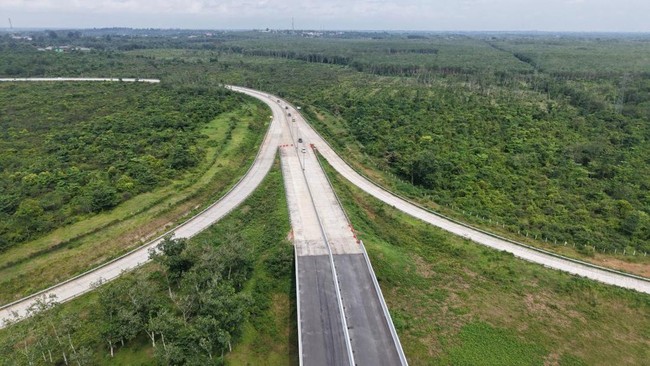
The significance of the Palembang-Betung Toll Road extends far beyond local commuting convenience; it serves as a crucial linchpin in the national government’s long-term vision to bind the entire island of Sumatra through a continuous, high-capacity arterial expressway. Triono Junoasmono, the Expert Staff to the Minister of Public Works for Institutional Relations, emphasized that the project is an indispensable building block in expanding the overarching Trans-Sumatra network.
The historical trajectory of the JTTS has prioritized connecting southern economic hubs upward. Currently, fully operational toll segments stretch seamlessly from Bakauheni in Lampung all the way to Palembang. The ongoing integration of the Palembang-Betung section represents the immediate northward push of this logistics backbone.
"If we examine the current landscape, the operational toll roads extend continuously from Bakauheni in Lampung up to Palembang. This network is now being actively continued through the Palembang-Betung section, and we harbor strong optimism that subsequent phases will successfully enter the construction phase extending all the way to Jambi," Triono explained.
This systematic progression reflects a deliberate infrastructural strategy. By bridging the geographical gaps between major provincial capitals and industrial centers, the central government aims to dismantle the logistical bottlenecks that have historically hampered Sumatra’s economic competitiveness.
Socio-Economic Implications and Regional Growth Prospects
The completion of the Musi V Bridge and the broader Palembang-Betung Toll Road carries profound socio-economic implications for South Sumatra and the wider region. Transport economists and regional planners anticipate a cascade of positive externalities once the corridor becomes fully operational.
First and foremost is the drastic reduction in travel time. Historically, transit between Palembang and Betung—and further onward toward Jambi—was constrained by heavily congested national roads shared by passenger vehicles, heavy freight trucks, and local commerce. The new toll expressway bypasses dense residential and commercial pockets, allowing freight transporters to maintain steady average speeds, minimize fuel consumption, and drastically cut down turnaround times for goods delivery.
Second, the enhancement of supply chain efficiency is expected to lower logistics costs, which currently constitute a significant percentage of retail and manufacturing expenses across Indonesia. By easing the distribution of agricultural commodities, manufactured goods, and industrial raw materials from South Sumatra’s interior to major maritime ports and neighboring provinces, the toll road acts as a direct stimulus for regional trade.
Third, improved infrastructure invariably catalyzes regional economic development. Areas adjacent to toll interchanges typically experience accelerated urbanization, attracting investments in warehousing, manufacturing facilities, commercial real estate, and hospitality services. Local small and medium enterprises (SMEs) stand to benefit from increased consumer mobility and expanded market reach, transforming previously isolated agrarian communities into vibrant economic sub-centers.
Looking Ahead: Challenges and Future Outlook
While the overarching progress of the Palembang-Betung project remains on schedule, project stakeholders continue to navigate standard infrastructural hurdles. Maintaining momentum through the final quarters of 2026 requires rigorous coordination among engineering contractors, regulatory bodies, and financial institutions. Environmental management, safety compliance, and final utility relocations remain focal points for project supervisors as they approach the target operational windows for late 2026 and early 2027.
Nevertheless, with the structural integrity of the Musi V Bridge officially certified and the overarching timeline clearly mapped out by the Ministry of Public Works and BPJT, the realization of a fully connected Trans-Sumatra expressway inches ever closer to reality. As Indonesia continues to prioritize structural reforms and regional equity through capital investments, the Palembang-Betung Toll Road stands as a testament to modern engineering prowess and long-term national vision, promising a faster, safer, and economically integrated future for the people of Sumatra.

