
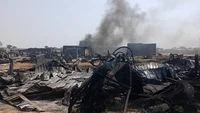
The ongoing civil war in Sudan reached a grim milestone this Sunday, November 29, as a series of drone strikes targeted civilian infrastructure in the West Kordofan region, resulting in the deaths of at least 14 individuals. The attacks, which occurred in two separate incidents, have drawn renewed international concern regarding the safety of non-combatants in a conflict that has displaced millions and devastated the nation’s socio-economic fabric.
According to testimonies from local residents, sources within the Rapid Support Forces (RSF), and reports from the Kordofan Observatory, the strikes represent a significant escalation in the use of unmanned aerial vehicles (UAVs) in areas previously considered peripheral to the primary fighting in Khartoum and the Darfur region.
Chronology of the Attacks
The first incident occurred early Sunday morning when a vehicle carrying civilians was struck while traveling between the village of Fakouki and the market town of Ghubeish in the Wad Banda locality. Witnesses reported that the vehicle was hit directly by a drone-launched projectile, causing the transport to burst into flames immediately.
"We evacuated eight bodies from the charred remains of the vehicle and buried them at the site," one local witness told reporters on the ground. The victims were reportedly civilian merchants and travelers navigating the precarious roads of West Kordofan to reach local supply centers.
Hours later, a second strike was reported in the Al-Adiya region, specifically targeting a restaurant located in the Khuwairat market. This strike resulted in the deaths of six additional people, including several members of a single family who were seeking refuge or food in the market area. The Kordofan Observatory, which tracks human rights abuses and civilian casualties in the region, confirmed the casualty count and noted that the proximity of these strikes to civilian gathering points suggests a disregard for the principles of distinction and proportionality under international humanitarian law.
The Strategic Context of West Kordofan
West Kordofan has increasingly become a critical theater of operations in the broader Sudan conflict, which began in April 2023. The region is not merely a geographic point on the map; it serves as a vital artery connecting central Sudan with the Darfur states and the nation’s primary oil-producing fields.
The RSF has been working to consolidate control over these transit corridors to secure supply lines and prevent the Sudanese Armed Forces (SAF) from isolating their units in western Sudan. Consequently, the SAF has utilized air power—including drone technology—to disrupt RSF logistics. However, human rights groups argue that these aerial campaigns have frequently struck civilian populations under the guise of targeting military logistical hubs.
Since the outbreak of the war, Sudan has witnessed one of the world’s largest humanitarian crises. The UN Office for the Coordination of Humanitarian Affairs (OCHA) estimates that more than 10 million people have been displaced, either internally or as refugees in neighboring countries. The violence in West Kordofan complicates an already fragile humanitarian situation, as aid organizations struggle to access remote areas where telecommunications are unreliable and infrastructure is collapsing.
Official Responses and Allegations
The attribution of these strikes remains a point of intense contention. The Kordofan Observatory and RSF-linked sources have explicitly accused the Sudanese military of operating the drones responsible for the Sunday attacks. These groups argue that the precision of the strikes, combined with the flight patterns observed by locals, points to state-run military aviation assets.
Conversely, the Sudanese Armed Forces have maintained a policy of denial regarding the targeting of civilians. A military spokesperson, speaking on condition of anonymity to international press outlets, stated, "We do not target civilians under any circumstances. Our mission is to protect the citizenry from the incursions of the RSF militia." The military often maintains that its aerial operations are strictly limited to neutralizing RSF combatants, command centers, and weapon stockpiles.
The cycle of accusation and counter-accusation has become a hallmark of the conflict. International observers, including the UN Independent International Fact-Finding Mission for the Sudan, have previously noted that both sides have committed actions that may amount to war crimes. The lack of independent verification on the ground, coupled with the restricted access for international journalists, makes it difficult to definitively assign responsibility for every tactical maneuver, yet the patterns of civilian casualty events remain consistent with the operational capabilities of the SAF’s air wing.
Broader Implications of Aerial Warfare
The use of drones in the Sudanese conflict reflects a broader trend of "technologized warfare" in African civil conflicts. Cheap, off-the-shelf, or state-supplied surveillance and strike drones have allowed warring parties to project force across vast distances without the need for large, vulnerable troop deployments.
However, the military utility of these drones is frequently overshadowed by the civilian cost. The strikes on the vehicle near Ghubeish and the restaurant in Khuwairat are indicative of a conflict that is increasingly encroaching on the daily survival activities of the Sudanese people. When markets and transit routes become "battlefields," the local economy suffers, and the threat of famine—already exacerbated by the destruction of agricultural cycles—intensifies.
The regional impact is also significant. As the fighting spreads into West Kordofan, there is a risk of further destabilizing the border regions near South Sudan and Chad. If the transit routes for oil and goods are further disrupted, the national government’s ability to function will continue to erode, potentially leading to the further fragmentation of the Sudanese state.
Humanitarian and Human Rights Analysis
The international community, including the African Union (AU) and the Intergovernmental Authority on Development (IGAD), has consistently called for a cessation of hostilities. Yet, diplomatic efforts have stalled, and the recent violence in West Kordofan serves as a sobering reminder that the war is not reaching a stalemate but is instead evolving into a more indiscriminate phase.
Human rights experts suggest that the failure to document and hold perpetrators accountable for strikes on civilian infrastructure creates a climate of impunity. "When markets, vehicles, and residential areas become targets, the civilian population loses the ability to distinguish between a safe zone and a front line," noted one analyst specializing in conflict zones. "This leads to secondary displacement, where families flee not just from front-line combat, but from the constant, invisible threat of drone strikes from above."
For the families of the 14 victims in West Kordofan, the political maneuvering of the RSF and the SAF is of little consequence. Their reality is the loss of loved ones and the destruction of the fragile peace they had managed to maintain in their rural communities.
Outlook for the Conflict
As the rainy season subsides and ground conditions improve for military maneuvering, experts fear that both the SAF and the RSF will intensify their efforts to control key territories before the end of the year. This likely implies an increase in aerial reconnaissance and subsequent strikes.
Without a robust monitoring mechanism or a localized ceasefire agreement, the risk of further civilian casualties remains high. The international community faces a difficult challenge: how to pressure the warring parties to prioritize the protection of non-combatants when both sides view the conflict as an existential struggle for the control of the state.
The tragedy in West Kordofan is a microcosm of the larger war in Sudan. Until there is a political solution that addresses the grievances of both the military and the paramilitary groups, and until there is a genuine commitment to adhering to international humanitarian standards, civilians will remain the primary victims of this protracted conflict. The deaths of these 14 individuals serve as a stark indicator that the war, far from winding down, continues to extract a devastating price from the most vulnerable segments of Sudanese society.
