
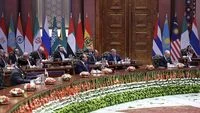
Indonesian President Prabowo Subianto engaged in a series of pivotal, informal discussions with world leaders on the sidelines of the 18th BRICS Summit in New Delhi, India, on Saturday, September 12. The interactions, which featured key figures including Indian Prime Minister Narendra Modi, Russian President Vladimir Putin, and Chinese President Xi Jinping, underscore Indonesia’s strategic commitment to maintaining a non-aligned, active, and balanced foreign policy in an increasingly polarized geopolitical landscape.
The informal dialogues occurred just moments before the official opening of the summit, providing a rare window into the personal diplomacy that often dictates the trajectory of international relations. Cabinet Secretary Teddy Indra Wijaya, who accompanied the President, noted that the atmosphere was characterized by warmth and mutual respect, reflecting the deepening rapport between Indonesia and these global powers.
The Context of the 18th BRICS Summit
The BRICS grouping—originally comprising Brazil, Russia, India, China, and South Africa—has recently undergone a significant expansion, reflecting a shift toward a multipolar world order. By hosting the 18th summit in New Delhi, India sought to position itself as a bridge between the Global South and the established economic powers of the West. For Indonesia, the summit represents a critical platform to advocate for the interests of developing nations while securing trade partnerships that are essential for the country’s ambitious "Golden Indonesia 2045" economic vision.
Prabowo’s presence in New Delhi is part of a broader diplomatic offensive aimed at diversifying Indonesia’s economic partnerships. Since assuming the presidency, Prabowo has emphasized that Indonesia will not be subservient to any single power block. Instead, he advocates for "good neighbor" policies and robust economic engagement with all nations, provided such relations are built on the foundations of sovereignty and mutual benefit.
A Chronology of Diplomatic Engagement
The morning of September 12 began with a series of bilateral preparations. Before the formal plenary session, President Prabowo was observed in a private conversation with President Vladimir Putin. Shortly thereafter, the group expanded as Prime Minister Narendra Modi and President Xi Jinping joined the exchange.
This sequence of events is significant for several reasons:
- Pre-Session Synergy: The fact that these four leaders converged before the opening ceremonies suggests a pre-existing alignment on several key agenda items, likely including food security, energy transition, and the reform of international financial institutions.
- Balancing Act: For Indonesia, interacting simultaneously with China and India—two nations currently navigating complex border and economic competition—demonstrates Jakarta’s capability to act as a neutral interlocutor.
- Sustained Momentum: This engagement follows months of ministerial-level discussions between Indonesia and the BRICS bloc, moving the relationship from symbolic participation to substantive collaboration.
Strategic Economic Implications
Indonesia’s participation in the BRICS forum is not merely symbolic; it is a calculated economic strategy. With the global economy facing headwinds from inflation and supply chain volatility, Indonesia is looking to secure its place in the global supply chain for critical minerals, particularly nickel, and to expand its export markets.
According to data from the Indonesian Ministry of Trade, exports to BRICS member states have seen a consistent upward trend over the last three fiscal years. Strengthening these ties allows Indonesia to tap into the New Development Bank (NDB), an institution established by BRICS to provide alternatives to traditional Western-led financial bodies. For an emerging economy like Indonesia, having access to diverse capital sources is vital for funding infrastructure projects and industrial downstreaming programs.
Furthermore, the conversation between President Prabowo and President Xi Jinping is expected to touch upon the acceleration of the Belt and Road Initiative (BRI) projects in Indonesia, including the Jakarta-Bandung High-Speed Railway’s potential expansion and future renewable energy investments.
Official Responses and Diplomatic Protocol
The Cabinet Secretariat’s office released a formal statement emphasizing that the interactions observed in New Delhi were indicative of "close communication" between world leaders. The statement noted that while formal plenary sessions provide the framework for policy decisions, the "corridor diplomacy" occurring during breaks is where trust is established and potential bottlenecks in negotiations are addressed.
"The warmth displayed by the leaders is a reflection of Indonesia’s enduring and strategic relationships with these nations," stated Cabinet Secretary Teddy. He added that the President’s presence in New Delhi serves as a clear signal of Indonesia’s intent to play a more proactive role in shaping global governance, particularly in areas like climate change mitigation and the equitable distribution of vaccine and food resources.
International observers have noted that Prabowo’s approach is a continuation of the "free and active" (bebas dan aktif) foreign policy doctrine, which has been the cornerstone of Indonesia’s international relations since the 1955 Bandung Conference. However, under Prabowo, this doctrine is being applied with a more assertive, commercially driven edge.
Analysis: The Future of Indonesian Foreign Policy
The informal gathering in New Delhi provides a microcosm of the challenges and opportunities facing the current Indonesian administration. By positioning himself among the leaders of Russia, China, and India, President Prabowo is signaling that Indonesia is a central player in the emerging global narrative.
Several factors will determine the success of this diplomatic outreach:
- Investment Outcomes: The true measure of the BRICS summit for Indonesia will be the volume of foreign direct investment (FDI) that follows these meetings. If these conversations lead to concrete agreements in the energy, digital, and infrastructure sectors, it will validate the current administration’s focus on high-level personal diplomacy.
- Multilateral Stability: Indonesia’s ability to remain neutral while the global geopolitical environment remains fractious is a delicate task. The presence of both Putin and Xi in the same circle as the Indonesian President highlights the need for a sophisticated, nuanced diplomatic strategy that avoids alienating Western partners.
- Domestic Impact: The government must ensure that these international engagements translate into domestic prosperity. This means ensuring that foreign partnerships align with local regulations, labor standards, and environmental sustainability goals.
Conclusion: A Pivot Toward Strategic Autonomy
As the 18th BRICS Summit proceeds, all eyes will be on the final declarations and the specific bilateral memorandums of understanding that may be signed. President Prabowo’s ability to foster a "warm and friendly" environment with leaders who often hold diverging views on global security architecture suggests that Indonesia is successfully leveraging its position as a major democratic, G20-member economy to foster dialogue.
The events of September 12 in New Delhi are a testament to the fact that Indonesia is no longer merely a participant in the global arena; it is an architect of its own future, actively seeking to build bridges across the divide of the East and West. By maintaining an open-door policy, Prabowo is ensuring that Indonesia remains a destination for investment and a partner for progress, regardless of the shifting tides of international power.
As the summit concludes, the focus will shift from the pleasantries of the opening session to the long-term implementation of the discussed partnerships. For the citizens of Indonesia, these diplomatic maneuvers represent a hopeful sign that the nation’s international influence is being translated into tangible economic development and national security. The path forward is complex, but the warmth displayed in New Delhi suggests that Indonesia is well-positioned to navigate the challenges of the 21st century with confidence and strategic clarity.
