
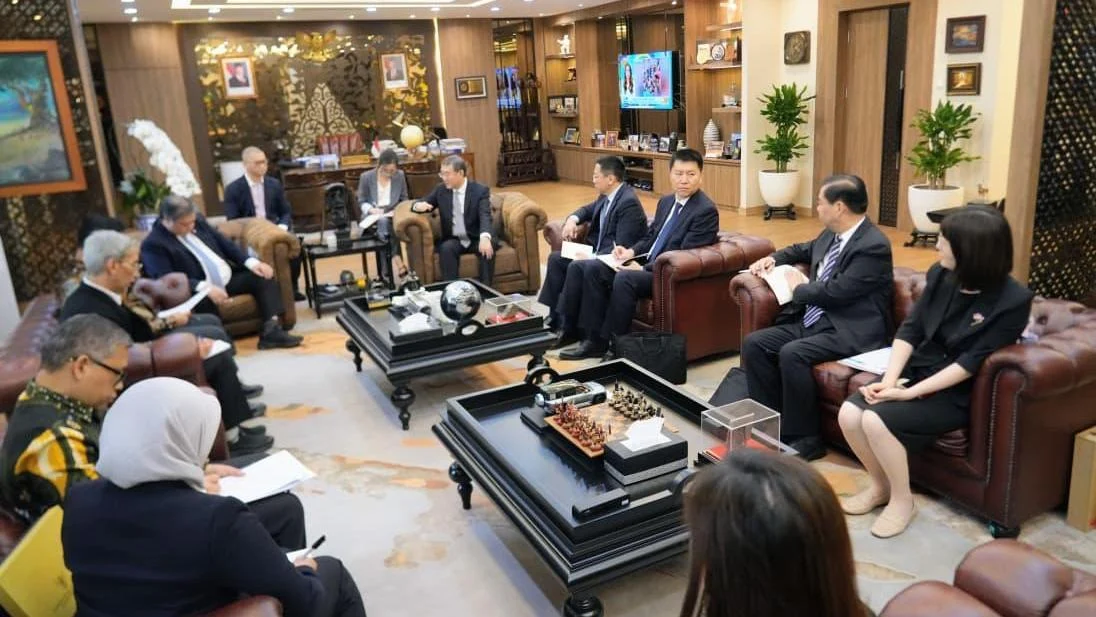
Coordinating Minister for Economic Affairs of Indonesia, Airlangga Hartarto, hosted Zhao Zenglian, the Vice Governor of the People’s Government of Fujian Province, China, at the Coordinating Ministry for Economic Affairs office in Jakarta on Friday, July 24, 2026. The high-level meeting underscored a mutual commitment to deepen economic cooperation through the expedited implementation of the "Two Countries, Twin Parks" (TCTP) program, with a particular emphasis on developing a concrete list of potential projects and priority sectors tailored to the needs and strategic objectives of both nations. This initiative is envisioned as a critical vehicle for enhancing bilateral trade, attracting significant investment, and fostering industrial development, thereby strengthening the economic resilience and growth trajectories of Indonesia and China.
Strategic Imperative: Realizing Indonesia’s Shenzhen in Batang
A cornerstone of the discussions revolved around the ambitious vision for the Batang Industropolis Special Economic Zone (KEK) in Central Java. Minister Airlangga reiterated President Prabowo Subianto’s directive to rapidly transform the Batang KEK into "Indonesia’s Shenzhen," a hub of innovation, manufacturing, and technological advancement. The Batang KEK, officially inaugurated on March 20, 2025, represents a flagship project designed to attract high-value industries, create substantial employment opportunities, and catalyze regional economic growth. The acceleration of concrete projects within the TCTP framework is seen as instrumental in achieving this ambitious transformation, leveraging Chinese expertise and investment to build a world-class industrial ecosystem.
The Batang Industropolis KEK spans an expansive area, strategically located with excellent connectivity to major seaports and transportation networks. Its designation as a Special Economic Zone provides investors with a range of fiscal and non-fiscal incentives, including tax holidays, customs duty exemptions, simplified licensing procedures, and robust infrastructure support. The vision to emulate Shenzhen is not merely about scale but also about fostering an environment conducive to innovation, advanced manufacturing, and export-oriented industries. This includes developing facilities for research and development, providing skilled labor training, and integrating digital technologies across industrial operations. For Indonesia, the success of Batang KEK is pivotal to its long-term industrialization strategy, aiming to move up the global value chain and diversify its export base beyond raw commodities.
The Two Countries, Twin Parks (TCTP) Framework: A Deeper Dive
The TCTP program, a unique bilateral economic cooperation mechanism, seeks to establish integrated industrial parks and economic zones in both Indonesia and China, fostering symbiotic development and mutual benefit. The core idea is to create twin industrial ecosystems where companies from one country can invest and operate in the other’s park, facilitating cross-border supply chains, technology transfer, and market access. In Indonesia, the primary focus areas for TCTP include the Batang KEK and potentially other strategic industrial zones, while in China, Fujian Province plays a central role.
The program, initially conceived as part of China’s Belt and Road Initiative (BRI) and Indonesia’s Global Maritime Fulcrum vision, aims to streamline investment processes and provide a robust framework for long-term economic partnership. Fujian Province, with its strong manufacturing base, strategic coastal location, and historical ties to Southeast Asia, is a natural partner for Indonesia in this endeavor. The province has a long tradition of outward investment and a well-developed industrial ecosystem, making it an ideal counterpart for developing complementary industries and value chains.
Since its inception, the TCTP framework has actively promoted collaboration between various stakeholders, including economic and industrial zones, local governments, and business communities from both nations. This multi-layered approach ensures that the program benefits from broad participation and tailored solutions. To date, this collaborative effort has culminated in the signing of 30 Memoranda of Understanding (MoUs), signifying a robust pipeline of potential projects and partnerships. These MoUs represent an estimated investment value of approximately IDR 37.1 trillion (approximately USD 2.4 billion, based on current exchange rates), a substantial figure that underscores the commitment and potential impact of the program. These investments are expected to flow into diverse sectors, ranging from advanced manufacturing and processing industries to digital infrastructure, renewable energy, and logistics, aligning with Indonesia’s national development priorities.
Fujian’s Commitment and Strategic Steps for Acceleration
Vice Governor Zhao Zenglian expressed Fujian’s unwavering commitment to the TCTP program and outlined several strategic steps to expedite its implementation. These measures include strengthening coordination among all stakeholders, a crucial element for ensuring seamless execution and overcoming potential bureaucratic hurdles. Furthermore, Zhao emphasized the importance of proactively identifying specific projects and priority sectors that offer the greatest potential for mutual development and impact. This targeted approach will ensure that resources are allocated efficiently and that investments are aligned with the strategic objectives of both Fujian and Indonesia.
"We are ready to work hand-in-hand with the Indonesian Government in promoting the development of areas within the TCTP program," Vice Governor Zhao stated, underscoring Fujian’s proactive stance. He added, "We are committed to identifying priority sectors that have the potential for joint development with Fujian Province." This commitment highlights Fujian’s willingness to not only invest but also to share expertise and collaborate on strategic planning, ensuring that the projects are mutually beneficial and sustainable. The identified priority sectors are likely to include areas where Fujian has a comparative advantage, such as electronics manufacturing, petrochemicals, textiles, and modern agriculture, which can complement Indonesia’s industrial development goals.
Enhancing the Ecosystem: Facilitating Trade and Investment
Both Indonesian and Chinese officials recognize that successful implementation of the TCTP program hinges on a robust and supportive ecosystem for trade and investment. Significant efforts are underway to strengthen this ecosystem, addressing key areas that impact business operations and cross-border transactions. These initiatives include enhancing trade facilitation measures, which aim to simplify customs procedures, reduce processing times, and lower the costs associated with international trade. Improved coordination between customs authorities of both countries is a vital component of this effort, ensuring a smoother flow of goods and raw materials.
Furthermore, supporting the seamless movement of goods across borders and improving market access are paramount. This involves not only logistical enhancements but also addressing non-tariff barriers and ensuring regulatory alignment where possible. By creating a more predictable and efficient operating environment, these measures are expected to significantly boost the attractiveness of TCTP regions for investors. The goal is to cultivate a highly conducive business climate that minimizes operational complexities and maximizes investment returns, thereby accelerating the realization of the TCTP’s full potential. This includes exploring digital trade platforms, enhancing port infrastructure, and developing integrated logistics corridors that connect TCTP zones directly to international markets.
Broader Implications and Future Outlook
The acceleration of the TCTP program and the focused development of the Batang KEK carry significant implications for the broader economic landscape of Indonesia and the nature of its bilateral relations with China. Economically, the successful implementation of these initiatives is expected to generate thousands of direct and indirect jobs, stimulate local economies, and foster technology transfer from China to Indonesia. The emphasis on advanced manufacturing and export-oriented industries in Batang KEK could significantly boost Indonesia’s non-oil and gas exports, helping to diversify its economy and strengthen its position in global supply chains. The influx of foreign direct investment (FDI) will also provide much-needed capital for infrastructure development and industrial expansion.
Strategically, the TCTP program reinforces Indonesia’s role as a key partner in China’s Belt and Road Initiative, while also aligning with Indonesia’s own vision for national development and regional connectivity. It demonstrates a practical approach to bilateral cooperation that moves beyond traditional trade in commodities to more sophisticated industrial partnerships. This collaboration also serves to deepen the economic interdependence between the two Asian giants, potentially fostering greater stability and understanding.
However, challenges remain. These include ensuring environmental sustainability in industrial development, addressing potential social impacts on local communities, and navigating complex regulatory frameworks. Robust governance, transparent investment processes, and effective stakeholder engagement will be crucial for the long-term success of the TCTP program. Furthermore, ongoing efforts to enhance human capital through vocational training and skill development programs will be essential to ensure that the Indonesian workforce is equipped to meet the demands of advanced industries setting up in Batang and other TCTP areas.
The meeting between Minister Airlangga Hartarto and Vice Governor Zhao Zenglian marks a pivotal moment in the TCTP journey. It signifies a renewed commitment to concrete action, moving beyond conceptual frameworks to tangible project identification and implementation. As Indonesia strives to become an industrialized nation and China seeks to expand its global economic footprint, the TCTP initiative stands as a testament to the power of strategic bilateral cooperation in driving mutual growth and prosperity in the Indo-Pacific region. The coming months and years will be critical in translating these ambitious agreements into operational realities that benefit both economies and their peoples.
