
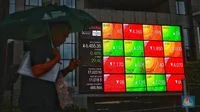
The Jakarta Composite Index (IHSG) experienced a significant downturn during the first trading session on Tuesday, September 22, 2026, as investors retreated amid mounting uncertainty. The benchmark index plummeted by 71.16 points, or 1.11%, to settle at 6,313.57. This sharp correction underscores a period of heightened volatility within the Indonesian capital market, driven by a combination of global geopolitical tensions and a cautious domestic macroeconomic outlook ahead of crucial monetary policy announcements.
Market Performance and Trading Dynamics
The morning session was characterized by a clear dominance of bearish sentiment. Out of the total stocks traded, 537 counters recorded declines, while only 157 managed to register gains, with 269 stocks remaining stagnant. The breadth of this sell-off suggests that the pressure was widespread rather than concentrated in a few isolated pockets of the market.
Market participation remained robust despite the downward trend. Total trading volume reached 19.64 billion shares, with a total frequency of 1.249 million transactions. The value of these trades amounted to Rp7.97 trillion. When factoring in the broader data provided by Stockbit, the total volume in terms of lots reached 206.30 million, with a total transaction value of approximately Rp7.99 trillion across 1.36 million transactions.
The intraday movement painted a picture of a failed recovery. The market initially opened on a positive note at 6,392.34 and climbed to an intraday high of 6,423.84. However, the momentum could not be sustained, and a wave of profit-taking and defensive selling pushed the index to a session low of 6,277.68. While a modest recovery attempted to pull the index back toward the 6,300 mark, the market ultimately lacked the buying power to erase the losses incurred during the mid-morning slump.
Sectoral Pressures and Leading Laggards
The decline was largely fueled by weakness in the energy and real estate sectors. The energy sector bore the brunt of the selling pressure, slumping by 3.07%. This sector, often highly sensitive to global commodity price fluctuations, was significantly impacted by the performance of heavyweight constituents. The real estate and utility sectors followed, shedding 1.5% and 1.2% respectively.
PT Bayan Resources Tbk (BYAN) emerged as the primary drag on the index, contributing a massive -16.71 points to the decline. The stock saw a sharp correction of 7.81%, dropping back to the 12,100 level from its previous close of 13,825. This volatility in a high-cap stock like BYAN highlights the fragility of the index when major constituents face negative sentiment. Other notable laggards included state-owned banking giant PT Bank Rakyat Indonesia (Persero) Tbk (BBRI), which contributed -8.76 points, alongside PT Bumi Resources Minerals Tbk (BRMS), PT Telkom Indonesia (Persero) Tbk (TLKM), and PT Bumi Resources Tbk (BUMI).
Conversely, some resilience was observed in specific counters. Stocks such as PT Amman Mineral Internasional Tbk (AMMN), PT Bank Central Asia Tbk (BBCA), PT Merdeka Gold Resources Tbk (EMAS), PT Indosat Tbk (ISAT), and PT Charoen Pokphand Indonesia Tbk (CPIN) acted as modest buffers, helping to mitigate an even deeper slide in the index.
The Macroeconomic Landscape: The BI Rate Watch
The primary driver of investor hesitation on this Tuesday is the ongoing Rapat Dewan Gubernur (RDG) or Board of Governors Meeting of Bank Indonesia. This meeting, scheduled for September 22-23, 2026, holds significant weight for the financial markets as it will culminate in the decision regarding the BI Rate.
This meeting is particularly noteworthy as it marks the first major policy deliberation led by Destry Damayanti since her appointment as the definitive Governor of Bank Indonesia on September 2, 2026. Market consensus currently leans toward the expectation that the central bank will maintain the BI Rate at 5.75%, alongside keeping the deposit facility and lending facility rates unchanged at 4.75% and 6.5% respectively.
Analysts suggest that Bank Indonesia is likely prioritizing stability over aggressive policy shifts. With the global economy facing headwinds from persistent geopolitical friction in the Middle East, maintaining a steady hand on interest rates is seen as a prudent measure to protect the Rupiah and prevent capital flight. However, the market remains on edge, as any deviation from the expected "hold" decision could trigger significant volatility in the bond and equity markets.
Global Sentiments and External Influences
Beyond domestic policy, the Indonesian market is grappling with a complex global narrative. The recent performance of Wall Street and the fluctuations in the cryptocurrency market, particularly Bitcoin, have provided mixed signals. While a strong performance in US markets typically offers a tailwind for emerging markets like Indonesia, the prevailing anxiety regarding the Middle East conflict continues to dominate risk-off sentiment.
Investors are increasingly wary of the potential for supply chain disruptions and energy price spikes associated with regional instability in the Middle East. Such events often lead to a flight to safety, where investors move capital out of emerging market equities and into safe-haven assets. The combination of these external pressures with the domestic anticipation of the central bank’s decision created a "wait-and-see" environment that ultimately favored sellers on Tuesday.
Analysis of Market Implications
The current correction in the IHSG represents a consolidation phase that is heavily influenced by policy uncertainty. Historically, the period leading up to a Bank Indonesia rate announcement often sees reduced volume and increased volatility as institutional investors adjust their portfolios to align with potential interest rate scenarios.
From a technical perspective, the inability of the IHSG to hold above the 6,400 level suggests that the immediate upside momentum has been exhausted. Support levels at 6,250 and 6,200 will be closely watched by market participants in the coming sessions. If the central bank signals a hawkish shift or expresses concern over inflation, the index could face further downside risks. However, if the decision remains in line with market expectations, a relief rally could potentially materialize, allowing the index to regain lost ground.
Furthermore, the sectoral divergence observed today—specifically the heavy rotation out of energy stocks—indicates that investors are re-evaluating their exposure to commodity-linked assets. As global demand outlooks fluctuate, the energy sector may continue to experience heightened volatility, thereby acting as a barometer for broader market health.
Looking Ahead
As the market enters the next trading session, focus will remain firmly on the outcome of the Bank Indonesia meeting. Market participants will be looking for guidance on future policy trajectories, particularly regarding how the central bank intends to navigate the dual challenges of domestic economic growth and currency stability.
Furthermore, monitoring the performance of the Rupiah will be essential. A stable or strengthening currency would provide a much-needed confidence boost to foreign investors, who have been net sellers in several recent sessions. While the market has endured a difficult start to the week, the underlying fundamentals of the Indonesian economy remain a point of interest for long-term investors, provided that macroeconomic stability is maintained through the current cycle of global uncertainty.
In summary, the Tuesday sell-off was a multi-faceted event, driven by the weight of major energy sector corrections and the strategic positioning of investors ahead of a high-stakes central bank decision. Whether this trend continues will depend heavily on the clarity provided by Bank Indonesia on Wednesday and the subsequent reaction of global equity markets to the ongoing geopolitical climate. For now, market participants are advised to maintain a defensive posture, prioritizing liquidity and monitoring the developments from the Bank Indonesia headquarters with keen interest.
