
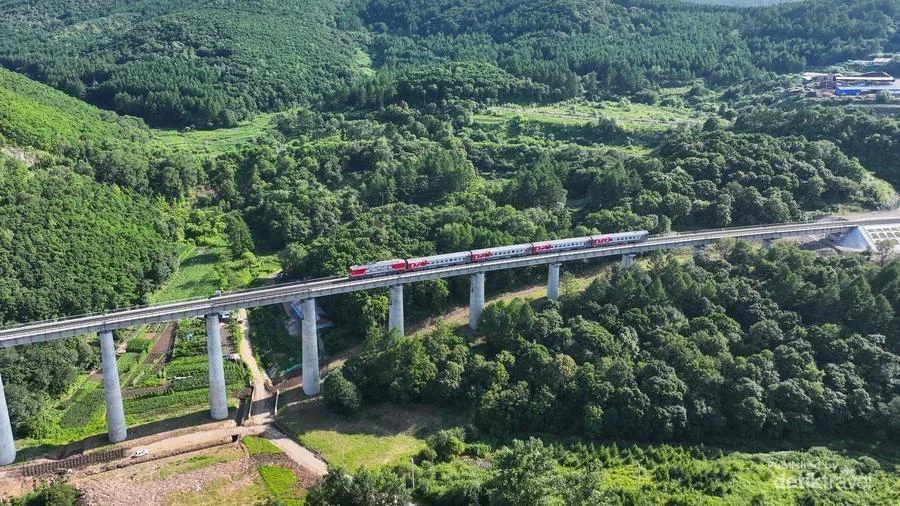
The geopolitical and economic landscape of Northeast Asia marked a significant milestone on July 18, 2026, as China and Russia officially inaugurated a new cross-border tourist train service. This dedicated rail link, connecting the Russian Far East hub of Vladivostok with the Chinese border city of Suifenhe, represents a strategic effort to streamline international travel and deepen the cultural and commercial bonds between the two neighboring giants. The launch of this service is not merely a logistical achievement but a symbolic gesture of the "no-limits" partnership that has come to define Sino-Russian relations in the mid-2020s.
On its maiden voyage, the train facilitated a seamless exchange of visitors, signaling a new era for regional tourism. A group of Russian travelers arrived in Suifenhe to begin a four-day curated tour of China’s Heilongjiang province, while simultaneously, approximately 180 Chinese tourists boarded the return service destined for Vladivostok. This synchronized movement of people underscores the high demand for accessible cross-border experiences and the effectiveness of the new infrastructure in meeting that demand.
A New Era of Cross-Border Connectivity
The journey between Vladivostok and Suifenhe now takes approximately eight hours, a timeframe that has been optimized to balance speed with the leisure requirements of a tourist-centric service. Unlike standard commercial rail lines that prioritize cargo or rapid transit, this new service is designed as an integrated tourism product. The route is not just a means of moving from point A to point B; it is a "moving hotel" experience that incorporates various scenic destinations along the border, allowing travelers to enjoy a comprehensive itinerary within a single service package.
The rolling stock used for this route has been specifically outfitted to cater to diverse traveler preferences. The train features a unique interior configuration: one side of the carriage is dedicated to regular seating for short-haul comfort, while the other side utilizes an open-concept bunk bed system for those wishing to rest during the eight-hour transit. For premium travelers, the "soft sleeper" cabins provide a higher level of privacy and luxury, including access to onboard shower facilities—a rarity on many regional lines—ensuring that passengers arrive at their destination refreshed.
The enthusiasm for this new service was palpable during the launch. Among the passengers was Gao Hailong, a tourist from China’s eastern Zhejiang Province. Gao’s journey illustrates the significant draw of the new rail link; he traveled over 2,000 kilometers by air just to be among the first to experience the cross-border train. "I flew more than 2,000 kilometers from Zhejiang just to try this train," Gao told reporters. "The convenience of a direct, comfortable rail link to Russia is something many of us in the south have been waiting for. I am incredibly excited to finally step on board."
Strategic Context: The 2025 Visa-Free Policy
The launch of the Vladivostok-Suifenhe tourist train is the culmination of several years of diplomatic and administrative groundwork. A pivotal moment in this timeline was the implementation of a comprehensive visa-free policy for Russian tourists entering China, which went into effect in September 2025. This policy was designed to revitalize the border economy of Heilongjiang Province, which had seen fluctuating fortunes in previous decades.
Since the policy’s inception, cities like Suifenhe and Mudanjiang have seen a dramatic uptick in international arrivals. According to official data from the Suifenhe Land Port, the first half of 2026 saw more than 310,000 inbound and outbound crossings. This represents a 30.6 percent increase compared to the same period in 2025. The introduction of the tourist train is expected to accelerate this growth trend by removing the logistical "friction" of changing buses or navigating complex customs procedures at multiple transit points.
Cong Yunhong, the Deputy Director of the Bureau of Culture, Sports, Radio, Television, and Tourism of Mudanjiang City, highlighted the efficiency of the new service. "This service opens an efficient and comfortable cross-border tourism corridor," Cong stated. "Travelers from both nations can now truly travel by rail and reach their destination in a single journey without the need for transfers. This not only improves the experience but also significantly slashes the costs associated with cross-border travel."
Economic and Regional Implications
The economic ramifications of the new rail link extend far beyond the ticket sales of the train itself. Suifenhe, often referred to as the "Window to Russia," has long been a hub for the trade of timber, coal, and consumer goods. However, the provincial government has been keen to diversify the local economy toward high-value services, particularly tourism and cultural exchange.
By facilitating a steady stream of Russian tourists, Suifenhe and the surrounding Mudanjiang region stand to benefit from increased spending in the hospitality, retail, and dining sectors. Russian visitors are known to frequent Chinese border cities for medical tourism, affordable consumer electronics, and diverse culinary experiences. Conversely, Vladivostok—a city that boasts European-style architecture and a burgeoning Pacific coast arts scene—offers Chinese tourists a "gate to Europe" without the need for long-haul flights to Moscow or St. Petersburg.
The "one-stop" nature of the train service also appeals to the burgeoning middle class in China’s southern and eastern provinces. As demonstrated by Gao Hailong’s journey, there is a significant appetite for "frontier tourism"—trips that offer a sense of adventure and international exposure while remaining relatively accessible.
Technical Sophistication and Passenger Comfort
The decision to include high-end amenities like soft sleepers and showers reflects a shift in how China and Russia are marketing their rail services. Historically, cross-border trains in the region were utilitarian, often catering to "shuttle traders" who carried large quantities of goods across the border. The 2026 tourist train, however, is a clear pivot toward a "lifestyle" travel model.
The eight-hour duration is strategically timed. It allows for a morning departure and an evening arrival, or vice versa, maximizing the daylight hours for sightseeing through the large panoramic windows of the carriages. The route passes through the lush, forested landscapes of the Primorsky Krai in Russia and the agricultural heartlands of Northeast China, offering a visual narrative of the region’s shared geography.
A Chronology of Enhanced Cooperation
The timeline leading to the July 18 launch reveals a steady progression of bilateral cooperation:
- September 2025: Implementation of the reciprocal visa-free agreement for tour groups, significantly lowering the barrier to entry for Russian and Chinese citizens.
- January – June 2026: Modernization of the Suifenhe railway station and customs facilities to handle increased passenger volumes and implement "smart" border checks.
- Early July 2026: Final technical trials of the tourist train, ensuring the compatibility of rail gauges and safety systems between the Russian and Chinese segments.
- July 18, 2026: The official inaugural journey, carrying approximately 180 Chinese tourists and a reciprocal group of Russian visitors.
Broader Geopolitical Analysis
From a broader perspective, the Vladivostok-Suifenhe rail link is a component of the larger "Greater Eurasian Partnership" envisioned by Moscow and the "Belt and Road Initiative" (BRI) championed by Beijing. As Russia continues its "Pivot to the East" in response to shifting global alliances, the development of the Russian Far East has become a top priority for the Kremlin. Enhancing connectivity with China is seen as the primary engine for this regional development.
For China, the project aligns with the national strategy to revitalize the "Rust Belt" of the Northeast (Liaoning, Jilin, and Heilongjiang provinces). By transforming these provinces from industrial centers into logistics and tourism hubs, Beijing aims to create a new corridor of prosperity that bridges the gap between the affluent coastal regions and the inland borders.
Furthermore, the project serves as a buffer against geopolitical volatility. By fostering "people-to-people" exchanges, both nations are building a foundation of cultural familiarity that supports their high-level diplomatic agreements. When citizens from Zhejiang or Vladivostok interact through tourism, it creates a layer of social integration that hardens the bilateral relationship against external pressures.
Future Outlook: Expansion and Integration
Local officials are already looking beyond the initial success of the Vladivostok-Suifenhe line. There are ongoing discussions to expand the frequency of the service and potentially introduce "themed" trains, such as winter sports specials or historical tours that explore the shared revolutionary history of the two nations.
As the infrastructure matures, there is also the possibility of integrating this rail link with the wider Trans-Siberian Railway network, allowing tourists to start their journey in Vladivostok and travel all the way to Beijing or Harbin with standardized ticketing and visa-free arrangements.
The success of this maiden voyage on July 18, 2026, serves as a proof of concept. It demonstrates that despite the complexities of international borders, a combination of political will, modern infrastructure, and a focus on passenger experience can turn a historic trade route into a vibrant corridor of modern tourism. For the 180 pioneers who boarded the train to Vladivostok and the Russian visitors exploring Suifenhe, the world has just become a little smaller and much more accessible.
