Jakarta — In the contemporary professional landscape, data literacy has evolved from a supplementary competency into a foundational requirement across virtually all industry sectors. While spreadsheet software such as Microsoft Excel is routinely introduced during undergraduate education, the operational reality of the modern workplace demands analytical capabilities that extend far beyond basic data entry, rudimentary calculations, and simple tabular formatting. As organizations increasingly rely on data-driven decision-making, professionals at all levels are finding that standard operational knowledge is frequently insufficient for handling massive datasets, generating comprehensive business reports, and constructing dynamic executive dashboards.
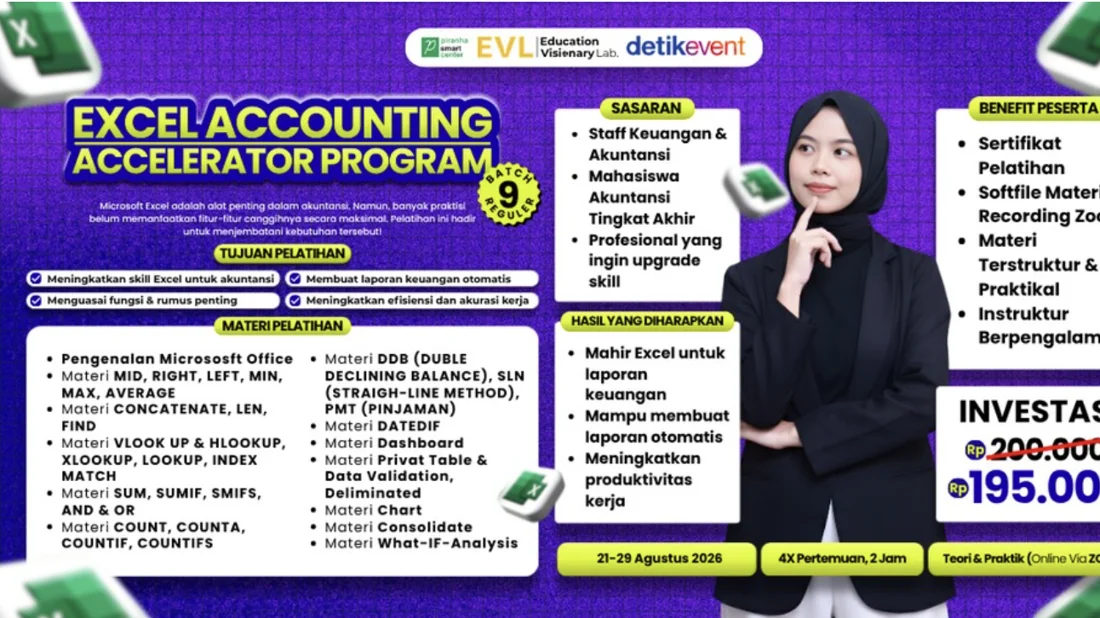
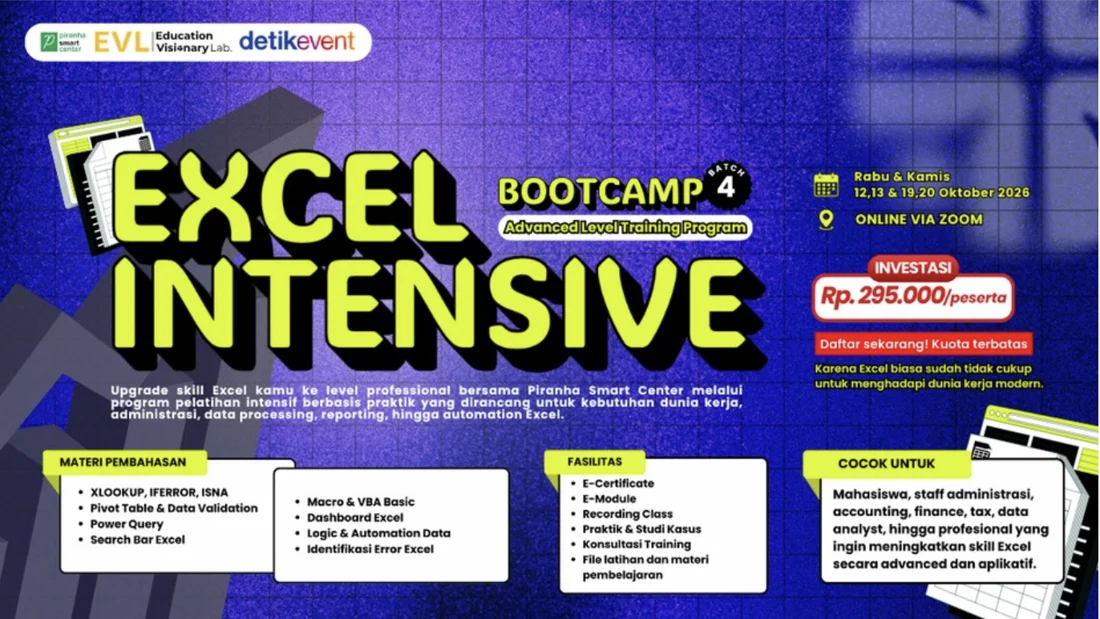
Recognizing this widening competency gap, Piranha Smart Center, operating through its Education Visionary Lab division, has officially announced the upcoming rollout of the Excel Intensive Bootcamp (Advanced Level Training Program) #4. Designed specifically to transition corporate workers, administrative personnel, and aspiring analysts from basic spreadsheet users to advanced data handlers, the upcoming intensive training program aims to address the critical need for sophisticated data processing skills in today’s competitive job market.
The Evolution of Corporate Spreadsheet Utilization
The transition from academic spreadsheet exercises to enterprise-level data management represents a significant hurdle for many early-career professionals. In an academic environment, Excel is typically utilized for straightforward tasks such as calculating descriptive statistics, organizing small sets of experimental data, or drafting basic financial models. Conversely, the corporate ecosystem requires professionals to ingest, clean, aggregate, and visualize thousands—sometimes millions—of rows of disparate data under stringent time constraints.
Industry observers note that while many employees are comfortable with fundamental functions like SUM, AVERAGE, and basic VLOOKUP operations, they often encounter operational bottlenecks when tasked with cross-referencing complex relational databases, automating repetitive administrative workflows, or identifying systemic calculation errors. Furthermore, the modern corporate hierarchy places a premium on visual data communication. Executives and department heads rarely have the time to parse dense, unformatted spreadsheets; instead, they demand intuitive, interactive dashboards that synthesize key performance indicators (KPIs) at a glance.
This operational shift underscores the necessity of mastering advanced spreadsheet features. Tools and methodologies such as XLOOKUP for robust data retrieval, Pivot Tables for multidimensional data summarization, Power Query for automated data transformation, Data Validation for maintaining data integrity, and Macro & VBA (Visual Basic for Applications) for workflow automation are no longer exclusive to data scientists. They have become standard requirements for efficient general office administration, financial analysis, marketing analytics, and operational management.
Comprehensive Curriculum of the Intensive Bootcamp
To bridge the gap between basic utility and advanced mastery, the curriculum for the Excel Intensive Bootcamp #4 has been meticulously structured around practical, real-world application. Rather than relying solely on theoretical lectures, the program utilizes an interactive learning methodology that incorporates live demonstrations, comprehensive case studies, independent practical exercises, and collaborative group discussions.
The training modules cover a broad spectrum of advanced spreadsheet functionalities designed to streamline data architecture and reporting. Participants will receive in-depth instruction on advanced formula deployment, enabling them to construct nested logical statements and dynamic range calculations. The syllabus places heavy emphasis on Pivot Table mastery, teaching attendees how to slice, dice, and group complex datasets to extract actionable business intelligence.
Additionally, the program addresses data hygiene and automation—two critical pain points for modern administrative professionals. Through dedicated sessions on Data Validation, participants will learn how to implement strict input controls to minimize human error in collaborative work environments. The integration of Power Query will empower attendees to connect, combine, and refine data from multiple external sources seamlessly, significantly reducing the manual labor traditionally associated with report generation.
For those looking to eliminate repetitive daily tasks, the curriculum features specialized modules on Search Bar Excel development, as well as an introduction to Macro and VBA Basic programming. These tools enable users to record and script automated sequences, turning hours of routine data formatting into single-click operations. Finally, the training covers advanced dashboard design principles, instructing participants on how to transform raw analytical outputs into visually compelling, easy-to-read executive summaries, alongside rigorous protocols for identifying and resolving complex Excel calculation errors.
Event Timeline and Administrative Details
The Excel Intensive Bootcamp (Advanced Level Training Program) #4 is scheduled to take place over two consecutive weekends in October 2026. To accommodate the schedules of working professionals, the organizer has structured the program as an online interactive series conducted via the Zoom platform.
The official training schedule spans four sessions held on Mondays and Tuesdays:
- Monday, October 12, 2026
- Tuesday, October 13, 2026
- Monday, October 19, 2026
- Tuesday, October 20, 2026
Each daily session will run during evening hours, specifically from 18:30 to 20:30 Western Indonesia Time (WIB), allowing participants to balance their daytime professional responsibilities with evening skill enhancement.
To ensure that attendees maximize the value of the program, Piranha Smart Center has curated a comprehensive support package for all registered participants. Upon successful completion of the bootcamp, attendees will receive an official e-certificate validating their advanced proficiency. Additionally, participants will be provided with comprehensive e-modules, full session recordings for asynchronous review, standardized practice and study case files, and ongoing access to training consultation services to assist with post-program application in their respective workplaces.
Industry Implications and the Growing Demand for Data Literacy
Labor market analysts and human resource experts consistently emphasize that digital fluency and advanced data processing capabilities significantly enhance employability and career mobility. As companies across all sectors undergo digital transformation, administrative and analytical tasks are becoming increasingly sophisticated. Employees who possess the ability to manipulate complex datasets independently not only increase their own operational productivity but also contribute directly to strategic organizational efficiency.
The introduction of specialized training initiatives like the Education Visionary Lab bootcamp reflects a broader trend toward continuous professional development in the digital age. With remote and hybrid work models placing a premium on self-directed efficiency, the capacity to automate data workflows and produce clear, error-free financial and operational reports is a tangible asset that distinguishes high-performing professionals in the job market.
Registration and Participation Guidelines
Professionals, administrative personnel, data handlers, and individuals seeking to elevate their spreadsheet competencies beyond basic operational levels are encouraged to secure their slots early, as capacity for the interactive sessions is subject to availability.
Interested candidates can review further program details, access enrollment documentation, and complete their registration process directly through the official ticketing and event platform via detikevent. By moving beyond foundational knowledge and embracing advanced analytical tools, participants can future-proof their skill sets and position themselves for greater operational impact in their respective professional fields.