
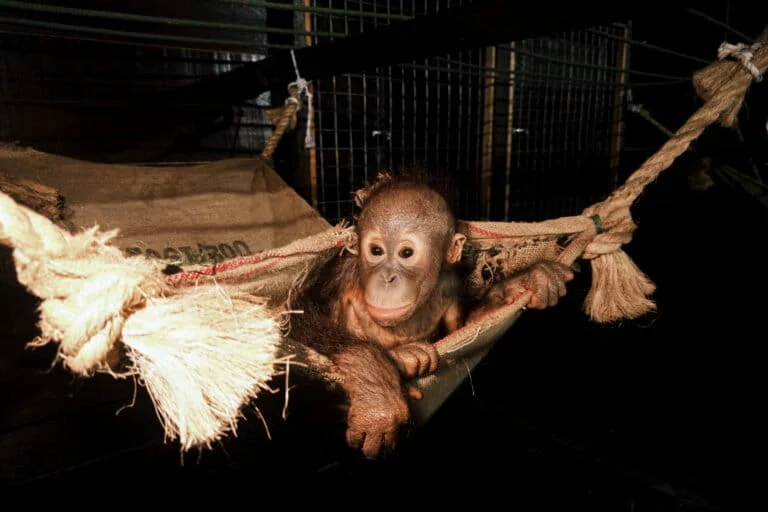
The survival of the Bornean orangutan (Pongo pygmaeus) rests on a delicate balance of habitat preservation and the intricate transmission of survival knowledge from mother to offspring. In the wild, an orangutan infant never lives in isolation; from the moment of birth, they are tethered to their mothers, who serve as their sole protectors and primary educators. This maternal bond is one of the longest in the animal kingdom, often lasting up to eight years, during which the young learn the complexities of forest life—identifying thousands of fruit species, navigating the high canopy, and constructing sturdy sleeping nests. When this bond is severed by human encroachment, poaching, or habitat loss, the infant is left not only vulnerable to predators but also fundamentally ill-equipped to survive. Throughout 2025, the Pusat Penyelamatan Satwa (PPS) Long Sam, managed by CAN Borneo in collaboration with the East Kalimantan Natural Resources Conservation Agency (BKSDA Kaltim), intervened in three such tragedies, rescuing three orphaned infants named Lucas, Hannes, and Jack.
The rescue of these three individuals highlights a persistent crisis in East Kalimantan’s Kutai Timur Regency, where the intersection of industrial agriculture and wildlife habitats often leads to fatal consequences for adult orangutans and the displacement of their young. While Lucas, Hannes, and Jack were found at different times and under varying circumstances, they share a common trauma: the loss of their maternal guidance before they were ready to face the wild. Their journey through the PPS Long Sam rehabilitation program represents a multi-year commitment to restoring their wild instincts and eventually returning them to a protected forest environment.
Profiles in Survival: The Chronology of the 2025 Rescues
The first arrival at the PPS Long Sam facility in 2025 was Lucas. Discovered in the village of Miau Baru, Kutai Timur, Lucas was found in a state of extreme vulnerability. Estimated to be only two to three months old, the infant had not yet developed teeth and was entirely dependent on milk. In the wild, an orangutan of this age would be physically attached to its mother’s ventral hair 24 hours a day. The absence of this contact left Lucas in a state of psychological distress; caretakers reported that he would cry whenever he was not being held or comforted. For Lucas, the rehabilitation process began with intensive 24-hour surrogate care, where "animal keepers" had to mimic the warmth and security of a biological mother to ensure his basic survival.
In August 2025, the team received a second orphan, Hannes, from the Bengalon area. Unlike Lucas, Hannes was approximately one year old upon rescue and exhibited significantly more advanced survival skills. It was evident to the veterinary team that Hannes had spent a substantial amount of time with his biological mother before their separation. He displayed a healthy "wild" temperament, showing a natural aversion to human contact and a preference for staying high in the trees. Hannes was already capable of foraging for certain foods and attempting to build rudimentary nests. In the social hierarchy of the PPS Long Sam "Forest School," Hannes assumed the role of an inadvertent mentor. Lucas, still grounded by his age and lack of experience, would often watch Hannes from below, observing how the older juvenile navigated the branches and selected leaves. This peer-to-peer learning is a critical component of rehabilitation, as it reduces the infants’ reliance on human keepers.
The final rescue of the year occurred toward the end of 2025 with the discovery of Jack. Found wandering alone in a palm oil plantation in Kutai Timur, Jack’s condition was the most concerning from a medical perspective. Upon arrival, he was suffering from a fever and mild dehydration. More tellingly, his limbs were covered in abrasions and scratches caused by the sharp thorns of the oil palm trees—a vegetation type that is entirely unnatural and hazardous to orangutans. Jack’s behavior was markedly different from the others; he was withdrawn and timid, frequently seeking the proximity of veterinarians for a sense of safety. His recovery has been a slow process of medical stabilization followed by gradual social integration.
The Biological and Ecological Necessity of Maternal Learning
The rescue of Lucas, Hannes, and Jack underscores a biological reality that makes orangutan conservation particularly challenging. Unlike many other mammals that rely on instinct, orangutans are highly "culture-dependent." A significant portion of their survival skill set is learned through observation and mimicry.
Research indicates that Bornean orangutans must learn to identify over 200 different types of edible plants and fruits, many of which are only available seasonally. They must also learn the "mechanical" skills of the forest, such as how to extract seeds from hard-shelled fruits or how to use tools to access honey. Without a mother to demonstrate these tasks, an orphaned infant is effectively illiterate in the language of the forest. The PPS Long Sam rehabilitation program acts as a remedial school, where human experts and older orangutans provide the lessons that were lost. This process is not a matter of weeks or months, but years. An orangutan typically remains in rehabilitation until they are approximately seven to nine years old, mirroring the natural weaning and independence cycle found in the wild.
Habitat Loss and the Role of Industrial Expansion
The geographic origin of these three orphans—Kutai Timur and Bengalon—points to the broader systemic issues facing East Kalimantan. This region has seen some of the most rapid land-use changes in Indonesia, driven primarily by the expansion of palm oil plantations and coal mining. As the primary rainforest is fragmented, orangutan populations become isolated in small pockets of forest. When food sources in these fragments are exhausted, orangutans often venture into plantations in search of young palm shoots or fruit, leading to human-wildlife conflict.
In many cases, mother orangutans are killed because they are viewed as pests or out of fear, leaving the infants to be captured for the illegal pet trade or left to starve. The fact that Jack was found with injuries from palm thorns is a direct physical manifestation of this habitat transition. The BKSDA Kaltim has emphasized that while rescue and rehabilitation are vital, they are "downstream" solutions. The "upstream" necessity remains the protection of remaining high-conservation-value (HCV) forests and the establishment of wildlife corridors that allow orangutans to move safely between forest patches without entering human-dominated landscapes.
Official Responses and the Rehabilitation Framework
Officials from BKSDA East Kalimantan have lauded the collaboration with CAN Borneo, noting that the management of a rescue center requires specialized veterinary knowledge and long-term financial commitment. "The rescue is only the first step," a representative from the agency noted in a recent briefing. "The real challenge is the five to seven years of rehabilitation that follow. We must ensure these animals do not become ‘humanized,’ or they will never be able to survive a release back into the wild."
At PPS Long Sam, the protocol for Lucas, Hannes, and Jack involves a phased approach:
- Quarantine and Medical Stabilization: Ensuring the animals are free from human diseases (such as tuberculosis or hepatitis) which can be fatal to great apes.
- Forest School Level 1: Infants learn to climb and move in a controlled outdoor environment.
- Forest School Level 2: Juveniles are moved to a more complex forest setting where they must find their own food and build nests daily.
- Pre-Release: The orangutans are placed on a protected island or a strictly monitored forest area to ensure they can survive without any human intervention.
Broader Implications for Great Ape Conservation
The stories of Lucas, Hannes, and Jack are symptomatic of the "Critically Endangered" status of the Bornean orangutan, as categorized by the IUCN Red List. With population estimates suggesting a decline of more than 60% since 1950, every individual saved represents a significant contribution to the genetic viability of the species.
Furthermore, the rehabilitation of these orphans has significant economic and social implications. It requires a dedicated workforce of local "guardian" animal keepers, providing employment and fostering a conservation-centric mindset within local communities. By involving the people of East Kalimantan in the care of these animals, organizations like CAN Borneo help shift the perception of orangutans from agricultural pests to national treasures.
The analysis of the 2025 rescues suggests that while the immediate health of the three infants is improving, the environmental pressures that led to their orphaning remain unabated. The survival of Lucas, Hannes, and Jack in the PPS Long Sam facility is a testament to human compassion and scientific dedication. However, their ultimate success will not be measured by how well they adapt to the rescue center, but by whether there will be a safe, expansive forest for them to return to once their "schooling" is complete.
As Lucas begins to grow his first teeth, as Hannes climbs higher into the canopy, and as Jack’s wounds heal, they remain symbols of a species in transition. They are learning to be "real orangutans" again, a process that is as much about healing the spirit as it is about physical growth. The work of BKSDA and CAN Borneo ensures that for these three, the story did not end in the palm oil rows of Kutai Timur, but continues in the hope of a future release into the heart of Borneo.

