
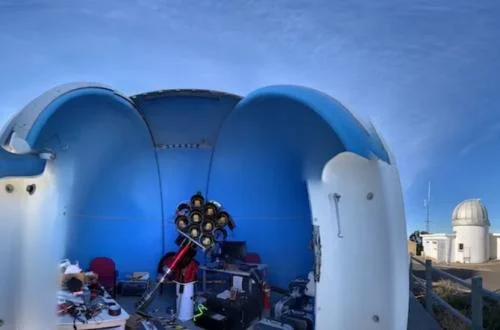
In a landmark development for the field of observational astronomy, researchers at Macquarie University in Australia have successfully pioneered a new technique that allows for the precise measurement of stars, satellites, and other celestial targets during broad daylight. This breakthrough was achieved using the university’s innovative Huntsman Telescope, a multi-lens array located at the Siding Spring Observatory in Coonabarabran, New South Wales. By integrating specialized light filters and high-speed processing, the team has effectively bypassed the traditional limitations of ground-based astronomy, which historically restricted optical observations to the hours of darkness. This advancement promises to transform our ability to monitor the increasingly crowded orbital environment of Earth and provides a new window into the behavior of volatile stellar objects.
The Challenge of Daylight Astronomy and the Huntsman Solution
For centuries, the primary adversary of the optical astronomer has been the Sun. The scattering of sunlight in Earth’s atmosphere—a phenomenon known as Rayleigh scattering—creates a bright blue canopy that easily overwhelms the relatively faint light emitted by distant stars and orbiting satellites. Consequently, most of the world’s premier observatories remain dormant during the day, waiting for the Sun to dip below the horizon before commencing their work. While radio astronomy and certain infrared observations can operate during daylight, high-resolution optical tracking has remained an elusive goal for the scientific community.
Sarah Caddy, a doctoral candidate and key figure in the design and construction of the Huntsman Telescope, emphasized the historical difficulty of this feat. In an official statement released by Macquarie University, Caddy noted that while astronomers have attempted to observe stars in the optical spectrum during the day for generations, the signal-to-noise ratio has almost always been too poor to produce meaningful data. However, the unique architecture of the Huntsman Telescope, combined with modern sensor technology, has finally provided a solution.
The Huntsman Telescope is not a traditional single-mirror instrument. Instead, it is composed of an array of 10 high-performance Canon 400mm f/2.8 L-series lenses. These lenses are oriented in parallel, allowing them to simultaneously capture the same patch of sky. This design, inspired by the "Dragonfly Telephoto Array" developed in North America, is specifically optimized for detecting ultra-low-surface-brightness features in the night sky. The Macquarie team’s recent innovation involved repurposing this sensitivity for daylight use through the application of sophisticated broadband filters.
Engineering and Technical Specifications
The success of the Huntsman’s daylight operations relies on a synergy of hardware and software. Each of the ten lenses is equipped with a specialized astronomical camera and an astro-mechanical focusing system. To combat the glare of the Sun, the team utilized broadband filters that selectively block the majority of the solar spectrum while permitting specific, scientifically relevant wavelengths to pass through.
One of the critical technical hurdles in daylight astronomy is atmospheric turbulence, which is significantly more pronounced during the day as the Sun heats the ground and causes air to rise in shimmering currents. To mitigate this "seeing" interference, the Huntsman’s cameras are capable of capturing thousands of short-exposure images per second. This high-speed acquisition allows researchers to employ a technique similar to "lucky imaging," where the clearest frames—those captured during moments of relative atmospheric stability—are selected and stacked. The resulting composite image offers a level of precision and clarity that was previously thought impossible under a noon-day sun.
The testing phase for this project was rigorous. Before deploying the technique on the full 10-lens array, the researchers spent months experimenting with a "mini-Huntsman" pathfinder, a single-lens version of the system. During this period, they refined their understanding of optimal exposure times, target tracking through turbulent air, and the precise timing required to capture celestial objects as they transition across the sky.
Monitoring the Red Supergiant: The Case of Betelgeuse
To demonstrate the practical utility of daylight observation, the Macquarie team turned their attention to one of the most famous stars in the night sky: Betelgeuse. Located approximately 650 light-years away in the constellation of Orion, Betelgeuse is a red supergiant nearing the end of its life cycle. In late 2019 and early 2020, the star captured global headlines when it underwent a "Great Dimming," losing more than 60% of its usual brightness.
This sudden change sparked intense speculation that Betelgeuse might be on the verge of a supernova explosion—a cataclysmic event that would be visible from Earth even during the day. Subsequent analysis suggested the dimming was actually caused by a massive ejection of surface material, which cooled and formed a dense dust cloud that temporarily obscured the star’s light.
Monitoring such stars is vital for understanding stellar evolution, yet Betelgeuse is often difficult to track continuously because, for several months each year, it appears too close to the Sun in the sky for nighttime observatories to view. The Huntsman Telescope’s daylight capability bridges this gap, allowing for year-round, 24-hour monitoring of such critical targets. By observing Betelgeuse during the day, astronomers can gather a continuous stream of data on its pulsations and brightness fluctuations, providing early warnings for any future eruptive behavior.
Space Situational Awareness and Orbital Safety
Beyond the study of distant stars, the Huntsman’s daylight capabilities have immediate and practical implications for "Space Situational Awareness" (SSA). The region of space immediately surrounding Earth is becoming increasingly congested. As of 2024, there are approximately 10,000 active satellites in orbit, alongside hundreds of thousands of pieces of space debris ranging from spent rocket stages to tiny paint flecks.
The rise of "mega-constellations"—large networks of satellites designed to provide global internet coverage—is set to exacerbate this problem. Over the next decade, international space agencies and private companies plan to launch an additional 50,000 satellites into Low Earth Orbit (LEO). This rapid expansion increases the risk of the "Kessler Syndrome," a theoretical scenario where a single collision creates a cloud of debris that triggers a chain reaction of further collisions, eventually rendering certain orbits unusable.
Current satellite tracking relies heavily on radar and nighttime optical telescopes. However, gaps in tracking occur when satellites pass over regions in daylight. The ability of the Huntsman Telescope to detect and track these objects during the day provides a much-needed layer of redundancy. By maintaining a 24-hour watch, astronomers can more accurately predict the trajectories of satellites and debris, facilitating "conjunction assessments" and allowing operators to perform evasive maneuvers to prevent collisions.
Sarah Caddy highlighted this necessity, stating that with the planned influx of tens of thousands of new satellites, the global community requires a dedicated network of telescopes capable of operating both day and night. The Huntsman’s success proves that such a network can be built using relatively affordable, off-the-shelf components like high-end camera lenses, rather than relying solely on multi-billion-dollar bespoke observatory systems.
Chronology of the Huntsman Project
The journey of the Huntsman Telescope from concept to daylight-capable powerhouse has followed a steady trajectory of innovation:
- 2019-2021: Initial design and construction phases. The Macquarie University team sought to create an instrument that could rival much larger telescopes in detecting faint, diffuse structures in the universe, such as the outer halos of galaxies.
- Late 2021: The Huntsman Telescope was officially commissioned at the Siding Spring Observatory, a site chosen for its high altitude and historically clear skies.
- 2022-2023: The team began exploring the limits of the multi-lens array, focusing on nighttime deep-space imaging. During this period, the idea for daylight observation was conceived as a way to maximize the telescope’s utility.
- Late 2023: Intensive testing began with the "mini-Huntsman" pathfinder. Researchers experimented with various broadband and narrowband filters to find the "sweet spot" where stellar light could be isolated from solar glare.
- May 20, 2024: The team’s findings were officially published in the Publications of the Astronomical Society of Australia, detailing the methodology and the successful observation of stars and satellites in daylight.
- May 29, 2024: The university publicly announced the breakthrough, signaling a new era for the observatory’s operations.
Analysis of Implications and Future Prospects
The implications of the Huntsman Telescope’s new capabilities extend far beyond the borders of Australia. By demonstrating that high-precision optical astronomy can be conducted in daylight, Macquarie University has effectively doubled the potential observing time of ground-based telescopes.
From a scientific perspective, this opens up new avenues for studying "transient" events—astronomical occurrences that happen quickly or unpredictably. Many such events are currently missed because they occur during the daytime for major observatories. With 24-hour coverage, the likelihood of capturing the early stages of a supernova, a gamma-ray burst, or a planetary transit is significantly increased.
From a geopolitical and commercial perspective, the advancement in satellite tracking is perhaps even more significant. As space becomes a more contested and commercialized domain, the ability to monitor orbital assets without interruption is a matter of national security and economic stability. The "Huntsman model"—using arrays of smaller lenses rather than one massive mirror—is also highly scalable and cost-effective, potentially allowing for a global network of similar telescopes to be deployed at a fraction of the cost of traditional space-tracking infrastructure.
In her concluding remarks, Sarah Caddy expressed optimism about the future of the field. "Astronomy daylight is an exciting field, and with advances in camera sensors, filters, and other technologies, we are seeing dramatic improvements in the sensitivity and precision that can be achieved in clear sky conditions," she said.
The research not only reinforces Macquarie University’s position as a leader in astronomical engineering but also serves as a reminder that innovation often comes from reimagining the tools we already have. As the Huntsman Telescope continues its vigil over the Southern Hemisphere, it stands as a testament to human ingenuity’s ability to see through the glare and find the stars, even in the middle of the day.

