
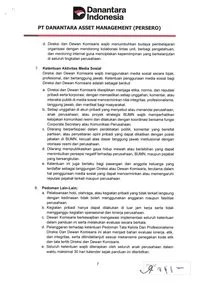
The Badan Pengelola Investasi Daya Anagata Nusantara (BPI Danantara) has officially introduced a rigorous framework governing the professional conduct and behavioral standards for the boards of directors and commissioners across Indonesia’s state-owned enterprises (BUMN). Formalized through circular letter SE/002/DI-DAM/DO/2025, the policy signifies a fundamental shift in the governance of state assets, aimed at curbing the perception of excessive luxury and refocusing leadership on performance, accountability, and fiscal discipline. This initiative, which became effective following its ratification on October 31, 2025, serves as a cornerstone for a broader, state-mandated transformation of human resources and corporate culture within the country’s public sector.
The new guidelines represent a significant tightening of the administrative leash. Among the most closely scrutinized provisions are those regarding the use of corporate resources for non-business purposes. The directive explicitly prohibits the use of company-funded facilities—including luxury lodging and private aviation—for personal engagements. Furthermore, the circular addresses the longstanding cultural practice of high-level business networking via golf, stipulating that such activities are strictly prohibited during working hours and must not, under any circumstances, be funded by the company budget.
A Shift Toward Institutional Professionalism
The impetus behind this directive is the government’s desire to redefine the role of BUMN executives. Chief Operating Officer of Danantara, Dony Oskaria, articulated the rationale behind these measures during a press briefing in Jakarta on October 26, 2026. He emphasized that, fundamentally, the management of BUMNs constitutes a branch of public service. As such, these individuals are expected to operate with the same degree of austerity and professional restraint as other government officials.
“We are establishing clear boundaries regarding what is permissible and what is not,” Oskaria stated. “This includes standardized protocols for air travel, the utilization of administrative assistants, and the presence of police escorts. The goal is to ensure that the management of these state-owned entities is grounded in true professionalism, rather than the entitlement often associated with executive positions in the past.”
The policy is not merely a list of prohibitions but a systemic overhaul of the "corporate culture" that has historically permeated state-owned enterprises. By mandating that all personal hobbies and leisure activities be confined to non-working hours and entirely self-funded, Danantara is attempting to decouple the status of a corporate executive from the use of public resources. This move is designed to address public concerns regarding the perceived gap between executive lifestyle and the actual performance metrics of various struggling state firms.
Chronology and Legislative Context
The introduction of this circular follows months of internal assessment by Danantara regarding the governance structure of Indonesia’s state-owned landscape. The timeline of this reform began in early 2025, as the new investment body sought to consolidate its oversight authority over BUMNs.
- Q1-Q2 2025: Initial audits of BUMN expenditure and facility usage were conducted by the Danantara oversight team. Findings indicated systemic inconsistencies in how "business development" budgets were applied to executive perks.
- August 2025: Drafts of the new Code of Conduct were circulated for review among internal stakeholders, focusing on tightening the interpretation of "official duty."
- October 31, 2025: The official issuance of circular SE/002/DI-DAM/DO/2025, marking the commencement of the new policy framework.
- October 26, 2026: Public reinforcement of these rules by Dony Oskaria, following a one-year observation period where the agency monitored the integration of these rules into existing corporate bylaws.
The year-long gap between the issuance of the policy and the recent high-profile commentary by Oskaria highlights the complexity of enforcing these changes across the diverse portfolio of Indonesian state firms, which range from energy and telecommunications to banking and infrastructure.
Economic and Ethical Implications
The implications of this policy are far-reaching. By restricting access to corporate-funded perks, the government is signaling that BUMNs must prioritize operational efficiency over executive comfort. In the context of the Indonesian economy, where state-owned enterprises contribute significantly to the national GDP and hold a dominant market share in strategic sectors, the professionalization of the C-suite is critical.

Independent governance experts suggest that the move could have several immediate effects:
- Reduction in Discretionary Spending: By curbing the use of private jets and luxury accommodations, BUMNs are expected to see a measurable reduction in general and administrative (G&A) expenses. While these individual costs may seem minor in the context of multi-trillion rupiah balance sheets, the cumulative effect of strict austerity across all BUMNs provides a cleaner fiscal image to domestic and international investors.
- Cultural Realignment: The prohibition of golf and other leisure activities during work hours is a symbolic move aimed at changing the "old boys’ network" culture that has historically influenced procurement and high-level decision-making. By forcing executives to adhere to standard office hours, the policy aims to foster a more meritocratic environment.
- Enhanced Public Accountability: As public scrutiny of state officials grows in the digital age, the strict rules regarding social media and public-facing behavior ensure that BUMN leaders remain conscious of their roles as representatives of the state.
Challenges to Implementation
Despite the clear mandates, implementation remains the primary challenge. BUMNs are complex entities, often governed by a mix of corporate law and public sector regulations. Monitoring compliance across dozens of subsidiaries and thousands of management-level employees requires robust internal audit mechanisms.
Moreover, there is the risk of "talent flight." Critics of the policy suggest that by placing stringent limitations on executive lifestyles, BUMNs may find it harder to attract high-caliber talent from the private sector, where such perks are often part of standard compensation packages. However, proponents argue that the role of a BUMN executive should be motivated by a sense of public duty and the challenge of managing national assets, rather than personal enrichment.
The inclusion of specific rules regarding "police escorts" (patwal) and administrative support is particularly noteworthy. In many instances, the use of sirens and security details for corporate executives has been a source of public frustration. By codifying the limits of these services, Danantara is effectively curbing the "power distance" that has historically existed between executives and the public they serve.
Future Outlook and Next Steps
The directive issued by Danantara is part of a larger, ongoing effort to centralize and modernize the management of state assets. Moving forward, the agency is expected to integrate these behavioral standards into the Key Performance Indicators (KPIs) of boards of directors and commissioners. Failure to adhere to these standards may soon carry consequences, ranging from administrative sanctions to the review of tenure.
As the implementation continues, the focus will likely shift from policy issuance to enforcement. Danantara has indicated that it will be conducting periodic reviews of expenditure reports to ensure that "official business" is not being used as a catch-all term for private travel or leisure.
For the Indonesian government, the success of this initiative is a litmus test for its broader goal of economic reform. If the state can effectively demonstrate that its most influential enterprises are managed with integrity, transparency, and austerity, it will likely bolster investor confidence in the country’s long-term economic stability. The era of the "lavish executive" in the Indonesian public sector appears to be coming to an end, replaced by a mandate for disciplined, professional, and accountable leadership.
The policy serves as a stark reminder to all BUMN leadership that they are stewards of national wealth. As the regulatory landscape continues to evolve, the expectation is that these firms will not only achieve financial profitability but also become benchmarks for good corporate governance within the Southeast Asian region. The transformation is, according to the current leadership, merely the first phase of a broader effort to ensure that the management of Indonesia’s state-owned enterprises is synonymous with excellence and integrity in the years to come.

