
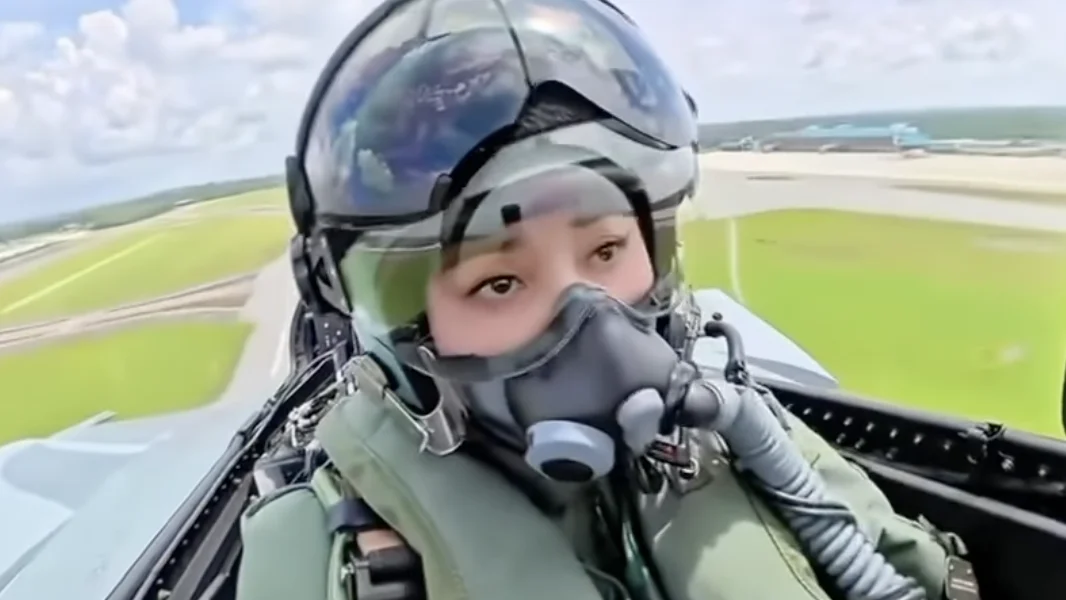
In a landmark achievement that has reverberated through both the international aviation community and global royal circles, Her Majesty Queen Suthida Bajrasudhabimalalakshana of Thailand has etched her name into the history books. On October 8, 2026, the 48-year-old monarch successfully piloted a JAS 39C Gripen multi-role fighter aircraft solo for 41 minutes, marking the first time in recorded history that a reigning queen has operated a frontline combat jet without the assistance of a co-pilot or instructor. This feat not only highlights the Queen’s technical prowess as an aviator but also underscores the evolving role of contemporary royalty in high-stakes military and technological domains.
A Historic Sortie at the Air Force Base
The flight, which took place at a Royal Thai Air Force facility, was the culmination of years of rigorous training. The JAS 39C Gripen, a sophisticated fourth-generation fighter jet developed by the Swedish aerospace company Saab, is renowned for its advanced avionics and high-speed maneuverability. Operating such an aircraft requires immense physical conditioning, spatial awareness, and cognitive agility.
According to observers present at the airbase, the Queen executed a series of maneuvers during her 41-minute sortie that demonstrated a high level of competency. Upon touching down, the Queen was greeted on the tarmac by her husband, King Maha Vajiralongkorn, in a moment that was captured by official palace photographers. The image of the Queen stepping out of the cockpit, dressed in flight gear, has since become an iconic representation of modern Thai monarchy—a blend of traditional protocol and 21st-century capability.
From Cabin Crew to Cockpit Command: A Professional Trajectory
To understand the significance of this achievement, one must examine the Queen’s unconventional path to the throne. Born Suthida Tidjai, she did not follow the typical aristocratic trajectory. Instead, her professional life began in the aviation sector, a background that arguably laid the foundation for her current expertise.
After graduating from Assumption University in Bangkok with a degree in Communication Arts, Suthida served as a flight attendant for Japan Airlines from 2000 to 2003. She subsequently joined Thai Airways International, serving in the cabin crew until 2008. These years in the airline industry provided her with a deep understanding of flight operations, safety protocols, and the mechanics of large aircraft.
Her pivot toward the military began in the mid-2000s, leading her to transition into the Royal Security Command. By 2016, she had achieved the rank of General, serving as the Deputy Commander of the Royal Security Command. Her marriage to King Maha Vajiralongkorn on May 1, 2019, and her subsequent coronation as Queen on May 4, 2019, elevated her public profile, yet she remained steadfast in her commitment to her aviation training.
Chronology of Aviation Excellence
Queen Suthida’s journey to the cockpit of a fighter jet was not an overnight endeavor. Her pursuit of flight proficiency has been consistent and methodical over the past two decades:
- 2010: Her initial interest in aviation was cemented when she began training on the Cessna T-41D, a light, single-engine aircraft used for military pilot training in Thailand.
- 2010–2026: Throughout these sixteen years, the Queen undertook numerous training modules, both domestically and abroad, to obtain various pilot licenses.
- Commercial Certification: She eventually earned her commercial pilot license, with specific kitting and certifications to operate the Boeing 737-800, a massive step up in complexity from her initial training aircraft.
- 2026 Milestone: By October 2026, palace records indicated that the Queen had accumulated over 1,188 flight hours, with over 450 hours dedicated specifically to the Boeing 737-800, reflecting her status as a serious and dedicated aviator.
- Diplomatic Piloting: Prior to her solo Gripen flight, she had demonstrated her skill in a professional capacity, notably acting as co-pilot during the King’s official state visit to Vietnam in September 2026.
Technical and Military Implications
The JAS 39C Gripen is a symbol of the Royal Thai Air Force’s (RTAF) modernization efforts. By training on and successfully piloting this specific aircraft, Queen Suthida has engaged with the same technology used to protect Thai airspace. Military analysts suggest that such involvement by a member of the Royal Family serves as a powerful morale booster for the armed forces. It signals an active, rather than symbolic, interest in the defense capabilities of the nation.
Furthermore, the Queen’s achievement acts as a bridge between the military and the civilian sectors. In a country where the monarchy holds a central position in national identity, her technical capability serves to demystify military aviation and encourage interest in STEM (Science, Technology, Engineering, and Mathematics) fields among young Thai citizens, particularly young women.
Global Reactions and Historical Precedent
While other royals have served in military roles—notably the late Queen Elizabeth II, who served as a truck driver and mechanic during World War II, and various princes who have served as combat pilots—none have reached the specific milestone of flying a modern jet fighter solo while holding the title of Queen.
International aviation circles have noted the rarity of this event. Pilots typically require years of repetitive training to maintain the "muscle memory" required for high-G maneuvers. The fact that the Queen manages these duties alongside her rigorous royal schedule is viewed as a testament to her discipline. While no official statement has been issued by the Thai government regarding the "political" nature of the flight, the move is widely interpreted as a reaffirmation of the monarchy’s strength and personal vitality.
Broader Impact: The Queen as a Modern Icon
The cultural impact of this flight within Thailand is profound. The image of the Queen as a pilot challenges traditional expectations of royal women in the region. By engaging in a discipline that is physically demanding, technically complex, and traditionally male-dominated, Queen Suthida has established herself as a forward-looking figure.
The psychological impact on the Thai public, particularly the youth, cannot be overstated. Seeing a monarch who is not only a symbol of the state but also a technically proficient pilot creates a narrative of competence and empowerment. This narrative is likely to influence national discourse on education and vocational training for years to come.
Looking Ahead
The successful flight on October 8, 2026, will likely be remembered as one of the most significant personal achievements of the Queen’s tenure. As she continues her royal duties, it is expected that her interest in aviation will remain a cornerstone of her public and private life.
For the Royal Thai Air Force, the event provides a unique opportunity to highlight its training standards and its commitment to the highest levels of proficiency. The Queen’s milestone is not merely a record-breaking event; it is a clear message that the boundaries of what is expected of a Queen are being redefined.
In conclusion, Queen Suthida’s 41-minute flight in a Gripen fighter jet stands as a historic intersection of tradition and modern capability. It is a moment that underscores a life of disciplined progression—from a flight attendant’s cabin to the cockpit of a supersonic combat aircraft. As the world watches, this achievement ensures that her legacy will be defined not just by her royal title, but by her extraordinary dedication to the skies above Thailand. Whether this will lead to further involvement in military operations remains to be seen, but one thing is certain: the Queen has secured her place as a pioneer in global aviation history.

