
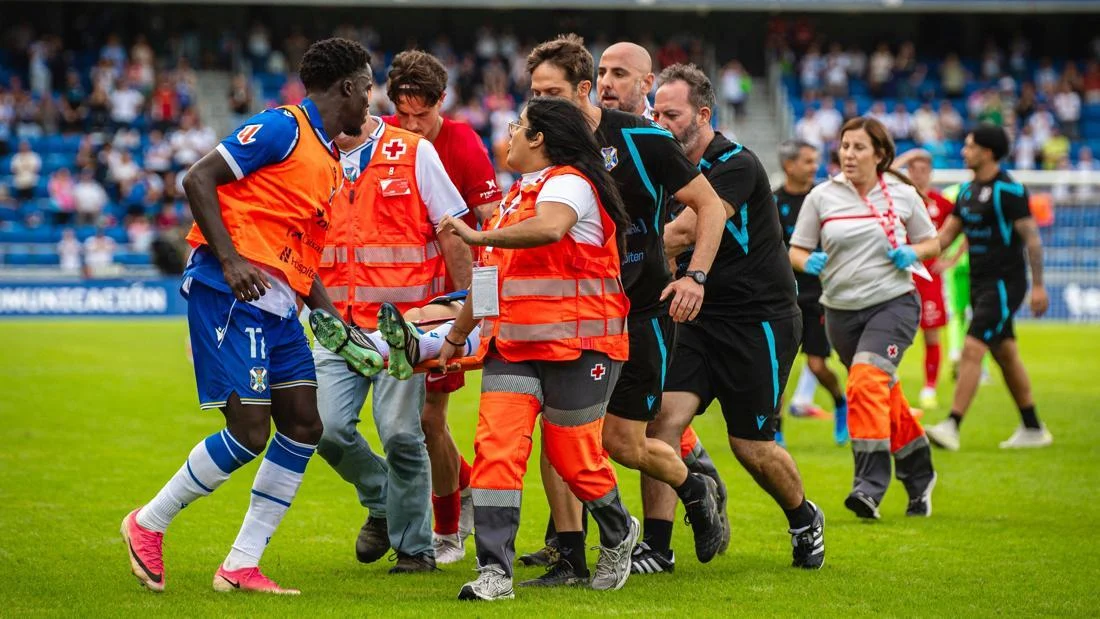
The global football community is in a state of profound mourning following the untimely and tragic death of CD Tenerife striker Jesus de Miguel. The 30-year-old professional footballer passed away after sustaining a severe impact during a Segunda División (Spanish Second Division) fixture against FC Andorra. The incident, which initially appeared to be a standard, albeit forceful, duel for the ball, rapidly deteriorated into a medical catastrophe that has once again highlighted the inherent physical risks associated with elite contact sports.
According to reports from prominent Spanish media outlets, de Miguel suffered a catastrophic cardiac event while in transit to the hospital. Despite the prompt intervention of medical personnel stationed at the stadium and within the emergency transport vehicle, attending physicians were unable to resuscitate him. This devastating event has sent shockwaves through Spanish football, prompting an outpouring of grief from teammates, opponents, sports governing bodies, and fans across Europe, while simultaneously igniting a critical medical conversation regarding the physiological impacts of blunt force trauma to the chest during high-intensity athletic competition.
The Chronology of the Incident
The tragic sequence of events unfolded during a high-stakes league match between CD Tenerife and FC Andorra. The fixture, characterized by the typical physical intensity and competitive vigor of the Spanish second tier, reached its fatal turning point during a contested play involving Jesus de Miguel and FC Andorra’s goalkeeper, Jesus Owono.
As the ball entered the penalty area, both players converged in a forceful aerial and ground duel. De Miguel suffered a severe, high-velocity blunt impact to his chest region following a direct collision with the opposing goalkeeper. Immediate on-field assessments indicated that the striker was in distress. Referee and player reactions prompted the rapid deployment of medical staff onto the pitch.
Initial first aid was administered on the turf, where medical professionals evaluated the player’s vital signs and stabilized him sufficiently to move him off the field. De Miguel was subsequently transferred to an awaiting ambulance to be rushed to the nearest medical facility for advanced trauma care. However, reports from Spanish journalism confirm that the player suffered a cardiac arrest while inside the ambulance en route to the hospital. Despite prolonged resuscitation efforts by emergency medical technicians and hospital specialists, de Miguel was pronounced dead, marking one of the most sorrowful days in modern Spanish football history.
Medical Analysis: How Blunt Force Trauma Triggers Cardiac Arrest
The sudden and fatal collapse of a conditioned, elite athlete has naturally raised complex medical questions regarding the direct correlation between physical impacts and cardiac failure. To understand how a collision can lead to such a catastrophic outcome, medical experts have turned to established cardiovascular principles.
Dr. Berlian Idris, SpJP, a prominent cardiovascular specialist and staff member at the Department of Cardiology and Vascular Medicine at the Faculty of Medicine, Universitas Indonesia – Dr. Cipto Mangunkusumo National General Hospital (FKUI – RS UI), provided crucial medical insight into the mechanics of the tragedy.
According to Dr. Berlian, severe blunt force trauma to the anterior chest wall can profoundly impact the coronary system, resulting in physiological trauma that mimics a traditional heart attack. "A hard blow to the chest can cause the coronary arteries—the blood vessels that supply blood to the heart muscle—to sustain an injury, producing an impact similar to a heart attack," Dr. Berlian explained.
From a clinical perspective, a conventional heart attack is a specific medical terminology describing a condition wherein a coronary artery becomes obstructed, starving the heart muscle of necessary oxygenated blood and potentially precipitating cardiac arrest. However, in the context of acute athletic trauma, the mechanism can extend beyond arterial obstruction.
Dr. Berlian further emphasized that high-impact collisions can trigger fatal electrical disturbances within the heart. "In addition, severe impacts can also trigger heart rhythm disorders that cause the heart to stop beating suddenly," he concluded. This phenomenon underscores the vulnerability of the human cardiovascular system, even in peak athletic specimens, when subjected to external mechanical forces of high magnitude.
Broader Context of Medical Emergencies in Football
The sudden passing of Jesus de Miguel places a glaring spotlight on the ongoing challenges of managing acute medical emergencies within professional sports. While advancements in sports science, on-field screening, and immediate trauma response have drastically improved player safety over recent decades, unpredictable physiological failures remain a persistent hazard.
In recent years, football governing bodies, including FIFA and UEFA, have heavily emphasized the deployment of advanced life support systems, mandatory defibrillators at all sanctioned matches, and rigorous training for medical staff. Protocols have been streamlined to ensure that golden-hour responses are executed within seconds of an incident.
Despite these rigorous safeguards, certain catastrophic medical events—such as those induced by severe mechanical trauma to the chest wall—present extraordinary clinical hurdles. Unlike chronic cardiac anomalies that might be detected through routine electrocardiograms (ECGs) or echocardiograms during pre-season medical evaluations, acute trauma-induced cardiac disruptions happen instantaneously, leaving little margin for error and testing the absolute limits of emergency medical infrastructure at sports venues.
Reactions and Tributes from the Football Community
In the wake of the tragedy, the footballing world has united in solidarity with CD Tenerife, the player’s family, and loved ones. CD Tenerife released an official statement expressing profound devastation over the loss of their forward, describing him as a dedicated professional, a cherished teammate, and an integral member of the club’s family.
Opposing clubs, league administrators, and fellow professionals took to social media and official communication channels to offer their condolences. FC Andorra, whose goalkeeper was involved in the accidental collision, issued a statement conveying their deepest sympathies and sorrow over the outcome of the matchday incident.
La Liga and the Royal Spanish Football Federation (RFEF) are expected to coordinate commemorative tributes, including moments of silence across upcoming fixtures in both the first and second divisions of Spanish football. Players and coaches have emphasized the emotional toll such an event takes on the dressing room, noting that the psychological well-being of the athletes who witnessed or partook in the match will require extensive support in the coming days and weeks.
Implications for Player Safety and Future Protocols
The tragic death of Jesus de Miguel is anticipated to reignite rigorous debates among sports scientists, medical committees, and football lawmakers regarding protective measures in contact sports. While outfield players and goalkeepers rely on agility and mobility, the increasing physicality, speed, and athleticism of modern football mean that accidental high-velocity collisions are an unavoidable reality of competitive play.
Discussions are likely to center on several key areas:
- Enhanced Trauma Protocols: Reviewing the speed and execution of extraction and emergency transport procedures from stadium grounds to fully equipped trauma centers.
- Advanced Diagnostic Training: Equipping pitch-side medical teams with specialized protocols to rapidly differentiate between standard concussive/musculoskeletal impacts and insidious cardiac trauma.
- Equipment Regulations: Evaluating whether modern gear or padding standards require modernization to mitigate the risk of direct, high-energy impact to the thoracic cavity, particularly for goalkeepers and players frequently engaged in aerial duels.
As the football community mourns the loss of Jesus de Miguel at the premature age of 30, his legacy will extend beyond his contributions on the pitch. This tragedy serves as a solemn reminder of the fragility of life, the intense physical sacrifices made by professional athletes, and the imperative need for continuous evolution in sports medicine and emergency safety standards across global football.

