
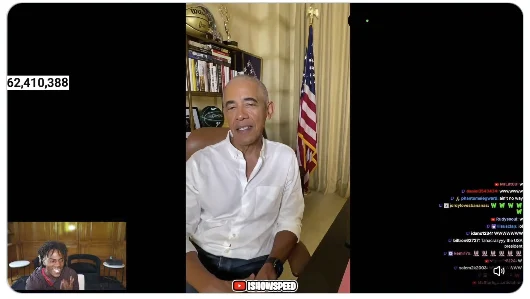
In an unexpected intersection of digital pop culture and global political legacy, American YouTuber and live-streamer IShowSpeed, born Darren Jason Watkins Jr., recently engaged in a high-profile virtual meeting with former United States President Barack Obama. The interaction, which occurred on November 16, 2026, became a viral sensation not only due to the stature of the participants but because of the streamer’s choice to converse in Indonesian—a language for which he has recently developed a strong public affinity. The exchange highlighted the evolving nature of celebrity influence and the increasing reach of Southeast Asian linguistic and cultural trends in the global digital sphere.
The virtual meeting was convened to discuss the upcoming release of the documentary project The Eyes of Ghana. The film, which explores sociocultural narratives within Ghana, is being produced by IShowSpeed, while former President Barack Obama and former First Lady Michelle Obama serve as executive producers through their media production company, Higher Ground. During the discussion, which was broadcast live to millions of viewers, the 21-year-old content creator pivoted from English to Indonesian, offering a polite greeting: "Barack Obama, apa kabar?" (Barack Obama, how are you?).
The former president, who famously spent four years of his childhood living in Jakarta, Indonesia, during the late 1960s, responded with visible surprise and immediate warmth. Acknowledging the grammatical accuracy and the natural cadence of the streamer’s delivery, Obama noted, "Baik. Dari mana kamu belajar berbicara bahasa Indonesia? Kamu bisa bahasa Indonesia!" (I am good. Where did you learn to speak Indonesian? You can speak Indonesian!). When IShowSpeed attributed his grasp of the language to his interest in Indonesian cinema, Obama offered a rare, informal compliment, stating, "Tidak buruk. Aksenmu juga tepat. Aku paham yang kamu katakan, bro" (Not bad. Your accent is also correct. I understand what you are saying, bro).
The Chronology of a Viral Cultural Exchange
The events leading up to this moment reflect a deliberate, albeit rapid, immersion into Indonesian culture by the streamer. For several months, IShowSpeed has been incorporating Indonesian phrases into his broadcasts, a trend that escalated following his high-profile visit to Jakarta, Yogyakarta, and Bali in September 2024. During that tour, the streamer drew thousands of fans to public spaces, highlighting the immense growth of his audience in the Indonesian archipelago.
The timeline of his linguistic transition reached a climax on November 12, 2026, at The Streamer Awards in Los Angeles. Upon receiving the prestigious Streamer of the Year award, Watkins bypassed the standard English acceptance speech. Instead, he delivered a heartfelt address entirely in fluent Indonesian. He told the audience, "Terima kasih banyak semuanya. Aku mulai dari nol, cuma anak kecil dengan mimpi besar. Kalian sudah bersamaku dari awal" (Thank you all very much. I started from zero, just a small kid with big dreams. You have been with me from the start). This performance, followed just four days later by his conversation with Obama, cemented the narrative that his language acquisition was not a fleeting gimmick but a sustained commitment to connecting with his international demographic.
Project Background: The Eyes of Ghana
The meeting with Barack Obama was primarily professional, focused on the distribution strategy for The Eyes of Ghana. In a move that aligns with his disruptive approach to traditional media, IShowSpeed proposed that the documentary be made available for free on his YouTube channel, rather than through restricted streaming platforms. The goal, according to the streamer, is to maximize the documentary’s accessibility to a global, youth-oriented audience.
Higher Ground, the Obamas’ production company, has consistently sought to bridge the gap between high-quality storytelling and diverse, modern distribution models. By collaborating with a digital-native creator like IShowSpeed, the Obamas are signaling an acknowledgment of the shift in media consumption patterns. By the end of the meeting, the agreement was finalized: the documentary is scheduled for a global release on IShowSpeed’s YouTube channel on November 17, 2026. This partnership represents a significant validation for the creator economy, positioning independent digital stars as viable partners for established political and social media institutions.
Linguistic and Cultural Implications
The fact that a former U.S. President engaged in an impromptu conversation in Indonesian underscores the unique position of the language on the global stage. Indonesian, or Bahasa Indonesia, is the official language of the world’s fourth-most populous nation. Its emergence in Western pop culture through figures like IShowSpeed provides a fascinating case study in soft power.
Language experts and cultural analysts note that when high-profile figures from the West engage with Indonesian, it significantly elevates the profile of the language among international youth. For Obama, the experience was a nostalgic reminder of his formative years in Jakarta. For IShowSpeed, the interaction served as a professional milestone. Following the call, the streamer expressed his disbelief to his audience, stating, "Bro, apa yang baru saja terjadi? Aku baru saja berbicara dengan Barack Obama, presiden ke-44, menggunakan bahasa Indonesia!" (Bro, what just happened? I just talked to Barack Obama, the 44th president, using Indonesian!). His exuberant reaction, which included a desire to perform a backflip, illustrates the profound impact such interactions have on the digital creator community.
The Rise of the Independent Digital Producer
The collaboration between the Obamas and IShowSpeed is indicative of a broader trend: the institutionalization of the creator economy. Historically, content creators operated on the fringes of the entertainment industry, often viewed with skepticism by legacy media. However, the success of The Eyes of Ghana project suggests that major production houses are now looking to influencers not just for their audience numbers, but for their ability to facilitate direct, unfiltered engagement.
Data from the digital media sector suggests that creators with massive, highly engaged audiences—often referred to as "community leaders"—can generate more meaningful social impact for documentary projects than traditional marketing campaigns. By utilizing IShowSpeed’s channel, the Obamas are ensuring that their educational and social narratives reach the Gen Z and Gen Alpha demographics, who are less likely to consume content through traditional television or subscription-based streaming services.
Analysis: A New Media Era
The interaction between the former President and the streamer is more than a viral clip; it is a manifestation of the digital era’s "borderless" communication. When an American YouTuber and a former American President use an Indonesian dialect as a medium of communication, it highlights how technology has effectively collapsed geographical and cultural barriers.
Furthermore, the professional success of IShowSpeed in securing a production partnership with the Obamas suggests that the barrier to entry for high-level media production is crumbling. In 2026, the value of a brand is no longer determined solely by traditional credentials, but by the ability to cultivate a loyal community and communicate across cultural divides.
As the release date for The Eyes of Ghana approaches, the industry will be watching closely to see how the audience responds to this cross-generational and cross-cultural collaboration. If successful, this model could become the blueprint for future documentary projects that aim to blend political gravitas with the reach and spontaneity of the creator economy.
In conclusion, while the interaction was brief and underscored by the charm of an unexpected linguistic display, its implications are profound. It showcases a world where the lines between political legacy and digital entertainment are increasingly blurred, and where language—specifically Indonesian, in this instance—serves as the bridge between disparate worlds. Whether this marks a permanent shift in how documentaries are distributed or merely a one-time experiment remains to be seen, but the event has undeniably set a new benchmark for what is possible in the age of global digital influence.

