
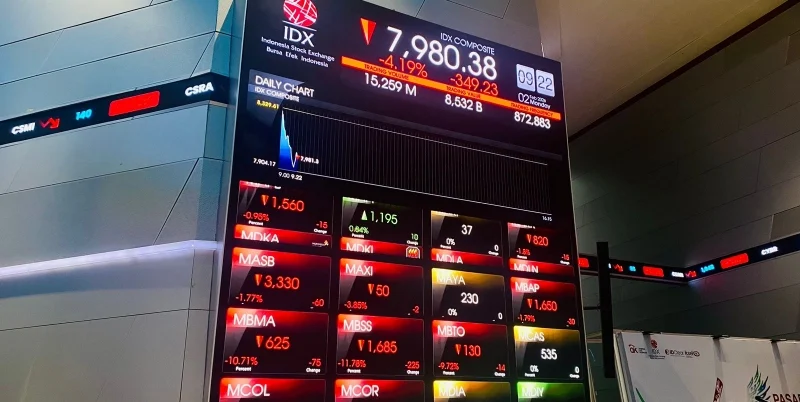
Indonesia’s financial markets presented a nuanced picture on Monday, July 20, 2026, as the benchmark Jakarta Composite Index (IHSG) closed positively, yet the national currency, the Rupiah, continued its depreciation against the US Dollar, nearing a critical psychological threshold of IDR 18,000. This divergence highlights the complex interplay of domestic resilience and persistent external pressures shaping the archipelago’s economic landscape.
Market Dynamics: A Mixed Picture
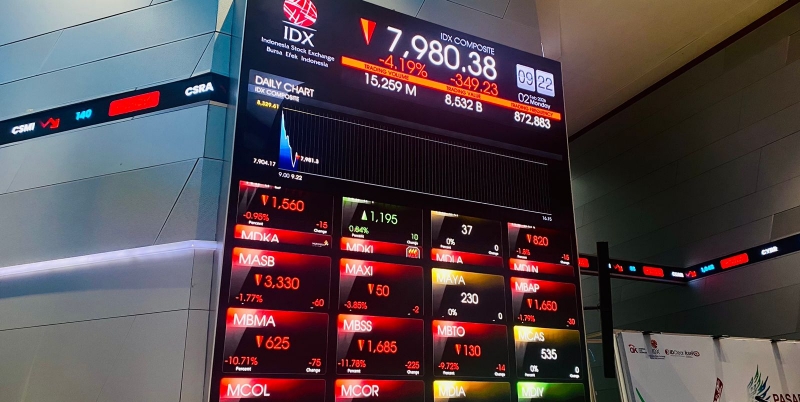
The day’s trading saw the IHSG defy broader currency headwinds, securing a gain in early week trading. The index settled at 6,231 points, marking an increase of 57.2 points or 0.91 percent from the previous trading session. This upward movement was largely driven by robust activity across several key sectors, suggesting a degree of investor confidence in specific segments of the Indonesian economy despite the prevailing currency weakness.
Indonesian Equities Defy Currency Headwinds
Throughout the trading day, the IHSG demonstrated moderate volatility, reaching an intra-day high of 6,249 points before retracing slightly to its closing level. The lowest point touched during the session was 6,191 points, indicating that while there was buying interest, profit-taking also occurred. This resilience in the equity market could be attributed to a variety of factors, including potentially strong corporate earnings reports from major listed companies, sector-specific positive catalysts, or an influx of domestic liquidity seeking opportunities amidst global uncertainties.
Trading volume on the Indonesia Stock Exchange (BEI) was substantial, with 35 billion shares changing hands, reflecting active participation from both institutional and retail investors. The total transaction value for the day amounted to IDR 16 trillion (approximately USD 1.1 billion at current exchange rates), executed across 2.3 million transactions. This high frequency of transactions underscores a dynamic market environment. Furthermore, the overall market capitalization experienced a significant surge, reaching IDR 10,860 trillion (approximately USD 735 billion), signaling an increase in the aggregate value of listed companies.
The breadth of the market’s strength was notable, with 399 stocks recording gains, outweighing the 210 stocks that experienced declines. An additional 185 stocks remained stagnant, indicating a generally positive sentiment permeating a significant portion of the market. Analysts suggested that the rally might have been concentrated in sectors perceived as defensive or those benefiting from specific commodity price movements or government infrastructure spending initiatives. For instance, large-cap banking stocks, which often serve as bellwethers for economic health, or resource-based companies benefiting from global commodity cycles, could have played a significant role in propping up the index. The performance of the IHSG, therefore, painted a picture of selective strength, underpinned by internal market dynamics that, for the moment, were able to absorb the pressure from a weakening Rupiah.
Rupiah’s Retreat: Diving Towards Critical Thresholds
While the equity market showed resilience, the Indonesian Rupiah continued its downward trajectory, concluding the day’s trading session considerably weaker against the US Dollar. According to Bloomberg data, the Rupiah closed at IDR 17,948 per US Dollar, marking a depreciation of 27 points or 0.15 percent compared to its previous close. This move brings the currency alarmingly close to the IDR 18,000 psychological barrier, a level that historically has triggered heightened concerns among policymakers and market participants.
Global and Domestic Pressures on the Garuda
The weakening of the Rupiah is not an isolated event but rather a confluence of global and domestic factors. Globally, the persistent strength of the US Dollar, driven by the US Federal Reserve’s monetary policy stance and its perceived safe-haven status amidst geopolitical uncertainties, has put significant pressure on emerging market currencies worldwide. If the US Fed had recently signaled or implemented further interest rate hikes, or if global risk aversion was high due to ongoing conflicts or economic slowdowns in major economies, capital could have flowed out of riskier assets like Indonesian bonds and equities, leading to Rupiah depreciation.
Domestically, factors such as Indonesia’s current account balance, inflation outlook, and foreign direct investment (FDI) inflows play crucial roles. A widening current account deficit, where a country imports more goods, services, and capital than it exports, typically puts downward pressure on the currency. Similarly, higher domestic inflation relative to trading partners can erode purchasing power and weaken the Rupiah. While Indonesia has generally maintained a healthy trade balance in recent years, shifts in global commodity prices or domestic demand patterns can quickly alter this equilibrium. Furthermore, any perception of reduced FDI or increased capital outflows by foreign investors, perhaps due to concerns over regulatory stability or economic growth prospects, can exacerbate currency weakness.
Chronology of the Day’s Currency Movement (Inferred): The Rupiah likely opened in a defensive posture, reflecting the previous day’s closing weakness or overnight global market movements. Throughout the morning, it might have experienced minor fluctuations, possibly reacting to local economic data releases or initial equity market movements. As European and US markets began to open and global dollar demand solidified, the Rupiah could have faced increased selling pressure, pushing it further down. Bank Indonesia, the country’s central bank, might have been active in the foreign exchange market, potentially intervening to manage excessive volatility, though such interventions are often subtle and not immediately visible in daily closing figures. The consistent downtrend towards the close suggests that fundamental pressures outweighed any short-term support mechanisms.
Official Responses and Policy Stances
The persistent pressure on the Rupiah inevitably draws attention to the responses from Indonesia’s monetary and fiscal authorities. Both Bank Indonesia (BI) and the Ministry of Finance are key stakeholders in maintaining economic stability and currency integrity.
Bank Indonesia’s Vigilance
Bank Indonesia, as the guardian of currency stability, has a clear mandate to manage inflation and maintain the Rupiah’s value. In situations of significant currency depreciation, BI typically reiterates its commitment to market stability and its readiness to intervene in the foreign exchange market to curb excessive volatility. Governor Perry Warjiyo, or his successor in 2026, would likely issue statements emphasizing BI’s data-driven approach, highlighting the robust fundamentals of the Indonesian economy, and assuring market participants that the central bank possesses adequate foreign exchange reserves to manage currency fluctuations. Any potential policy adjustments, such as changes to the benchmark interest rate (BI 7-Day Reverse Repo Rate), would be carefully considered, balancing the need to support the Rupiah against the imperative to foster economic growth and manage inflation. Analysts would be closely watching for any hawkish signals from BI that might indicate a readiness to raise interest rates to make Rupiah-denominated assets more attractive, thereby stemming capital outflows.
Fiscal Policy in Support
Concurrently, the Ministry of Finance plays a complementary role. The Minister of Finance, Sri Mulyani Indrawati, or her successor in 2026, would likely emphasize the government’s commitment to prudent fiscal management, aiming to maintain investor confidence. This could involve highlighting efforts to control the budget deficit, manage national debt sustainably, and implement structural reforms to improve Indonesia’s investment climate. A strong fiscal position provides a crucial buffer against external shocks and can reassure investors about the country’s long-term economic stability, indirectly supporting the Rupiah. Government statements might also focus on initiatives to boost exports, diversify revenue streams, and attract quality foreign direct investment, all of which contribute to improving Indonesia’s external balance and strengthening the currency over time.
Economic Implications and Forward Outlook
The continued weakening of the Rupiah, even as the stock market shows signs of strength, has several critical implications for the broader Indonesian economy and its various stakeholders.

Inflationary Pressures and Trade Balances
One of the most immediate concerns arising from a depreciating currency is its potential to fuel imported inflation. As the Rupiah weakens, the cost of imported goods, raw materials, and components increases in local currency terms. This can lead to higher production costs for domestic industries and subsequently higher prices for consumers, eroding purchasing power. Sectors heavily reliant on imports, such as manufacturing, electronics, and pharmaceuticals, would feel this impact most acutely.
Conversely, a weaker Rupiah can make Indonesian exports more competitive in international markets, potentially boosting export volumes and revenues. However, the net effect on the trade balance depends on the price elasticity of demand for Indonesian exports and imports. If Indonesia primarily exports commodities with inelastic demand and imports essential goods, the benefits of a weaker currency on exports might be offset by the higher cost of imports. For an economy like Indonesia, which is a significant exporter of commodities such as coal, palm oil, and nickel, global commodity price trends remain a crucial determinant of the trade balance, alongside currency movements.
Investor Sentiment and Capital Flows
Currency volatility can significantly influence investor sentiment, particularly among foreign portfolio investors. While a depreciating Rupiah might make Indonesian assets cheaper in dollar terms, sustained weakness or sharp declines can deter new foreign investment and even trigger capital outflows, as investors seek more stable or higher-yielding alternatives. The psychological threshold of IDR 18,000 per US Dollar is particularly important; crossing this level could trigger further panic selling and increase speculative pressure on the currency.
Foreign direct investment (FDI), which is more long-term in nature, is generally less sensitive to daily currency fluctuations but can still be impacted by perceptions of economic stability and long-term currency trajectory. The government’s efforts to streamline investment processes, provide incentives, and ensure a predictable regulatory environment become even more critical in periods of currency stress to maintain FDI inflows.
Corporate Earnings and Debt Servicing
For Indonesian corporations, a weaker Rupiah presents a mixed bag. Export-oriented companies that earn in foreign currencies but incur costs in Rupiah may see their profitability improve. Conversely, companies with significant foreign currency-denominated debt or those heavily reliant on imported raw materials will face increased debt servicing costs and higher operational expenses, potentially squeezing profit margins. Banks, while often having natural hedges through foreign currency assets and liabilities, would need to closely monitor their clients’ foreign currency exposures and assess potential increases in non-performing loans.
The Path Ahead
Looking forward, market participants will be keenly observing several key indicators and events. The future trajectory of the Rupiah will largely depend on the US Federal Reserve’s monetary policy path, global risk appetite, and Indonesia’s own economic data releases, including inflation figures, trade balance reports, and GDP growth rates. Bank Indonesia’s future monetary policy decisions, particularly any moves on interest rates or interventions in the foreign exchange market, will be crucial in shaping the currency’s outlook.
Furthermore, the government’s commitment to structural reforms aimed at enhancing productivity, improving the business climate, and strengthening domestic demand will be vital for long-term economic resilience and currency stability. While the IHSG’s performance offers a silver lining, the continued pressure on the Rupiah underscores the ongoing challenges Indonesia faces in navigating a complex global economic environment. The convergence or divergence of these two key financial indicators in the coming weeks will offer further insights into the health and direction of Indonesia’s economy.

