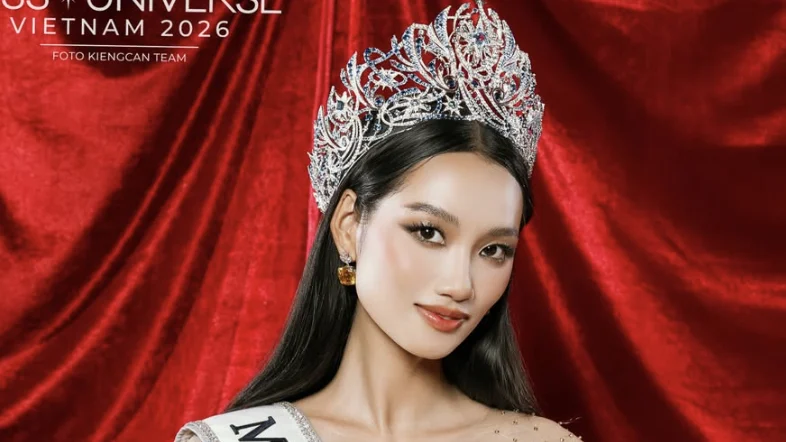
The glitz and glamour of the Vietnamese pageant circuit have been thrown into disarray following the shocking disqualification and disciplinary action taken against the newly crowned Miss Universe Vietnam 2026, Nguyen Quynh Anh. Less than a month after her coronation, the 27-year-old titleholder has been handed a six-month performance ban and significant financial penalties after internal private messages—riddled with derogatory remarks about judges, fellow contestants, and former titleholders—were leaked to the public, igniting a firestorm of controversy across Southeast Asia.
The scandal, which has sent shockwaves through the local entertainment industry, marks a significant low point for the Miss Universe Vietnam organization, an entity that prides itself on fostering empowerment, grace, and professional conduct. The incident has not only jeopardized Quynh Anh’s reign but has also raised critical questions regarding the vetting processes and the culture of conduct expected from those who represent the nation on the global stage.
The Chronology of the Scandal
The downfall of Quynh Anh began on October 27, 2026, when a series of screenshots from a private group chat surfaced on various social media platforms. These digital trails, purportedly belonging to a circle of contestants and insiders from the 2026 pageant, exposed a pattern of behavior that stood in stark contrast to the values promoted by the Miss Universe organization.
According to the leaked logs, the conversation was heavily centered on disparaging remarks directed at peers and authority figures. Notably, the messages contained targeted insults toward Nguyen Cao Ky Duyen, the winner of Miss Universe Vietnam 2024. The history between the two is long-standing; they were direct competitors in the 2024 edition, where Quynh Anh finished as the first runner-up, a loss that clearly harbored lingering resentment.
Furthermore, the leaked messages went beyond internal rivalries. They included explicit criticisms regarding the professional competency of pageant judges and invasive, mocking commentary concerning the personal life of the fourth runner-up, Trinh Hong Dang. The swift public backlash was immediate, with internet users labeling the group members as "mean girls," a term that has haunted the reputation of the organization since the leak went viral.
Disciplinary Measures and Official Responses
Upon the verification of the leaked materials, the Miss Universe Vietnam committee acted with uncharacteristic speed. Recognizing the threat to the brand’s integrity, the organization issued a formal statement confirming that the authenticity of the messages had been verified.
Quynh Anh was issued a six-month ban from performing or appearing in any official capacity as the reigning queen. Additionally, the committee imposed a substantial fine, the exact amount of which remains undisclosed, citing a breach of the moral clause stipulated in the contestant contract.
Trinh My Anh, the first runner-up of the 2026 edition, was also implicated in the scandal. Her involvement resulted in a three-month suspension from all stage appearances and public engagements, alongside her own set of financial penalties. By punishing both the winner and the runner-up, the organization signaled a zero-tolerance policy toward workplace toxicity, regardless of the individual’s status or tenure in the pageant.
Contextual Background: The Rise and Fall of Quynh Anh
To understand the magnitude of this fall, one must look at the trajectory of Quynh Anh’s career. Long before the controversy, she was viewed as a seasoned professional in the modeling industry. Having entered the spotlight at age 19, she initially gained traction through her participation in the reality show The Face in 2019. Her career trajectory seemed to be on a steep upward climb when she secured a victory in the reality competition Supermodel Me in 2021.
By 2022, she had achieved a level of international recognition that few Vietnamese models attain, participating in the prestigious Milan Fashion Week. Her return to the pageant world in 2024 was marked by near-success, as she secured the first runner-up position. When she finally captured the crown in early October 2026, it was widely celebrated as the culmination of years of hard work. The current scandal, therefore, serves as a poignant reminder of how fragile a public image can be in the era of digital transparency.
Broader Implications for the Pageant Industry
The fallout from the Quynh Anh case extends far beyond the individuals involved. For the Vietnamese pageant industry, this is a moment of reckoning. In recent years, beauty pageants have attempted to pivot from being mere "beauty contests" to platforms for advocacy and social change. However, incidents like this suggest that the internal competitive culture often remains cutthroat and, at times, toxic.
Industry analysts note that the "mean girl" narrative is not new to the global pageant circuit. However, the digitization of these interactions—where private thoughts are permanently stored and easily leaked—has fundamentally changed the risk profile for contestants. Organizations are now under pressure to implement more rigorous psychological vetting and character-building workshops as part of their pre-pageant training programs.
Furthermore, the financial impact on sponsors cannot be understated. High-profile beauty pageants rely heavily on corporate partnerships that prioritize "brand-safe" ambassadors. When a titleholder becomes embroiled in a bullying scandal, the immediate association with negative social sentiment creates a liability that sponsors are often unwilling to bear. This pressure is likely what forced the Miss Universe Vietnam organization to act as swiftly and decisively as they did.
Ethical and Professional Standards in Modern Pageantry
The core of the issue lies in the contractual obligations of a titleholder. When a woman is crowned, she ceases to be a private individual and becomes a representative of a brand. The "moral clause" in these contracts is designed to protect that brand. By engaging in vitriolic attacks against judges—the very people who assessed her suitability for the role—Quynh Anh arguably compromised the perceived legitimacy of her own win.
Critics have pointed out that the incident highlights a disparity between the "perfect image" presented on stage and the reality of the high-pressure, competitive environment behind the scenes. This dissonance can be jarring for fans and supporters who invest emotionally in the contestants.
As the six-month suspension period begins, the organization faces a dilemma: how to restore public trust in the crown while navigating the absence of its reigning queen. Many industry insiders suggest that the committee may need to lean more heavily on the runners-up who were not involved in the controversy, or potentially restructure the 2026 tenure entirely to distance the brand from the toxicity of the leaked chats.
Conclusion
The case of Nguyen Quynh Anh serves as a cautionary tale for those in the spotlight. In an age where every private message carries the potential to become public, the distinction between one’s private life and public persona has effectively evaporated.
As the dust settles, the Miss Universe Vietnam organization remains in a state of crisis management. Whether the six-month ban will be sufficient to rehabilitate the image of the pageant remains to be seen. What is certain, however, is that this incident will serve as a foundational case study for pageant organizers worldwide regarding the necessity of vetting not just for physical beauty or runway skill, but for character, emotional intelligence, and professional maturity.
For Quynh Anh, the road to redemption will be long. A career that took seven years to build was severely damaged in less than 24 hours of leaked data. Her story is a stark reminder that in the eyes of the public and the organizations they support, the crown is not just a symbol of beauty, but a responsibility that, if mishandled, can lead to a swift and public fall from grace.