
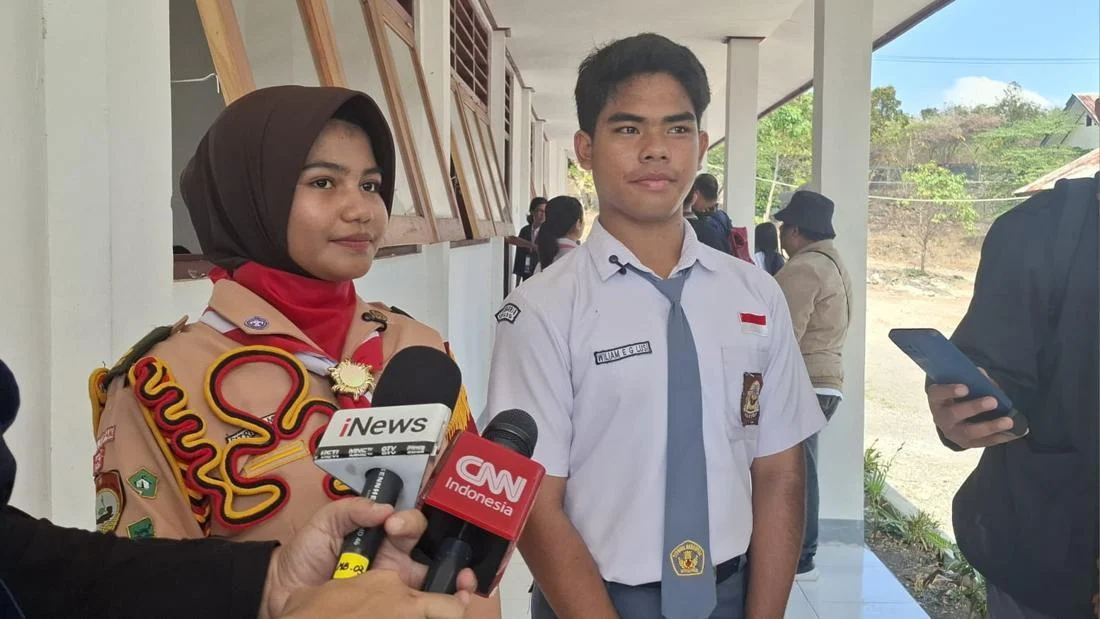
The landscape of secondary education in East Nusa Tenggara is undergoing a significant metamorphosis, as evidenced by the recent structural and pedagogical overhaul of SMAN 8 Kupang. For years, students at this institution faced the daunting reality of pursuing academic excellence within the confines of deteriorating infrastructure, characterized by fractured walls, peeling paint, and overcrowded classrooms. However, a targeted revitalization project funded by the central government has successfully transitioned the school from a state of neglect to a modern hub of learning, fundamentally altering the educational experience for hundreds of students in the provincial capital.
This transformation was the focal point of a high-level journalistic visit organized by the Ministry of Communication and Digital on Tuesday, July 21, 2026. During the site inspection, officials and media representatives observed firsthand the tangible results of a Rp 1.2 billion investment aimed at upgrading the school’s facilities. The project, which primarily focused on the construction of four new, high-specification classrooms, has not only addressed the physical shortcomings of the campus but has also served as a catalyst for improved student morale and academic focus.
The Psychological Impact of Infrastructure on Learning
The correlation between the physical environment and cognitive performance is well-documented in educational psychology, and the case of SMAN 8 Kupang serves as a poignant contemporary example. William Evan Gabriello Sosi, an 11th-grade student at the school, articulated a sentiment shared by many of his peers regarding the "glow up" of their learning environment. Before the intervention, William described a setting that was actively detrimental to the concentration of the student body. The previous classrooms were marred by structural instability, with deep cracks in the masonry and aesthetic decay that created a sense of disorder.
"The previous conditions were quite distracting," William remarked during the ministerial visit. "The walls were cracked, and the paint was constantly peeling away, creating a dusty and unkempt atmosphere. It was difficult to maintain focus when the very room you were sitting in felt like it was falling apart."
Since the completion of the revitalization, William reports a total shift in the atmosphere. The new classrooms, which he now occupies, offer a clean, vibrant, and professional setting. This physical upgrade has translated into a psychological "reset" for the students. According to William, the current environment is conducive to "ceria" (cheerfulness) and comfort, which directly correlates with his ability to absorb complex lessons. The elimination of visual clutter and structural decay has allowed the students to redirect their mental energy toward their curriculum rather than the deficiencies of their surroundings.
Addressing Overcrowding and Improving Classroom Dynamics
Beyond the aesthetic and structural improvements, the revitalization project has addressed a critical logistical hurdle: classroom density. For years, SMAN 8 Kupang struggled with a high student-to-teacher ratio that often saw more than 40 students packed into a single, poorly ventilated room. This overcrowding led to excessive noise, reduced individual attention from educators, and a general sense of claustrophobia that hindered the learning process.
Nonia, a 12th-grade student, highlighted this change as one of the most significant benefits of the new building. Under the new configuration, class sizes have been reduced to approximately 30 students per room. This 25% reduction in density has profoundly impacted the classroom climate. "It used to be so crowded that it felt suffocating, and the noise levels were often unmanageable," Nonia explained. "Now, we have the space to breathe. It is much quieter, and we can actually interact with the teachers more effectively."
The reduction in student density is a strategic move that aligns with national educational standards aimed at improving the quality of instruction. By providing more physical space per student, the school has created an environment where modern teaching methodologies, such as collaborative group work and individual presentations, can be implemented without the logistical nightmares of a cramped room.
Financial Investment and Technological Integration
The Rp 1.2 billion allocated for the revitalization of SMAN 8 Kupang represents a focused application of state funds toward regional educational equity. While the sum was primarily used for the construction of the four new classrooms, the investment also extended to the interior amenities. Each new room is equipped with ergonomic furniture, replacing the worn-out desks and chairs that had been in use for decades.
Furthermore, the introduction of interactive boards—digital touch-screen displays that replace traditional chalkboards—marks a significant leap forward in the school’s technological capabilities. These boards allow for a more dynamic and multimedia-rich teaching approach, enabling teachers to integrate internet resources, video content, and interactive software directly into their daily lessons. Syahrini Rismayanti Said, another 12th-grade student, noted that these technological additions have made learning "more fun" and engaging, bridging the gap between traditional rote learning and modern, digitally-integrated education.
The Broader Context of Educational Development in NTT
The revitalization of SMAN 8 Kupang does not exist in a vacuum but is part of a broader national strategy to elevate the Human Development Index (HDI) in East Nusa Tenggara. Historically, NTT has faced significant challenges in education due to its unique geography, economic disparities, and infrastructure gaps compared to the more developed islands of Java and Sumatra.
Data from the Ministry of Education and Culture indicates that infrastructure remains a primary barrier to educational quality in the eastern regions of Indonesia. By targeting schools like SMAN 8 Kupang, the government is attempting to ensure that students in the periphery have access to the same quality of facilities as their counterparts in metropolitan centers like Jakarta or Surabaya. This "bottom-up" approach to infrastructure development is seen as essential for achieving the "Indonesia Emas 2045" (Golden Indonesia 2045) vision, which relies heavily on the quality of the nation’s human capital.
The involvement of the Ministry of Communication and Digital in this journalistic visit also underscores the importance of digital literacy in these newly renovated spaces. As schools receive better physical infrastructure, the next logical step is the provision of robust high-speed internet and digital curriculum tools, ensuring that the "glow up" of the walls is matched by the "glow up" of the students’ digital competencies.
Chronology of the Revitalization Project
The journey toward the new SMAN 8 Kupang began several years ago when school administrators and local education authorities flagged the deteriorating condition of the campus as a high-priority concern. The proposal for revitalization underwent a rigorous vetting process at the provincial and national levels before being approved for funding under the central government’s infrastructure development program.
Construction began in the previous fiscal year, with a focus on utilizing durable materials capable of withstanding Kupang’s specific climatic conditions. The region is known for its intense heat and rocky terrain, which necessitates specific architectural considerations. The project was completed ahead of the 2026 academic cycle, allowing students like William, Nonia, and Syahrini to begin their new terms in the upgraded facilities.
The Ministry of Communication and Digital’s visit on July 21 served as a formal assessment of the project’s impact. Such visits are crucial for government transparency, allowing officials to verify that allocated funds have been used effectively and that the intended beneficiaries—the students—are experiencing the promised improvements.
Remaining Challenges and Future Requirements
While the revitalization has been hailed as a success, the students of SMAN 8 Kupang were quick to point out that the journey toward a perfect campus is not yet complete. During the visit, a recurring theme in student feedback was the presence of coral rock formations scattered across the school grounds.
Kupang is geologically dominated by limestone and coral reefs, which often protrude through the soil. At SMAN 8, these sharp, uneven rocks occupy much of the open space in front of the school, posing a safety hazard and limiting the usable area for student activities. The students expressed a collective hope that the government would provide additional support to clear these obstructions and level the ground, creating a safer and more functional outdoor environment.
Furthermore, the school currently lacks a dedicated, independent assembly hall (aula). Currently, school gatherings and large-scale events are held in spaces that must be shared with classrooms, leading to scheduling conflicts and disruptions to the academic timetable. "We really need an aula," William stated. "Right now, we have to take turns using limited space, and since that space is also used for classes, it makes everything more difficult. Having a dedicated hall would allow us to hold extracurricular activities and ceremonies without interrupting our studies."
Analytical Conclusion: A Model for Regional Development
The revitalization of SMAN 8 Kupang serves as a blueprint for how targeted, relatively modest financial investments can yield disproportionately high social and educational returns. For Rp 1.2 billion, the government has not only built four walls and a roof; it has restored the dignity of the learning process for hundreds of students.
The transition from 40-student "crowded" rooms to 30-student "breathing" rooms is a vital step toward pedagogical excellence. When students feel respected by their environment, they are more likely to respect the educational process. The "glow up" of SMAN 8 Kupang is more than a cosmetic change—it is a structural commitment to the future of East Nusa Tenggara.
As the government looks toward future projects, the feedback from the students regarding the coral rocks and the need for an assembly hall provides a clear roadmap for the next phase of development. By listening to the end-users of these facilities, policymakers can ensure that future investments are even more precisely tuned to the needs of the community. For now, SMAN 8 Kupang stands as a testament to the power of infrastructure to transform lives, proving that with the right investment, every student can have the opportunity to learn in a space that inspires rather than hinders their potential.
