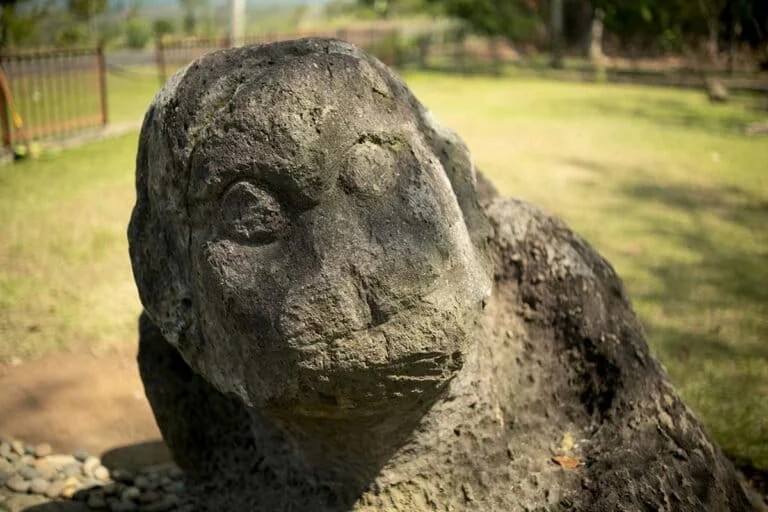
The journey to the Tinggi Hari megalithic site in Lahat Regency, South Sumatra, is an ascent through the winding roads of the Gumay highlands. As one traverses these hills, the panoramic view opens to a lush valley carved by the Liem River, a vital tributary that feeds into the mighty Lematang River. Within this verdant landscape lies a profound historical repository: a vast collection of stone carvings, menhirs, and stone mortars that stand as silent witnesses to the sophisticated Pasemah megalithic culture. This region, encompassing parts of Lahat, Pagaralam, and Empat Lawang, serves as a significant archaeological corridor that continues to challenge contemporary understandings of prehistoric Southeast Asian societies.
A Landscape Defined by Stone and Water
The Tinggi Hari complex, subdivided into three distinct sites—Tinggi Hari I, II, and III—is merely a fragment of a much larger archaeological puzzle. The Pasemah plateau is home to approximately 1,165 megalithic artifacts, including 85 intricate stone statues and 25 stone burial chambers. These relics are not scattered randomly; they are meticulously positioned within the geography of the highlands.
Mario Andramartik, a member of the Cultural Heritage Expert Team of Lahat Regency, highlights the deliberate placement of these artifacts. "The megalithic sites in the Pasemah region are predominantly located in close proximity to water sources, whether they be rivers, ponds, or lakes," Andramartik explains. This spatial distribution is far from coincidental; it underscores the fundamental reliance of prehistoric populations on hydrological systems. Water was not merely a survival necessity; it was the lifeblood of their socio-economic organization and spiritual cosmology.
Archaeologist Sondang M. Siregar of the National Research and Innovation Agency (BRIN) corroborates this, noting that the presence of rock art and engravings near riverbanks suggests a lifestyle deeply intertwined with the riparian environment. "They were clearly enjoying their lives by the riverbanks," Siregar observes, suggesting that these areas served as hubs for communal activities, artistic expression, and daily subsistence.
Harmony with the Animal Kingdom
One of the most striking features of the Pasemah megalithic tradition is the persistent depiction of fauna. The statues frequently portray human figures interacting with elephants, tigers, water buffalo, snakes, or crocodiles. These animals are captured in various states of interaction—some are positioned beside humans, while others are depicted being ridden or carried.
This artistic choice provides a rare glimpse into the ecological consciousness of the Pasemah people. The recurring motif of the tiger, in particular, suggests that these creatures held a position of reverence or symbolic power. According to Andramartik, these depictions reflect a profound state of coexistence. "This reflects and illustrates that the humans of that era possessed a highly harmonious relationship with the animals surrounding them," he notes.
Beyond the fauna, the anthropomorphic statues—some of which depict mothers cradling their children—offer insights into the social hierarchy and gender roles of the time. Siregar points out that the prominence of the mother figure signifies the essential role of women in maintaining the family unit and ensuring the continuity of future generations. These statues are widely considered by researchers to be related to ancestor worship, a cornerstone of many Austronesian and Austro-Melanesian belief systems.
Chronology and the Sriwijaya Connection
The antiquity of the Pasemah megaliths has long been a subject of scholarly debate, but recent radiocarbon dating and stratigraphic analysis have provided more precise timelines. Samples retrieved from the Kota Raya Lembak site indicate that the culture was active as recently as the 10th century CE. This timeline is particularly significant as it overlaps with the height of the Kedatuan Sriwijaya, the thalassocratic empire that dominated the Musi River basin and much of Southeast Asian maritime trade.
The coexistence of the Pasemah megalithic tradition with the early Islamic and Buddhist periods of the archipelago suggests a complex cultural layering. While the Sriwijaya empire was expanding its influence through trade and diplomacy, the people of the Pasemah highlands were continuing to honor their ancestors through the enduring medium of stone. This historical overlap challenges the traditional narrative of a sudden transition between "primitive" megalithic societies and "advanced" urbanized empires. Instead, it suggests a period of cultural continuity and interaction that is only now being fully mapped by archaeologists.
The Morphological Puzzle: Austro-Melanesian Roots
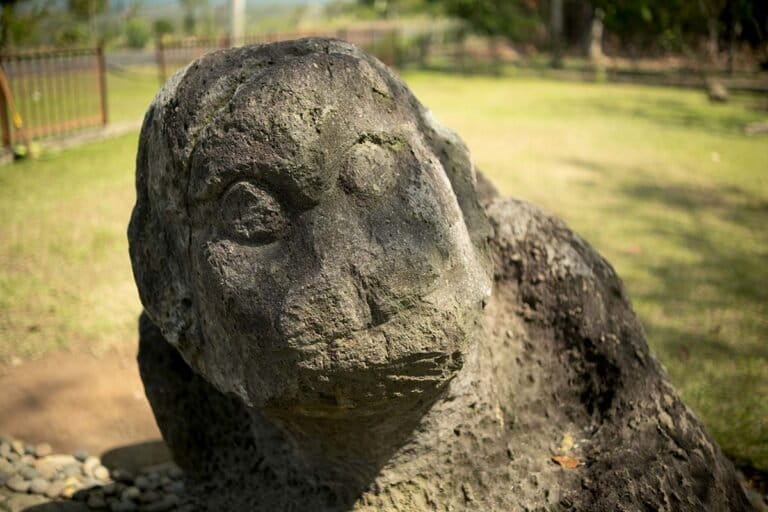
The physical characteristics of the stone figures in Pasemah provide a unique forensic record of the people who created them. Analysis of the facial features—such as round, elongated faces, curly or wavy hair, large eyes, flat noses, and thick lips—strongly indicates an Austro-Melanesian phenotype rather than the Austronesian features often associated with the later migrations that populated much of the Indonesian archipelago.
This finding suggests that the creators of the Pasemah megaliths may have been descendants of an earlier population group, or that there was a significant cultural and genetic blending within the Sumatran highlands that preserved these specific physical traits long after they had become less dominant in the coastal regions.
Challenges in Preservation and Management
Despite the immense archaeological value of the Pasemah sites, their long-term preservation remains a pressing concern. Out of 101 identified megalithic points across the region, only six have been formally designated as official cultural heritage sites. This designation disparity leaves the vast majority of these relics vulnerable to environmental degradation, illicit excavation, and the expansion of agricultural land.
The management of these sites is complicated by their remote locations and the fact that many are situated on private or communal farmland. "Protection and further research are essential," Andramartik emphasizes. "We must ensure that the knowledge embedded within these statues, stones, rivers, and the surrounding landscape remains available for future study."
The implications of failing to protect these sites are significant. Beyond the loss of historical data, the destruction of these megaliths represents the erasure of a tangible link to the environmental and spiritual history of South Sumatra. The stones are not merely static objects; they are primary sources of information regarding climate adaptation, indigenous animal management, and the evolution of social structures in tropical highland environments.
The Way Forward: Research and Sustainable Tourism
The path toward sustainable management of the Pasemah megalithic landscape involves a multi-stakeholder approach. Researchers like Sondang M. Siregar advocate for increased interdisciplinary studies that combine archaeology with geology and environmental science to better understand how the landscape itself influenced the migration and settlement patterns of the Pasemah people.
Furthermore, there is a growing consensus that the local community must be at the forefront of conservation efforts. By transforming these sites into hubs for educational tourism, the government and local stakeholders could provide a viable economic incentive for the protection of the artifacts. However, such efforts must be carefully balanced to prevent over-tourism, which could lead to physical damage of the fragile stone surfaces.
As the research continues, the Pasemah highlands stand as a testament to the resilience of human civilization. From the banks of the Liem River to the ridges of the Gumay hills, the stones continue to tell a story of a society that, centuries ago, mastered the art of living in equilibrium with their environment—a lesson that remains profoundly relevant in the face of modern ecological challenges. The preservation of these sites is not just an act of honoring the past; it is an investment in the collective memory of humanity, ensuring that the voices of the Pasemah ancestors are not lost to time.