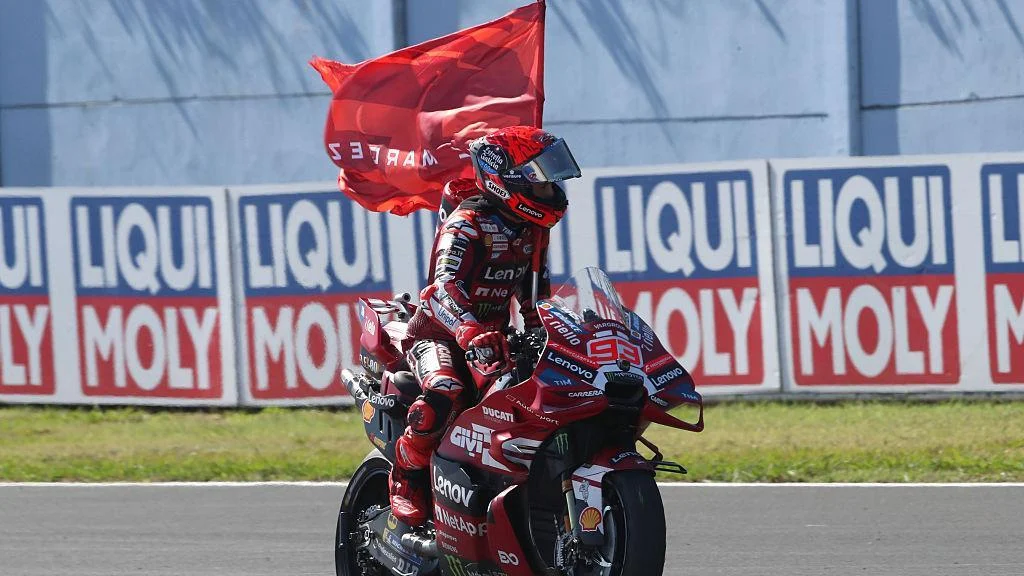
The 2026 MotoGP San Marino Grand Prix concluded this past Sunday, September 13, at the Misano World Circuit Marco Simoncelli, delivering a masterclass in tactical racing and high-stakes maneuvering. Marc Marquez, piloting the factory Ducati Lenovo, secured a hard-fought victory in a race that saw multiple championship favorites falter under the pressure of the 27-lap contest. The podium was finalized by his brother, Alex Marquez, who secured second place for BK8 Gresini Ducati, and the rising sensation Pedro Acosta, who claimed third for Red Bull KTM.
The race was defined by shifting momentum and a dramatic attrition rate, leaving the championship standings in a state of flux as the season enters its final quarter.
A High-Stakes Start and the Early Exit of Pole-Sitter Bezzecchi
The race began under immense anticipation, with Marco Bezzecchi starting from pole position, determined to capitalize on his qualifying pace. As the lights went out, Bezzecchi executed a near-perfect launch, effectively closing the door on Marc Marquez, who was lurking directly behind him. Behind the leading duo, Jorge Martin made an aggressive start, surging into third place and pushing Fermin Aldeguer back into fourth.
The tension, however, reached a boiling point early. On the 13th turn of the opening lap, the momentum shifted violently. Bezzecchi, while pushing the limits of his machine to maintain his lead, suffered a lowside crash that saw his bike slide helplessly into the gravel trap. The retirement of the pole-sitter was a significant blow to his weekend ambitions and immediately promoted Marc Marquez to the lead, with Jorge Martin slotting into second and Pedro Acosta moving into the final podium position.
The Mid-Race Duel and Tactical Shifts
As the race progressed, the field began to stretch, but the gaps remained precarious. By the third lap, a fierce battle for the third spot emerged between Alex Marquez and Pedro Acosta. Alex, showing a level of comfort with the Misano layout that would define his afternoon, successfully bypassed the KTM rider, with Fermin Aldeguer keeping the pressure on from the rear.
The race saw a major championship tremor on the sixth lap when Francesco "Pecco" Bagnaia suffered a crash, marking yet another DNF in a season that has been uncharacteristically difficult for the Italian. Bagnaia’s exit silenced the home crowd and left a void in the front-running pack.
By the seventh lap, the narrative shifted toward Jorge Martin. Utilizing a sharp line on the inside of turn four, Martin successfully overtook Marc Marquez, briefly snatching the lead. For the next several laps, the top three—Martin, Marc Marquez, and Alex Marquez—remained within a second of each other, creating a high-pressure environment where any error would prove costly.
The turning point occurred on lap 12. Marc Marquez, displaying the clinical patience for which he has become famous, initiated a maneuver on the inside of turn six, reclaiming the lead from Martin. The Ducati power began to show as the elder Marquez brother pulled away. Two laps later, Alex Marquez replicated his brother’s strategy, overtaking Martin at the same turn, effectively pushing the championship contender down to third.
Final Laps and the Closing Gap
Entering the final third of the race, the intensity did not wane, but the dynamics changed. Marc Marquez began to build a comfortable buffer, reaching a one-second lead over Alex by lap 15. Meanwhile, Jorge Martin’s pace began to deteriorate as his tires reached the end of their optimal performance window. Pedro Acosta capitalized on this, making a decisive pass on the eighth turn of the 16th lap to move into third. Fermin Aldeguer followed suit shortly after, further demoting Martin in the running order.
As the race entered the final five laps, Alex Marquez demonstrated significant pace, closing the gap to his brother from over a second down to just 0.624 seconds. The final three laps saw the younger Marquez push to within 0.3 seconds of the lead. Despite the pressure, Marc Marquez remained composed, managing his engine mapping and fuel consumption to cross the finish line first, securing a landmark win at San Marino.
Analysis: The Impact on the 2026 Championship Standings
The results at Misano have wide-reaching implications for the 2026 MotoGP World Championship. With Bagnaia and Bezzecchi failing to finish, and Jorge Martin finishing in a disappointing fifth place, the door has opened for Marc Marquez to consolidate his position at the top of the leaderboard.
Statistically, the race highlighted the current dominance of the Ducati machinery, which occupied the top two spots and had three riders in the top four. Pedro Acosta’s third-place finish serves as a reminder of KTM’s rapid development, with the young Spaniard consistently showing that he can compete with the established factory veterans.
"It was a challenging race from the start," noted a member of the Ducati paddock following the podium ceremony. "The attrition rate today shows just how hard these riders are pushing. Misano is a technical circuit that punishes even the smallest miscalculation, and we saw that with the crashes today."
Official Results and Post-Race Data
The classification for the 2026 San Marino Grand Prix reflects a mix of veteran success and emerging talent:
- Marc Marquez (Ducati Lenovo) – 27 laps
- Alex Marquez (BK8 Gresini Ducati) +0.657s
- Pedro Acosta (Red Bull KTM) +2.326s
- Fermin Aldeguer (BK8 Gresini Ducati) +6.027s
- Jorge Martin (Aprilia Racing) +14.021s
- Raul Fernandez (Trackhouse Aprilia) +18.252s
- Fabio Di Giannantonio (Pertamina VR46 Ducati) +20.581s
- Enea Bastianini (Red Bull KTM Tech3) +20.858s
- Luca Marini (Honda HRC Castrol) +22.911s
- Fabio Quartararo (Monster Yamaha) +23.229s
- Brad Binder (Red Bull KTM) +23.905s
- Toprak Razgatlioglu (Pramac Yamaha) +28.031s
- Franco Morbidelli (Pertamina VR46 Ducati) +28.927s
- Pol Espargaro (Red Bull KTM Tech3) +31.792s
The list of riders who failed to finish (DNF) includes several high-profile names, which underscores the technical volatility experienced throughout the weekend: Johann Zarco, Alex Rins, Joan Mir, Francesco Bagnaia, Jack Miller, Diogo Moreira, and Marco Bezzecchi.
Looking Ahead: The Road to the Title
As the MotoGP circus moves toward the next round, the primary focus will remain on the psychological battle between the Marquez brothers and their pursuers. For Marc, this victory is more than just a trophy; it is a statement of intent for the final races of the 2026 season.
The struggles of the Aprilia and Yamaha factory teams, evidenced by Martin’s fifth-place finish and Quartararo’s tenth, suggest that the upcoming technical developments—or lack thereof—will be the deciding factor in the championship. Teams now have limited time to analyze the data collected from the Misano circuit, which is notorious for being a high-grip track that tests chassis balance and braking stability.
The San Marino Grand Prix of 2026 will be remembered not only for the Marquez 1-2 finish but also for the high rate of attrition that rearranged the championship landscape. As teams prepare for the next race, the focus shifts to whether this result marks a permanent shift in power or if the challengers can regroup in time to mount a final, desperate charge for the title. With the gap narrowing in the points table, the remaining rounds promise to be as volatile and high-stakes as the afternoon in Misano.