
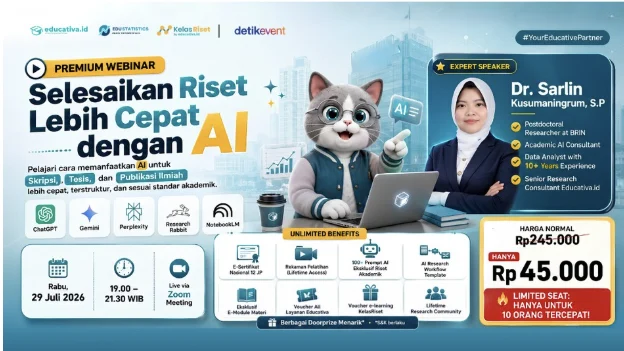
The rapid integration of Generative Artificial Intelligence (AI) into the academic landscape has fundamentally altered how students approach research, literature reviews, and thesis drafting. While these technologies offer unprecedented speed in processing vast amounts of information, they have simultaneously introduced a new set of risks that threaten the foundations of academic integrity and factual accuracy. In Jakarta and across global educational hubs, the phenomenon of AI "hallucination"—where an AI model generates plausible-sounding but entirely fabricated information—has become a primary concern for university faculties and students alike. To address these emerging challenges, a specialized webinar titled AI for Academic Research has been announced for July 2026, aiming to bridge the gap between technological efficiency and rigorous scholarly standards.
The Crisis of AI Hallucination in Higher Education
As Large Language Models (LLMs) such as ChatGPT, Gemini, and Claude become ubiquitous, the academic community has witnessed a surge in "hallucinated" citations. These occur because LLMs are designed to predict the next likely word in a sequence rather than to retrieve facts from a static database. Consequently, when asked to provide sources for a specific thesis, an AI might generate a perfectly formatted citation including a real author’s name and a realistic-sounding journal title, but the specific article or the data within it may not exist.
For graduate students working on skripsi (undergraduate theses), theses, or dissertations, the consequences of such errors are severe. A single fabricated reference can lead to allegations of academic misconduct, the rejection of a manuscript, or the revocation of a degree. The upcoming webinar focuses heavily on identifying these risks at the foundational level, teaching researchers how to verify AI-generated outputs against primary sources.
The Paradigm Shift: AI as a Research Assistant vs. Content Generator
One of the central themes of the upcoming training is the distinction between using AI as a tool for "augmentation" versus "substitution." Academic consultants observe that many students mistakenly use AI as a primary content creator, asking it to write entire chapters of their research. This approach not only bypasses the critical thinking process essential to higher education but also frequently violates university policies regarding original work.
The webinar, led by established Academic AI Consultants, will advocate for a workflow where the researcher remains the primary architect of the study. In this model, AI tools are utilized for administrative and organizational tasks—such as summarizing long-form papers, mapping connections between different authors, and identifying research gaps—while the synthesis of ideas and the final writing remain the responsibility of the human scholar. This distinction is vital for maintaining the "intellectual ownership" of the research.
Strategic Workflow and Specialized Toolsets
The 2026 webinar is structured to move beyond general-purpose chatbots and introduce students to a specialized ecosystem of academic AI tools. Each tool serves a specific niche in the research lifecycle:
- Perplexity AI: Unlike standard chatbots, Perplexity functions as a search engine that provides real-time citations for its claims, making it an essential tool for preliminary fact-checking.
- Research Rabbit: Often described as the "Spotify for Papers," this tool allows researchers to visualize the relationship between different academic works, helping them discover influential papers they might have missed through traditional keyword searches.
- NotebookLM: Developed by Google, this tool allows researchers to "ground" the AI in specific documents. By uploading their own PDF library, researchers can ensure the AI only draws information from verified sources, significantly reducing the risk of hallucination.
- ChatGPT and Gemini: While broader in scope, these tools are analyzed for their ability to refine language, suggest structural outlines, and help brainstorm research questions when guided by sophisticated prompting techniques.
Chronology of AI Adoption in Indonesian Academia
The timeline of AI integration in Indonesian universities has moved with remarkable speed. In late 2022 and early 2023, the initial reaction from many institutions was one of caution or outright prohibition. However, by 2024, the Ministry of Education, Culture, Research, and Technology began encouraging a more nuanced approach, recognizing that AI literacy is a necessary skill for the modern workforce.
By 2025, several top-tier universities in Jakarta and Yogyakarta had established "AI Integrity Task Forces" to draft guidelines for the ethical use of LLMs in research. The scheduled webinar on July 29, 2026, represents the next phase of this evolution: the move toward standardized professional training. As the academic year progresses, students are no longer asking if they should use AI, but how to use it without compromising their academic standing.
Supporting Data: The Impact of AI on Research Productivity
Recent surveys conducted among postgraduate students in Southeast Asia indicate that the proper application of AI tools can reduce the time spent on literature reviews by up to 40%. However, the same data suggests that students without formal training in "prompt engineering" spend 30% more time correcting errors and hallucinations than those who have undergone structured workshops.
Furthermore, a 2025 study on academic publishing noted a 15% increase in the submission of papers containing AI-generated artifacts that were caught during the peer-review process. This data underscores the urgent need for programs that teach researchers how to maintain "human-in-the-loop" oversight. The webinar aims to address these statistics by providing a clear framework for accountability.
Expert Perspectives on Academic Integrity
Academic consultants scheduled to speak at the event emphasize that the "black box" nature of AI is its greatest weakness in a research context. "A researcher must be able to defend every sentence in their thesis," says one prospective speaker. "If a student cannot explain how a conclusion was reached because an AI generated it, they have failed the fundamental test of scholarship."
The consensus among educational technologists is that the future of research lies in "Cyborg Research"—a collaborative effort where the AI handles the heavy lifting of data sorting and the human handles the nuance, ethics, and original contribution to the field. The webinar is designed to be a practical roadmap for achieving this balance.
Event Logistics and Registration Details
The webinar, titled "Selesaikan Riset Lebih Cepat dengan AI" (Complete Research Faster with AI), is scheduled to take place on Wednesday, July 29, 2026. The session will run from 19:00 to 21:30 WIB, utilizing the Zoom platform to allow for nationwide participation.
The organizers have implemented a tiered pricing structure to ensure accessibility for the student population. An early bird rate of Rp45,000 is available for those who register before the deadline of July 28, 2026, at 23:30 WIB. Registration is handled through the official detikEvent portal, providing a streamlined process for participants to secure their spots.
Broader Implications for the Future of Scholarship
The shift toward AI-assisted research has implications that extend far beyond the classroom. As these tools become more sophisticated, the very definition of "original research" may undergo a transformation. If an AI can identify a research gap by analyzing 10,000 papers in seconds—a task that would take a human months—the value of a researcher will increasingly lie in their ability to design creative experiments and interpret complex results within a socio-ethical framework.
The 2026 webinar serves as a critical intervention in this transition. By teaching students the technical skills to avoid hallucinations and the ethical framework to maintain integrity, the program ensures that the next generation of Indonesian scholars is equipped to compete on a global stage. As academic journals implement more rigorous AI-detection protocols, the ability to use these tools transparently and accurately will become a prerequisite for professional success in any scientific or humanities-based discipline.
In conclusion, while the threat of AI hallucinations and the erosion of academic rigor are significant, they are not insurmountable. Through structured education and the adoption of specialized research workflows, the academic community can harness the power of artificial intelligence to enhance, rather than replace, human intellect. The upcoming webinar represents a proactive step in fostering a culture of responsible innovation within the Indonesian research ecosystem, ensuring that the speed of AI is always matched by the precision of the human mind.

