
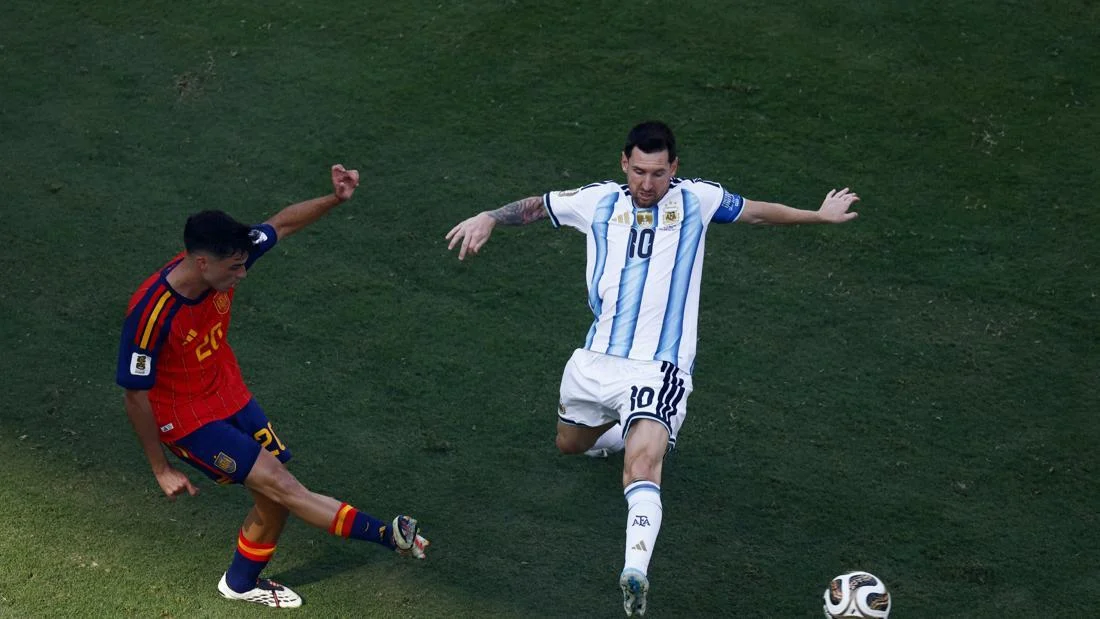
East Rutherford, NJ – The culmination of the 2026 FIFA World Cup, a highly anticipated clash between Spain and Argentina, has been forced into extra time after a tense 90 minutes of regulation play concluded with a goalless draw at the New Jersey Stadium. The iconic trophy remains undecided as both European and South American giants prepare for a grueling additional 30 minutes of play, a testament to the defensive resolve and tactical discipline displayed by both nations. The match, held on Monday, July 20, 2026, under the bright lights of the Garden State, has thus far been a masterclass in strategic maneuvering, with neither side able to breach the other’s formidable backline.
A Tactical Chess Match Unfolds
From the opening whistle, Spain asserted a clear dominance in possession, dictating the tempo and forcing Argentina into a largely defensive posture. La Furia Roja, known for their intricate passing networks and possession-based football, attempted to weave their way through the Albiceleste’s organized ranks. Argentina, however, proved resilient, employing a robust physical approach, frequently disrupting Spain’s rhythm with well-timed tackles and aggressive marking. Several Spanish players found themselves on the receiving end of strong challenges, highlighting the intensity and stakes of the final.
Early Encounters and Missed Opportunities
Spain’s initial breakthrough came tantalizingly close in the fifth minute. Young sensation Lamine Yamal, showcasing the flair that has defined his meteoric rise, orchestrated a slick one-two passing sequence with Dani Olmo. Yamal’s subsequent shot, aimed at the bottom corner, forced a sharp save from Argentine goalkeeper Emiliano Martínez, who demonstrated his early readiness to be a pivotal figure in the match.
Following this initial flurry, the game settled into a more measured pace. Neither team managed to carve out significant scoring opportunities for an extended period. The midfield battle was fierce, with possession changing hands frequently, but clear-cut chances remained elusive. The tactical ebb and flow suggested a game that would be decided by a moment of individual brilliance or a defensive lapse.
The next notable chance arrived in the 38th minute. Spain constructed a patient build-up from the left flank, with the ball eventually finding its way to Mikel Oyarzabal positioned just outside the penalty area. The forward struck a first-time left-footed shot, but it was straight at Martínez, who comfortably gathered it.
Defensive Setbacks and Rising Tensions
The physical nature of the encounter was underscored by the game’s first yellow card, issued to Argentine defender Lisandro Martínez in the 40th minute for a foul on Oyarzabal in the opposition half. The tension in the stadium was palpable as both teams navigated the high-stakes environment.
Just moments later, Argentina suffered a significant blow. In the 43rd minute, their key defender, Lisandro Martínez, was forced to leave the field due to a thigh injury. His departure necessitated a tactical reshuffling by the Argentine coaching staff, with Nicolás Otamendi coming on to shore up the defense. This forced substitution marked a crucial turning point in the defensive dynamics of the match.
Despite these disruptions, the first half concluded without a breakthrough, the scoreboard remaining stubbornly at 0-0. Both teams entered the halftime interval with much to ponder, the tactical battle lines drawn, and the dream of World Cup glory still very much alive for both nations.
Second Half: Increased Urgency and Near Misses
The second half saw Spain continue their statistical dominance, controlling possession and probing the Argentine defense. Argentina, in turn, sought to inject more dynamism into their play through strategic substitutions. Otamendi, the experienced defender, immediately went to work, diligently intercepting Spanish passes aimed at their forward line. Similarly, Gonzalo Montiel was seen making crucial defensive interventions, notably thwarting a dangerous advance from Marc Cucurella.
Spain came agonizingly close to breaking the deadlock in the 64th minute. Dani Olmo found himself in a promising position just outside the penalty area. With time and space, he unleashed a shot, but it lacked the necessary power and was easily saved by Martínez.
A golden opportunity fell to Ferran Torres in the 67th minute. Lamine Yamal delivered a pinpoint cross, and Torres met it with a header. However, his effort was expertly parried away by the vigilant Martínez, who was proving to be Argentina’s last line of defense.
Recognizing the need to increase their attacking threat, Spain introduced fresh legs in the 75th minute, bringing on Nico Williams and Mikel Merino. This tactical change aimed to inject more pace and creativity into their forward line.
The double substitution seemed to spur Spain on, as they created two rapid-fire chances. In the 77th minute, Pedri’s shot was saved by Martínez. Two minutes later, Pau Cubarsi unleashed a shot from a tight angle, forcing another spectacular diving save from the Argentine keeper, resulting in a corner.
Spain’s relentless pressure continued. In the 80th minute, Aymeric Laporte met a cross from Pedri with a header, but the effort lacked conviction and was comfortably collected by Martínez.
Late Drama and Extra Time Beckons
As regulation time wound down, Spain intensified their offensive efforts, desperately seeking a decisive goal. Nico Williams tested Martínez again in the 93rd minute with a shot that was parried away.
The closing moments of regulation time were marred by further drama. In the 94th minute, Enzo Fernández of Argentina received his second yellow card for a reckless challenge on Cubarsi, resulting in his expulsion from the match. Argentina were reduced to ten men, a significant disadvantage heading into the potential extra time period.
In the dying seconds of injury time, Lamine Yamal nearly snatched victory for Spain. A direct free-kick from the edge of the penalty area required another acrobatic save from Emiliano Martínez, who tipped the ball over the bar. This final, dramatic intervention ensured that the score remained 0-0, pushing the World Cup final into the grueling spectacle of extra time.
The Road to the Final: A Tale of Two Nations
Spain’s Journey: Spain’s path to the final has been characterized by a blend of youthful exuberance and experienced composure. Under the guidance of their astute manager, they navigated the group stages with efficiency, showcasing their trademark possession-based football. Their knockout stage encounters saw them overcome resilient opponents through disciplined defensive displays and clinical finishing when opportunities arose. Their progression was a testament to their tactical flexibility and the emergence of new stars like Lamine Yamal, who has captured the world’s attention with his dazzling performances. Their ability to control the midfield and create intricate passing triangles has been a hallmark of their campaign.
Argentina’s Resilience: Argentina, on the other hand, has relied on a potent combination of veteran leadership, particularly from Lionel Messi, and a steely determination. Their journey has been marked by passionate performances and a never-say-die attitude. They navigated challenging group fixtures and demonstrated their ability to grind out results in the knockout stages. Their defense, anchored by experienced campaigners, has been a crucial element of their success, often absorbing pressure and launching swift counter-attacks. The midfield, marshaled by the likes of Enzo Fernández and Alexis Mac Allister, has provided a crucial engine for their team.
Historical Context and Statistical Insights
The FIFA World Cup final is the pinnacle of international football, a tournament that captures the imagination of billions worldwide. This year’s final, pitting two of football’s traditional powerhouses against each other, was anticipated to be a tactical masterpiece. The 2026 edition, hosted across North America, has seen an expanded format, bringing new dynamics to the competition.
Statistically, Spain has historically enjoyed a strong record in possession-based metrics throughout the tournament. Their ability to retain the ball and dictate play has been a consistent feature. Argentina, while perhaps not always dominating possession, has often been more direct in their attacking approach, relying on moments of individual brilliance and effective counter-attacks.
In terms of defensive solidity, both teams have demonstrated remarkable discipline. Spain’s backline, often marshaled by experienced defenders, has been difficult to penetrate. Argentina’s defense, though tested, has shown grit and resilience, particularly in crucial moments. Emiliano Martínez, Argentina’s goalkeeper, has a reputation for his penalty-saving prowess and has once again proven to be a vital asset for his team in this final.
The Significance of Extra Time
The introduction of extra time in a World Cup final adds an immense layer of pressure and physical demand. Players are pushed to their absolute limits, and the mental fortitude of each individual becomes paramount. Fatigue can lead to mistakes, and it is often in these grueling periods that heroes are made. The tactical approach in extra time can shift dramatically, with teams perhaps adopting a more cautious approach or taking greater risks to secure victory.
The physical toll of a full 90 minutes, coupled with the emotional intensity of a World Cup final, means that any remaining energy reserves will be called upon. The tactical substitutions made by both managers in the closing stages of regulation time will now be crucial in determining which side has the fresher legs and the greater capacity to perform under extreme duress.
Expert Analysis and Predicted Scenarios
Pre-match analyses often highlighted the contrasting styles of Spain and Argentina. Spain’s possession-based game, while aesthetically pleasing, could be vulnerable to swift counter-attacks if their midfield press is bypassed. Argentina’s more direct approach, coupled with the individual brilliance of players like Messi, posed a constant threat.
The defensive solidity displayed by both teams has surprised some analysts, who expected a more open and high-scoring affair. The effectiveness of the respective defensive strategies has neutralized the attacking threats for the most part.
In extra time, the reduced number of players for Argentina due to Fernández’s red card will undoubtedly play a significant role. Spain will likely seek to exploit the numerical advantage, stretching the Argentine defense and creating more space for their attackers. However, Argentina’s renowned fighting spirit and the potential for individual brilliance from players like Messi could still pose a threat on the counter-attack. Penalty shootouts, a scenario that looms large after a goalless draw, are notoriously unpredictable and often come down to nerve and luck.
Broader Implications and Fan Reactions
The World Cup final is more than just a sporting event; it is a global spectacle that unites nations and ignites passions. The outcome of this match will have far-reaching implications, not only for the players and their respective federations but also for the millions of fans who have supported their teams throughout the tournament.
The tension and anticipation surrounding this final have been immense. Fans across Spain and Argentina, and indeed around the world, have been glued to their screens, experiencing a rollercoaster of emotions. The goalless draw, while perhaps frustrating for some seeking immediate excitement, has only amplified the drama and anticipation for the extra time period. The eventual victor will etch their name into football history, becoming the champions of the 2026 FIFA World Cup. The ongoing stalemate sets the stage for a truly memorable conclusion to the tournament, regardless of the final outcome.
Susunan pemain (Starting Lineups):
Spain: Unai Simon; Marc Cucurella, Aymeric Laporte, Pau Cubarsi, Pedro Porro; Fabian Ruiz (Pedri 62′), Rodri; Alex Baena (Nico Williams 75′), Dani Olmo (Mikel Merino 75′), Lamine Yamal; Mikel Oyarzabal (Ferran Torres 62′).
Argentina: Emiliano Martinez; Nicolas Tagliafico, Lisandro Martinez (Nicolas Otamendi 43′), Cristian Romero (Facundo Medina 70′), Gonzalo Montiel (Nahuel Molina 58′); Nico Gonzalez (Leandro Paredes 46′), Enzo Fernandez, Alexis Mac Allister, Rodrigo De Paul (Giuliano Simeone 70′); Julian Alvarez, Lionel Messi.

