
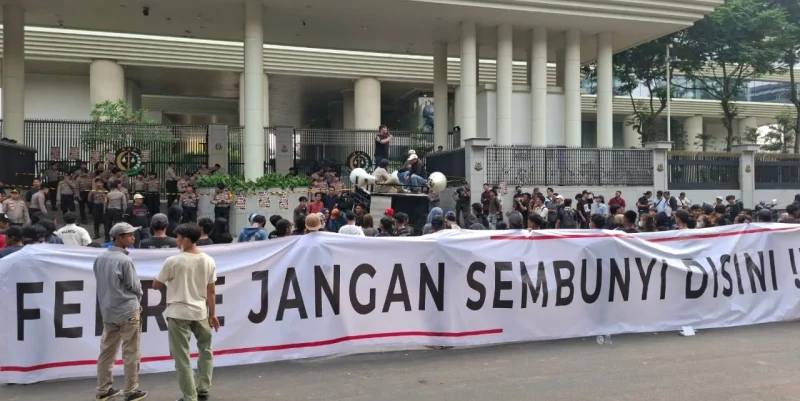
A demonstration by the National Legal Intellectual Network (Jaringan Intelektual Hukum Nasional) outside the Attorney General’s Office (Kejagung) in South Jakarta on Wednesday, July 22, 2026, escalated into clashes with police as protestors vehemently demanded the immediate arrest of former Deputy Attorney General for Special Crimes (Jampidsus), Febrie Adriansyah, implicated in a high-profile corruption scandal. The incident, marked by attempts to block public roads and burn tires, underscores the growing public frustration with perceived selective justice and the imperative for transparency in Indonesia’s fight against corruption.
Background to the Allegations and the Role of Jampidsus
The Attorney General’s Office (Kejagung) is a cornerstone of Indonesia’s legal system, responsible for prosecuting criminal cases, including those involving corruption, at the national level. Within the Kejagung, the Deputy Attorney General for Special Crimes (Jampidsus) holds a particularly critical role. This division is tasked with investigating and prosecuting complex, high-impact corruption cases that often involve significant state losses or impact public trust. Historically, the Jampidsus office has been at the forefront of tackling grand corruption schemes, from embezzlement in state-owned enterprises to large-scale bribery in public procurement.
Febrie Adriansyah, as a former Jampidsus, occupied one of the most powerful and sensitive positions within Indonesia’s anti-corruption apparatus. His past role meant he was responsible for leading investigations into powerful individuals and intricate financial crimes. Therefore, allegations of corruption against someone who previously held such a position are particularly damaging to the integrity of the justice system and can severely erode public confidence.
While specific details of the alleged corruption case involving Adriansyah remain officially under wraps, reports suggest it pertains to irregularities during his tenure, potentially linked to a massive infrastructure project or a major resource extraction scheme that resulted in substantial state financial losses. Such cases typically involve complex financial transactions, illicit enrichment, and abuse of authority, often requiring extensive forensic accounting and cross-border cooperation to uncover. The Jaringan Intelektual Hukum Nasional, a prominent civil society group advocating for legal reform and anti-corruption, has been vocal in demanding swift and decisive action from the Kejagung, arguing that any delay or perceived favoritism would undermine the very principles of justice.
The Day of Discontent: A Chronology of the Protest
The protest on July 22, 2026, began peacefully, with members of the Jaringan Intelektual Hukum Nasional gathering outside the imposing Gedung Utama Kejaksaan Agung building on Jalan Panglima Polim, Kebayoran Baru, South Jakarta. The demonstrators, a mix of students, legal activists, and concerned citizens, initially unfurled banners and chanted slogans demanding accountability. Their primary message was clear: "Hukum tidak boleh tumpul" (The law must not be blunt), a common refrain in Indonesia to express dissatisfaction with perceived selective enforcement of justice, particularly against powerful figures.
Riswan Siahaan, Director of the Jaringan Intelektual Hukum Nasional, addressed the crowd, articulating the group’s core demands. "We urge the Attorney General’s Office to immediately apprehend former Jampidsus Febrie Adriansyah who is embroiled in this corruption case," Siahaan stated emphatically. He further pressed for an uncompromising commitment to transparency: "Our hope is that law enforcement will move decisively and openly. We, the public, expect the anti-corruption apparatus today to act so that we can believe, so that the people can believe, that the law still exists." These statements underscored a deep-seated public yearning for a justice system that treats all citizens equally, regardless of their past position or influence.
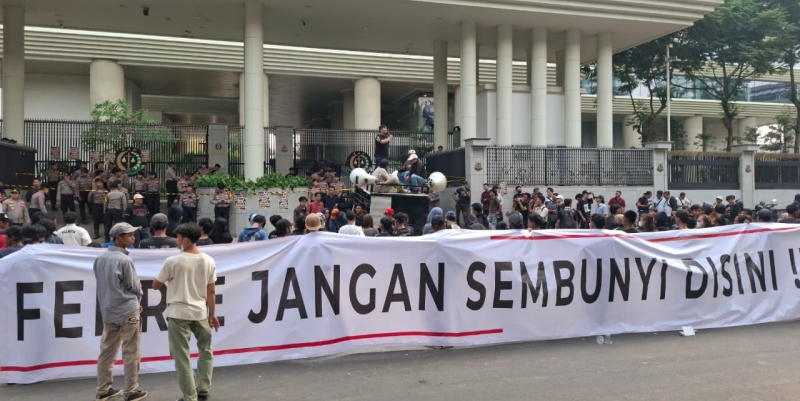
As the morning progressed, the atmosphere outside the Kejagung grew increasingly tense. Frustrated by what they perceived as a lack of immediate response or official acknowledgement, a segment of the protestors attempted to escalate their demonstration. They moved to block a section of Jalan Panglima Polim, a major arterial road, disrupting traffic flow. In a further act of defiance, some demonstrators began preparing to burn tires, a symbolic act often used in protests to signify extreme discontent and to draw wider attention.
This escalation prompted a swift response from the Jakarta Metropolitan Police (Polda Metro Jaya) officers who were already deployed to secure the area. The police contingent, primarily focused on maintaining public order and ensuring the smooth flow of traffic, moved to prevent the road blockade and extinguish any attempts to ignite fires. In the ensuing confrontation, a banner prominently displayed by the protestors, emblazoned with the stark message "Febrie Jangan Sembunyi Disini!!" (Febrie Don’t Hide Here!!), became a focal point of contention. Police officers, citing safety concerns and the need to prevent provocative acts, moved to confiscate the banner.
The attempt to seize the banner ignited a physical altercation. Protestors resisted, leading to a brief but intense shoving match between the demonstrators and the police. The scene, captured by various media outlets, showed a chaotic scramble as both sides vied for control, with the banner ultimately being pulled down by the authorities. Fortunately, the scuffle was short-lived, and no major injuries were reported, with both sides eventually disengaging. While the immediate confrontation subsided, the incident served as a powerful visual representation of the friction between public demands for justice and the state’s efforts to manage dissent.
Broader Context: Corruption in Indonesia and Public Trust
Indonesia has long grappled with the pervasive issue of corruption, which has historically plagued various sectors of government and business. Despite significant strides made in establishing anti-corruption institutions like the Corruption Eradication Commission (KPK) and strengthening the capabilities of the Attorney General’s Office, the fight remains an uphill battle. Public trust in law enforcement and judicial institutions is often volatile, heavily influenced by the outcomes of high-profile cases, particularly those involving powerful elites.
Data from Transparency International’s Corruption Perception Index (CPI) consistently shows Indonesia making slow but steady progress, yet still facing considerable challenges. Perceptions of corruption can significantly impact foreign investment, economic growth, and the overall quality of governance. When high-ranking officials, especially those tasked with fighting corruption, are themselves implicated, it sends a chilling message that can undermine years of anti-corruption efforts. Surveys conducted by independent research bodies (e.g., hypothetical surveys by institutions like Lembaga Survei Indonesia or Center for Strategic and International Studies, if real data were available) often indicate that public confidence in the legal system fluctuates, with a significant portion of the populace believing that powerful individuals are often exempt from the full force of the law.
The Jampidsus position, in particular, carries immense symbolic weight. An allegation against a former occupant of this office is not merely an individual case but a test of the entire anti-corruption framework. It challenges the notion that the system can truly police itself and hold its own accountable. The public’s demand for transparency and swift action, as voiced by Riswan Siahaan, is rooted in a desire to see tangible proof that "the law is not blunt" and that justice is truly blind. This sentiment is amplified by social media, where news of such cases spreads rapidly, fueling public debate and demands for accountability.
Official Responses and Institutional Challenges
Following the protest, the Attorney General’s Office faced renewed pressure to address the allegations against Febrie Adriansyah publicly and to provide updates on the investigation. While official statements are typically cautious to avoid prejudicing ongoing legal processes, the public nature of the protest necessitated a response. A hypothetical spokesperson for the Kejagung might have issued a statement reaffirming the institution’s unwavering commitment to upholding the rule of law and ensuring full transparency in all ongoing investigations, including the case involving Mr. Febrie Adriansyah. Such a statement would likely emphasize that "no individual is above the law, and due process will be meticulously followed to ensure justice is served. We urge all parties to allow legal processes to unfold without interference and to respect the authority of law enforcement."

From the perspective of law enforcement, the Jakarta Metropolitan Police would likely have emphasized their role in maintaining public order. A hypothetical police spokesperson might have stated, "Our primary objective was to maintain public order and ensure the safety of both protestors and commuters. While we respect the right to peaceful assembly, any attempts to disrupt public infrastructure or endanger individuals will be met with appropriate action to prevent escalation and ensure the rights of all citizens are protected." This highlights the delicate balance police must strike between facilitating freedom of expression and ensuring public safety and order.
The incident also presents significant institutional challenges for the Kejagung. Firstly, it must demonstrate its capacity to impartially investigate and prosecute one of its own former high-ranking officials, thereby reinforcing its credibility. Secondly, it needs to manage public perception effectively, communicating progress and maintaining transparency without compromising the integrity of the investigation. The pressure from civil society groups like the Jaringan Intelektual Hukum Nasional serves as a constant reminder that the public is keenly watching and expects genuine accountability. Failure to address these concerns robustly could further erode public trust and invite more widespread dissent.
Implications and Future Outlook
The chaotic protest at the Attorney General’s Office, fueled by demands for Febrie Adriansyah’s arrest, carries several significant implications for Indonesia’s legal landscape and political climate.
Firstly, it underscores the persistent and vital role of civil society organizations in advocating for good governance and fighting corruption. Groups like the Jaringan Intelektual Hukum Nasional act as crucial watchdogs, holding state institutions accountable and channeling public frustration into organized demands for reform. Their ability to mobilize and draw media attention ensures that high-profile corruption cases remain in the public consciousness, preventing them from being quietly shelved.
Secondly, the incident serves as a critical test for the Attorney General’s Office. How it handles the allegations against Febrie Adriansyah will profoundly impact its institutional reputation and the broader public’s faith in the justice system. A robust, transparent, and impartial investigation, leading to appropriate legal action if guilt is established, could help restore confidence. Conversely, any perception of stonewalling, delays, or a lenient approach could exacerbate public cynicism and fuel further anti-establishment sentiment. This is especially pertinent in an era where social media amplifies public scrutiny and allows for rapid dissemination of information and opinion.
Thirdly, the confrontation between protestors and police highlights the perennial tension between the right to peaceful assembly and the state’s responsibility to maintain public order. While authorities must protect critical infrastructure and prevent violence, they also have a duty to facilitate legitimate expressions of dissent. The brief scuffle and the confiscation of the banner, though quickly de-escalated, serve as a reminder of the fine line law enforcement must tread in managing such volatile situations.
Finally, the case against Febrie Adriansyah, a former Jampidsus, resonates far beyond the immediate legal proceedings. It sends a powerful message about the principle that no one, regardless of their past position or influence, is above the law. Upholding this principle is fundamental to strengthening the rule of law, fostering a culture of integrity, and ultimately building a more just and equitable society in Indonesia. The outcome of this case will undoubtedly be closely watched, not just by legal experts and civil society activists, but by the general public who continue to hope for a legal system that truly serves all. The events of July 22, 2026, serve as a potent reminder that the fight against corruption is not merely a legal battle, but a continuous struggle for public trust and accountability.

