
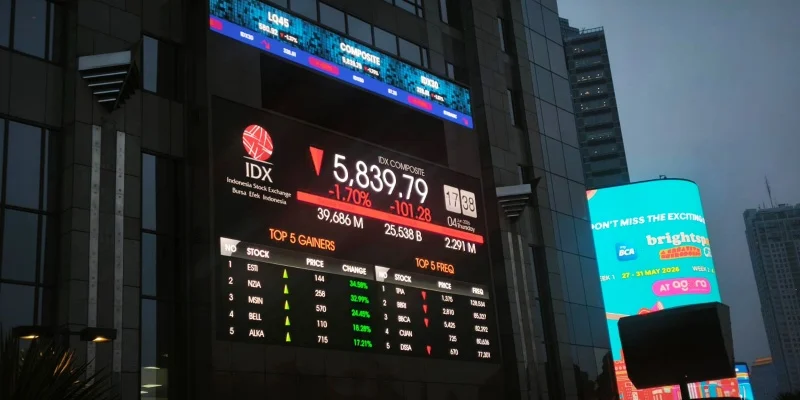
Both the Jakarta Composite Index (IHSG) and the Indonesian Rupiah concluded trading on Wednesday, July 21, 2026, firmly in negative territory, signaling a day of widespread selling pressure across the nation’s financial markets. The downturn reflected a complex interplay of domestic factors and prevailing global economic anxieties that prompted investors to adopt a more cautious stance. The session saw the benchmark stock index retreat from earlier gains, while the national currency continued its gradual weakening against the U.S. Dollar, adding to concerns about inflationary pressures and capital outflows.
Market Snapshot: A Deeper Dive into IHSG Performance
The Jakarta Composite Index, a key barometer of Indonesia’s economic health and corporate performance, closed at 6,315, marking a decline of 19.1 points or 0.30 percent compared to the previous trading session. This modest yet significant dip saw the index give back some of the gains accumulated over the past week, indicating a period of consolidation or potential profit-taking by market participants. Throughout the trading day, the IHSG demonstrated noticeable volatility, oscillating between an intraday high of 6,346 and a low of 6,306. This relatively tight range, however, belied the underlying nervousness among investors, as the index struggled to maintain upward momentum after an initial optimistic opening.
Trading activity on the Indonesia Stock Exchange (BEI) remained robust, with a total volume of 63 billion shares changing hands. This substantial volume, valued at approximately Rp23 trillion, was executed across 3.1 million transactions, underscoring the high liquidity and active participation within the Indonesian market. While these figures represent a healthy level of engagement, analysts noted that a significant portion of the transactions might have been driven by short-term positioning rather than long-term investment, contributing to the day’s fluctuating sentiment. Despite the daily decline, the overall market capitalization remained impressive, reaching Rp11,085 trillion, a testament to the sheer scale and growing importance of Indonesia’s equity market in the regional landscape.
The breadth of the market reflected a predominantly bearish sentiment, albeit with pockets of resilience. A total of 321 stocks experienced price declines, outweighing the 299 stocks that managed to register gains. Meanwhile, 176 stocks remained unchanged, indicating a mixed performance rather than a wholesale market panic. The sectors most affected by the downturn included those sensitive to interest rate expectations, such as property and banking, alongside some export-oriented manufacturing firms facing headwinds from fluctuating commodity prices and global demand shifts. Conversely, certain consumer staples and technology-related stocks showed signs of strength, suggesting a flight to defensive assets or continued optimism in specific growth areas.
The Rupiah’s Retreat: Currency Under Pressure
Concurrently with the equity market’s downturn, the Indonesian Rupiah also succumbed to selling pressure in the foreign exchange market. According to Bloomberg data, the national currency closed at Rp17,936 per U.S. Dollar, marking a depreciation of 19 points or 0.11 percent from its previous close. This movement, while seemingly minor on a daily basis, extended a trend of gradual weakening observed over the past few weeks, bringing the Rupiah closer to critical psychological levels against the greenback.
The Rupiah’s performance is often influenced by a confluence of domestic economic indicators, global risk sentiment, and the relative strength of the U.S. Dollar. On this particular day, the global context played a significant role. Market participants were closely monitoring statements from the U.S. Federal Reserve regarding its monetary policy trajectory, with expectations of continued hawkishness putting upward pressure on the dollar. Domestically, concerns about Indonesia’s trade balance and the potential for increased import costs due to rising global energy prices further contributed to the Rupiah’s vulnerability. Bank Indonesia (BI), the nation’s central bank, has consistently reiterated its commitment to maintaining Rupiah stability through market intervention and prudent monetary policy, but the sustained global dollar strength has presented persistent challenges.
Chronology of the Trading Day: A Rollercoaster Ride
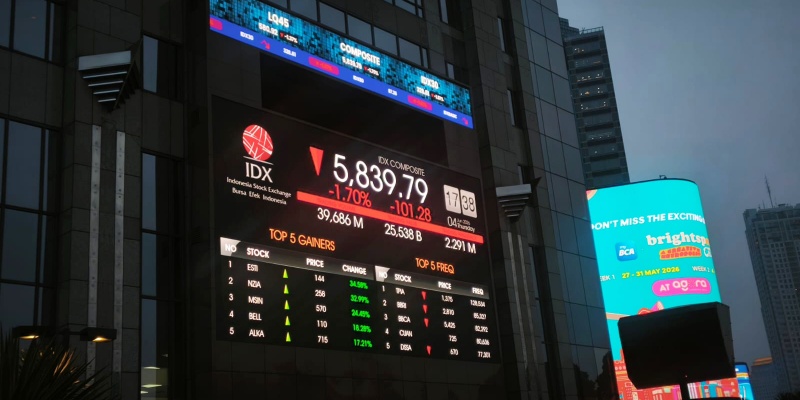
The trading day for July 21, 2026, began with a cautious optimism that quickly faded. The IHSG opened slightly higher, mirroring some positive cues from regional markets in early morning trading, as investors initially reacted positively to overnight data showing resilient industrial production in China. The index briefly touched its intraday high of 6,346 within the first hour of trading, fueled by early buying interest in select blue-chip stocks, particularly in the telecommunications and infrastructure sectors, which had been beneficiaries of recent government policy announcements.
However, this early enthusiasm proved short-lived. By late morning, selling pressure began to mount, particularly in financial and resource-based stocks. This shift was reportedly triggered by the release of less-than-stellar manufacturing Purchasing Managers’ Index (PMI) data from Europe, which reignited fears about a potential slowdown in global economic growth. The IHSG then gradually trended downwards, breaching its opening level and pushing towards its intraday low of 6,306 by early afternoon. This decline was exacerbated by institutional investors engaging in profit-taking activities, especially on stocks that had seen significant appreciation in the preceding weeks.
The afternoon session witnessed a brief attempt at recovery as some bargain hunters entered the market, preventing a steeper decline. However, the overall bearish sentiment persisted, and the index struggled to regain its footing. The final hour of trading saw renewed selling, particularly from foreign investors, pushing the IHSG to close near its daily lows. For the Rupiah, the weakening trend was more consistent throughout the day. Starting around Rp17,920 per dollar, the currency gradually slipped, primarily influenced by strong demand for the dollar from corporate importers and offshore investors repatriating funds. Despite intermittent interventions by Bank Indonesia to stabilize the currency, the sustained global dollar strength proved challenging to counteract, culminating in its closing at Rp17,936 per U.S. Dollar.
Background Context: Underlying Economic Currents in Mid-2026
The market movements on July 21, 2026, did not occur in a vacuum but were shaped by a complex web of global and domestic economic conditions. Globally, mid-2026 has been characterized by persistent concerns over inflation, particularly in major economies like the United States and Europe. Central banks worldwide, including the U.S. Federal Reserve, have been navigating a delicate balance between curbing inflation and avoiding a recession, often leading to higher interest rates that tend to strengthen the dollar and draw capital away from emerging markets like Indonesia. Geopolitical tensions, particularly in Eastern Europe and parts of Asia, also continued to cast a shadow over global trade and supply chains, contributing to general market uncertainty. Commodity prices, while off their peak, remained volatile, impacting Indonesia’s export revenues and import costs.
Domestically, Indonesia’s economy in 2026 has shown resilience but faces its own set of challenges. Inflation, while relatively contained compared to global averages, remains a key watchpoint for Bank Indonesia. The central bank has been proactive in managing price stability through targeted monetary policy measures, including several interest rate adjustments earlier in the year. The government’s fiscal policy has focused on infrastructure development and social welfare programs, aimed at stimulating domestic demand and job creation. However, the national budget is constantly under scrutiny, with revenue generation dependent on commodity prices and tax collection efficiency.
Furthermore, foreign direct investment (FDI) inflows have been a crucial driver of economic growth, but global economic slowdowns can temper investor appetite for emerging markets. The upcoming corporate earnings season for the third quarter of 2026 is also on investors’ radar, with expectations of mixed results across different sectors, reflecting varying degrees of sensitivity to input costs, consumer demand, and global trade dynamics. Political stability, especially in the run-up to the 2029 general elections, remains a supportive factor, but any signs of policy uncertainty can quickly impact investor confidence.
Analyst Perspectives and Market Sentiment
Market watchers and economic analysts provided various interpretations of the day’s performance. Mr. David Kurniawan, Head of Research at Nusantara Securities, commented, "Today’s correction in the IHSG is largely attributable to a combination of profit-taking after a decent run and renewed caution over global growth prospects. Investors are becoming more discerning, shifting away from riskier assets as major central banks signal continued vigilance against inflation." He added that the modest nature of the decline suggests that underlying fundamentals for the Indonesian economy remain relatively sound, but external headwinds are proving difficult to ignore.
Similarly, Ms. Sarah Wijaya, a senior FX strategist at Garuda Capital, highlighted the external factors influencing the Rupiah. "The Rupiah’s weakening is primarily a reflection of sustained dollar strength, driven by robust U.S. economic data and hawkish Federal Reserve rhetoric. While Bank Indonesia is actively managing volatility, the sheer momentum of the dollar and the global demand for safe-haven assets are exerting considerable pressure. We believe the central bank will continue to intervene strategically to prevent excessive depreciation."

The prevailing market sentiment could be best described as cautious optimism, leaning towards apprehension. While many investors still see long-term value in the Indonesian market given its strong demographics and economic potential, short-term tactical positioning has become more conservative. Concerns about potential further interest rate hikes, both domestically and globally, and the lingering effects of supply chain disruptions are tempering aggressive buying strategies.
Official Responses and Policy Implications
In response to the market movements, officials from key economic institutions have reiterated their commitment to stability. A spokesperson for Bank Indonesia (BI), speaking on background, affirmed the central bank’s readiness to "take necessary measures to ensure Rupiah stability in line with market mechanisms and to safeguard macroeconomic stability." This statement is widely interpreted as a signal that BI stands ready to intervene in the foreign exchange market to curb excessive volatility and prevent sharp depreciations that could fuel imported inflation. The central bank’s monetary policy committee is expected to closely monitor inflation trends and global monetary tightening cycles, potentially adjusting benchmark interest rates if deemed necessary to anchor inflation expectations and support the Rupiah.
From the fiscal side, the Ministry of Finance emphasized the government’s strong fiscal position and commitment to prudent economic management. "The government continues to prioritize a healthy and sustainable fiscal policy, focusing on structural reforms to enhance economic resilience," stated a ministry official. They highlighted ongoing efforts to improve the investment climate, diversify exports, and manage national debt effectively, which are crucial for maintaining investor confidence amidst global uncertainties. The Indonesian Stock Exchange (IDX) also issued a statement, assuring market participants of the robust regulatory framework and operational integrity of the exchange, reinforcing investor protection measures.
Broader Economic Impact and Future Outlook
The recent market downturn carries several implications for various stakeholders. For retail investors, the volatility serves as a reminder of market risks and the importance of diversification and long-term investment horizons. Institutional investors, both domestic and foreign, will likely continue to re-evaluate their portfolios, potentially shifting towards more defensive sectors or seeking opportunities in oversold quality stocks. The weakening Rupiah could increase the cost of imported goods and raw materials for Indonesian businesses, potentially squeezing profit margins and contributing to domestic inflationary pressures. Conversely, export-oriented companies might see a boost in their Rupiah-denominated revenues, though this benefit could be offset by weaker global demand.
Looking ahead, the short-term outlook for the IHSG and Rupiah remains subject to global macroeconomic developments, particularly the trajectory of inflation in major economies and the monetary policy responses of their central banks. Domestically, key economic indicators to watch include the upcoming inflation figures for August, which will provide crucial insights into price stability, and the release of Q3 2026 GDP growth data, expected in early November, which will gauge the overall health of the Indonesian economy. The government’s progress on infrastructure projects and its ability to attract sustained foreign investment will also be critical catalysts.
Analysts generally anticipate that the Indonesian market will remain resilient in the medium term, underpinned by strong domestic consumption, a growing middle class, and abundant natural resources. However, sustained global economic headwinds or significant domestic policy shifts could introduce further volatility. Investors are advised to remain vigilant, keep abreast of economic news, and adopt a well-informed investment strategy to navigate the evolving market landscape in the coming months. The performance on July 21, 2026, serves as a clear indicator of the delicate balance between domestic strength and external vulnerabilities that Indonesia’s financial markets currently face.

