
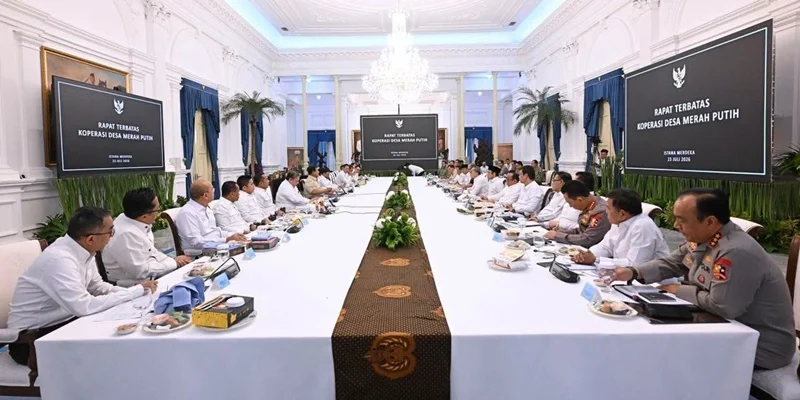
President Prabowo Subianto led a high-level limited meeting on Thursday, July 23, 2026, at the Presidential Palace in Jakarta, focusing on the strategic acceleration and strengthening of the Merah Putih Village/Urban Cooperatives (KDKMP) and Merah Putih Fishermen Cooperatives (KNMP). This pivotal gathering underscored the administration’s commitment to leveraging grassroots economic structures as a primary engine for national growth and equitable development, particularly in rural and coastal areas. The discussions emphasized the critical importance of robust synergy among various ministries and government institutions, including the Indonesian National Armed Forces (TNI) and the National Police (Polri), to ensure these ambitious programs are implemented effectively, integrated seamlessly across sectors, and sustained for long-term impact.
The meeting serves as a clear indication of President Subianto’s strategic vision to empower local economies, reduce regional disparities, and enhance the welfare of communities often at the forefront of economic vulnerability. By focusing on KDKMP and KNMP, the government aims to create resilient economic ecosystems that provide direct benefits to villagers and fishermen, fostering self-sufficiency and improved livelihoods.
The Mandate for Grassroots Empowerment: KDKMP and KNMP
The Merah Putih Village/Urban Cooperatives (KDKMP) and Merah Putih Fishermen Cooperatives (KNMP) are envisioned as cornerstone initiatives in the government’s broader economic strategy. These cooperatives are designed to be more than just business entities; they are intended as platforms for collective action, shared resources, and mutual benefit, deeply rooted in the principles of Indonesia’s Pancasila ideology and the spirit of mutual cooperation (gotong royong).
KDKMP targets the vast potential of Indonesia’s rural and urban periphery populations. These cooperatives are expected to facilitate access to capital, technology, training, and markets for village communities engaged in agriculture, small and medium-sized enterprises (SMEs), local crafts, and nascent tourism initiatives. By pooling resources, villagers can overcome individual limitations in production, processing, and distribution, thereby increasing their bargaining power and profitability. For instance, farmers within a KDKMP could collectively purchase fertilizers at lower prices, share modern farming equipment, process their harvests into higher-value products, and market them directly, bypassing exploitative middlemen. This approach seeks to address perennial challenges faced by rural communities, such as limited access to finance, market volatility, and technological disparities.
Similarly, KNMP is tailored to address the unique challenges and opportunities within Indonesia’s extensive coastal and maritime sectors. As an archipelago nation with immense marine resources, the welfare of its fishing communities is paramount. Fishermen often contend with issues ranging from fluctuating catch prices and limited access to cold storage and processing facilities to the threats of illegal fishing and unsustainable practices. KNMP aims to empower these communities by enabling collective ownership of fishing gear, shared access to ice machines and processing units, direct sales channels to urban markets, and promotion of sustainable fishing practices. Through these cooperatives, fishermen can enhance their productivity, improve the quality of their catch, add value through processing (e.g., dried fish, fish crackers, surimi), and secure fairer prices for their produce, ultimately elevating their economic standing and ensuring the sustainability of marine resources.
Strategic Context and Economic Imperatives
The meeting on July 23, 2026, reflects a timely and urgent response to ongoing economic challenges and opportunities. Indonesia’s economy, while robust, continues to grapple with issues of income inequality and regional disparities. Data from the Central Statistics Agency (BPS) consistently highlight that poverty rates are significantly higher in rural and coastal areas compared to urban centers. Agriculture and fisheries, despite contributing substantially to the national GDP and employing a large segment of the population, often see producers earning meager incomes due to fragmented supply chains and lack of value addition.
Indonesia boasts over 12,000 villages and more than 17,000 islands, many of which are home to traditional fishing communities. The total population engaged in agriculture and fisheries combined runs into tens of millions, underscoring the massive potential impact of successful cooperative movements. Strengthening KDKMP and KNMP aligns perfectly with the government’s broader agenda of fostering inclusive economic growth, enhancing food security, and achieving national self-sufficiency in key commodities.
President Prabowo Subianto’s administration has consistently articulated a commitment to strengthening the grassroots economy, viewing it as the bedrock of national resilience. This initiative is seen as a practical manifestation of his campaign promises to uplift farmers, fishermen, and small entrepreneurs, ensuring that economic development is not merely concentrated in urban hubs but permeates every corner of the archipelago.
The Crucial Role of Inter-Agency Synergy
A central theme of the presidential meeting was the absolute necessity of integrated and synergistic action across various governmental and non-governmental entities. The complexity of rural and coastal development demands a multi-sectoral approach that transcends traditional bureaucratic silos. The President’s emphasis on involving not just civilian ministries but also the TNI-Polri highlights a comprehensive strategy aimed at ensuring holistic support.
Key ministries and institutions expected to play pivotal roles include:
- Ministry of Cooperatives and SMEs: This ministry will serve as the primary policy architect and implementation guide, providing legal frameworks, training programs on cooperative management, financial literacy, and business development for KDKMP and KNMP members. Their expertise is crucial for ensuring cooperatives are well-managed and sustainable.
- Ministry of Villages, Disadvantaged Regions, and Transmigration: This ministry is vital for integrating KDKMP initiatives with the existing Village Fund program. By channeling village funds into productive cooperative activities, infrastructure development (e.g., storage facilities, local processing units), and capacity building, they can amplify the impact of KDKMP.
- Ministry of Maritime Affairs and Fisheries: For KNMP, this ministry will provide technical guidance on sustainable fishing practices, marine resource management, aquaculture development, and access to modern fishing technologies. They will also play a role in market access for marine products and combating illegal, unreported, and unregulated (IUU) fishing that threatens the livelihoods of legitimate fishermen.
- Ministry of Agriculture: This ministry will be instrumental in supporting KDKMP through agricultural extension services, provision of quality seeds and livestock, pest and disease control, and promotion of modern farming techniques to enhance productivity and crop quality.
- Ministry of Trade: This ministry’s involvement is crucial for facilitating market access for cooperative products, both domestically and internationally. They can help establish fair pricing mechanisms, connect cooperatives with buyers, and provide training on product standardization and quality control.
- Ministry of Finance: Beyond initial funding, the Ministry of Finance will work on developing sustainable financial models, including access to microcredit, rural banks, and other financial institutions tailored to the needs of cooperatives. They will also oversee fiscal incentives and regulatory frameworks that support cooperative growth.
- TNI-Polri (Indonesian National Armed Forces and National Police): Their involvement, as highlighted by President Subianto, extends beyond traditional security roles. In remote and coastal areas, TNI-Polri assets can provide logistical support, especially in transporting goods to and from distant markets or distributing essential supplies. They can also play a crucial role in maintaining security along supply chains, preventing theft, and combating illegal activities that undermine cooperative efforts, such as illegal fishing or smuggling of agricultural products. Furthermore, their presence can facilitate community outreach programs, build trust, and ensure a stable environment conducive to economic development. This integrated approach ensures that security and development go hand-in-hand, creating a holistic support system for grassroots initiatives.
This synergy aims to prevent fragmented efforts, optimize resource allocation, and create a cohesive support system that addresses the multifaceted challenges faced by rural and coastal communities. Without such coordinated action, even well-intentioned programs risk faltering due to lack of comprehensive support or conflicting priorities.
Historical Precedent and Economic Philosophy
The emphasis on cooperatives is deeply embedded in Indonesia’s economic philosophy, particularly Article 33 of the 1945 Constitution, which states that the economy shall be organized as a common endeavor based on the principle of familialism, with cooperatives playing a central role. Throughout Indonesia’s history, cooperatives have been seen as a democratic economic institution capable of promoting equitable distribution of wealth and fostering self-reliance.
However, the cooperative movement in Indonesia has faced its share of challenges, including issues of mismanagement, lack of capital, limited access to markets, and competition from larger private enterprises. The current administration’s initiative to "accelerate and strengthen" KDKMP and KNMP suggests a renewed commitment to revitalizing this sector, learning from past experiences, and implementing more robust frameworks for success. President Subianto’s vision aligns with a broader global trend of recognizing the importance of local economies and community-led development as a sustainable path to prosperity.
Implementation Challenges and Safeguards
While the vision is ambitious and promising, the successful implementation of KDKMP and KNMP will inevitably face significant challenges. These include:
- Bureaucratic Hurdles: Coordinating numerous ministries and agencies, each with its own mandates and procedures, can be complex. Streamlining processes and ensuring effective communication will be critical.
- Funding and Sustainability: Ensuring adequate and sustainable funding mechanisms beyond initial government injections will be vital. Cooperatives must ultimately become self-reliant and financially viable.
- Human Resources and Capacity Building: Many rural and coastal communities lack the necessary skills in financial management, marketing, and modern business practices. Extensive training and ongoing mentorship will be required.
- Market Access and Competition: Even with collective efforts, cooperatives will need support to compete effectively in broader markets against established private sector players.
- Oversight and Accountability: Robust mechanisms for monitoring progress, evaluating impact, and preventing corruption or mismanagement will be essential to maintain public trust and program integrity.
To mitigate these challenges, the government is expected to establish clear performance indicators, implement transparent reporting systems, and empower local communities with ownership and decision-making authority within their respective cooperatives. The involvement of academic institutions and non-governmental organizations in technical assistance and oversight could also play a significant role.
Projected Impact and Long-Term Vision
If successfully implemented, the acceleration and strengthening of KDKMP and KNMP could have profound and far-reaching impacts on Indonesia’s socio-economic landscape:
- Poverty Reduction and Income Growth: By empowering communities to increase productivity, add value, and access fairer markets, these cooperatives can significantly boost incomes and lift families out of poverty.
- Job Creation: The growth of cooperative enterprises will create new employment opportunities within villages and coastal areas, reducing the pressure for rural-to-urban migration.
- Food Security: Stronger agricultural and fisheries cooperatives will contribute directly to national food security by enhancing production efficiency and ensuring more stable supply chains.
- Sustainable Resource Management: By promoting collective responsibility and providing better economic incentives, KNMP can encourage more sustainable fishing practices and KDKMP can foster environmentally friendly agricultural methods.
- Enhanced Social Cohesion: The cooperative model, inherently built on shared ownership and mutual benefit, can strengthen community bonds and foster a greater sense of collective purpose.
- Regional Development and Reduced Disparities: By focusing on grassroots empowerment, these programs will contribute to more balanced regional development, narrowing the economic gap between urban centers and peripheral areas.
Economic analysts generally welcome initiatives that focus on empowering local communities, though they often emphasize the need for meticulous planning, adequate funding, and robust oversight for such large-scale programs to succeed. The integrated approach involving various government bodies and security forces is seen as a pragmatic response to the multi-dimensional nature of rural and coastal development challenges in Indonesia.
The meeting on July 23, 2026, marks a significant step in President Prabowo Subianto’s administration to translate its economic vision into tangible action. The focus on KDKMP and KNMP, underpinned by a commitment to inter-agency synergy, signals a serious effort to build a more inclusive, equitable, and resilient Indonesian economy from the ground up. The coming months and years will reveal the efficacy of this ambitious strategy as it moves from policy formulation to nationwide implementation.

