
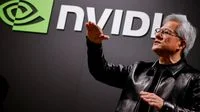
The global technology landscape was sent into a profound state of shock as Jensen Huang, the visionary co-founder and Chief Executive Officer of Nvidia, confirmed he is currently facing a rigorous internal investigation by the company’s board of directors. The probe comes on the heels of an explosive personal scandal involving an extramarital relationship with Alice Huang, a businesswoman who is now under intense scrutiny by American intelligence authorities over allegations of operating as an active covert agent for the People’s Republic of China. The unfolding crisis threatens not only the personal standing of one of Silicon Valley’s most revered figures but also casts a dark shadow over national security protocols, intellectual property protection, and the tightly regulated geopolitical trade of advanced artificial intelligence semiconductors.
According to international media reports, the controversy erupted as geopolitical tensions between the United States and China over semiconductor supremacy reached a fever pitch. Alice Huang—who also utilizes the legal alias Huang Le and bears no familial relation to the Nvidia chief executive—stands accused by U.S. counterintelligence officials of systematically cultivating a relationship with Jensen Huang to extract confidential corporate information and bypass stringent export controls. The allegations suggest that proprietary technical data regarding Nvidia’s cutting-edge hardware architecture may have been illicitly funneled directly to Beijing. As the world’s most valuable publicly traded enterprise, boasting a staggering market capitalization touching US$ 4.5 trillion, Nvidia now finds itself at the epicenter of a multi-layered espionage investigation that intersects corporate governance, international diplomacy, and high-stakes technological competition.
A Chronology of the Crisis: From Taipei to Washington
The public unraveling of the scandal began with a sudden internal memorandum distributed by Jensen Huang to Nvidia’s global workforce. In the correspondence, the 63-year-old executive openly acknowledged his infidelity to his wife of several decades, Lori Huang, and explicitly stated his willingness to accept full professional and personal accountability for his actions. "I take full responsibility for my actions," Huang wrote in the candid message to employees, attempting to preemptively manage the fallout before investigative reports saturated mainstream news outlets.
While the precise timeline of the initial romantic entanglement remains officially undisclosed, investigative reports have pieced together the public trajectory of their association. The pair were first documented together in June 2024 during a high-profile industry gathering in Taipei, Taiwan. Photographed at a local establishment alongside executive representatives from prominent technology firms Gigabyte and NetThunder, the meeting coincided precisely with the burgeoning commercial negotiations surrounding Megaspeed, a Singapore-registered cloud computing firm where Alice Huang served in a leadership capacity. Over the subsequent twenty-four months, Megaspeed emerged as an unusually aggressive buyer of enterprise-grade AI hardware, procuring massive volumes of advanced Nvidia processors.
Profiling Jensen Huang: The Architect of the AI Era
To understand the immense gravity of the current investigation, one must examine the towering stature of Jensen Huang within the modern global economy. Born in Taiwan and raised in the United States, Huang co-founded Nvidia in 1993 alongside Chris Malachowsky and Curtis Priem, initially focusing on the development of high-performance graphics processing units (GPUs) for the personal computer gaming market. Over three decades, Huang’s leadership—consistently symbolized by his signature black leather jacket—transformed the enterprise from a niche hardware vendor into the undisputed backbone of the global artificial intelligence revolution.
The commercial inflection point arrived in late 2022 with the widespread public release of generative AI platforms such as OpenAI’s ChatGPT. Overnight, demand for Nvidia’s parallel-processing chips skyrocketed, pushing the company’s valuation into historic financial territory. Beyond his corporate footprint, Huang’s family remains deeply integrated into the operational hierarchy of Nvidia. His daughter, Madison Huang, currently occupies the strategic role of Senior Director of Product and Technical Marketing for Physical AI Platforms, while his son, Spencer Huang, oversees the enterprise’s robotics software product division. This close-knit familial management structure, combined with Huang’s near-deity status among Silicon Valley investors, magnifies the destabilizing potential of the ongoing board inquiry.
The Enigmatic Profile of Alice Huang and the Megaspeed Nexus
Central to the counterintelligence facet of the investigation is the opaque professional background of Alice Huang. Corporate registries and investigative journalism have revealed
a heavily obscured career trajectory for the Chinese national. Public biographies previously circulated by associates indicated that she had worked as a television reporter for state-backed networks Hunan TV and CCTV before transitioning into the financial sector as an assistant to the president at HSBC and subsequently serving as a vice president at CITIC Securities. However, subsequent journalistic inquiries conducted by publications including The New York Post revealed substantial discrepancies, with network representatives at Hunan TV and official archives at CCTV noting no institutional record of her employment.
Financial disclosures and investment records in East Asia link Alice Huang to the digital entertainment and cloud infrastructure firm 7Road prior to her assumption of executive responsibilities at Megaspeed. Based in Singapore, Megaspeed established itself as an official Nvidia Cloud Partner within the broader Asia-Pacific region, securing prioritized allocations of state-of-the-art semiconductor architectures, including the highly coveted GB200 NVL72 and HGX H100 systems. U.S. regulatory investigators are currently auditing whether Megaspeed functioned primarily as a sophisticated shell corporation engineered to circumvent export restrictions imposed by the Department of Commerce, thereby facilitating the unauthorized diversion of restricted technology to mainland Chinese entities.
Allegations of State-Sponsored Intelligence Operations
According to leaked intelligence summaries circulating within national security circles, the Chinese Ministry of State Security (MSS) allegedly orchestrated a targeted influence campaign utilizing Alice Huang to penetrate Nvidia’s executive suite. The operation’s primary directives reportedly included gathering actionable intelligence on Nvidia’s long-term product roadmaps, supply chain vulnerabilities, and corporate lobbying strategies, while simultaneously exerting personal leverage over the CEO to advocate for relaxed export parameters regarding sales to China.
These allegations carry profound irony given Jensen Huang’s outspoken public criticisms of U.S. trade policy. For years, the Nvidia CEO openly warned that aggressive trade restrictions and blanket bans on semiconductor exports to China would inadvertently stifle domestic American innovation, fragment global supply chains, and incentivize Chinese competitors to accelerate indigenous semiconductor manufacturing capabilities. Critics and federal investigators are now re-evaluating whether those policy advocacy efforts were shaped or subtly influenced by external pressures stemming from his personal relationship with Alice Huang.
Political Fallout and Official Reactions in Washington
The intersection of national security, corporate espionage, and a foundational pillar of the American technology sector immediately drew reactions from the highest levels of the United States government. President Donald Trump addressed the unfolding scandal during public remarks, acknowledging the severe complexity of the situation while expressing lingering personal trust in Huang, who has historically served in informal economic and technological advisory capacities. "I always considered Jensen Huang to be a very honest person," Trump remarked, adding that the administration intends to examine the facts with meticulous thoroughness.
Meanwhile, Secretary of State Marco Rubio maintained a measured public posture, declining to offer specific commentary on ongoing internal corporate proceedings. However, behind closed doors on Capitol Hill, senior lawmakers from both major political parties, particularly prominent members of congressional intelligence and oversight committees, have initiated demands for formal briefings from Nvidia executives. Legislators are pressing to determine whether the integrity of America’s technological supply chain was compromised and whether classified intellectual property was exposed to foreign adversaries.
Nvidia’s Corporate Response and the Path Forward
In direct response to the escalating crisis, Nvidia’s board of directors moved swiftly to insulate the corporation from systemic reputational and operational damage. The board announced the formation of an independent special committee of directors, supported by external legal counsel and forensic investigators, to conduct an exhaustive, transparent review of the allegations.
In an official corporate statement, Nvidia emphasized that preliminary internal reviews have found no concrete evidence to suggest that U.S. national security data or core proprietary assets were compromised or transferred to unauthorized foreign actors. Furthermore, the board confirmed that Jensen Huang has pledged his unreserved cooperation with the investigative panel, committing to transparency as the audit proceeds.
Despite the turbulence at the executive level, Nvidia’s fundamental financial performance remains exceptionally robust. Bolstered by insatiable enterprise demand for machine learning infrastructure, the company reported historic quarterly earnings, pulling in staggering revenues that surpassed US$ 59.69 billion. As the board of directors continues its independent probe, the ultimate outcome will likely set a critical legal and governance precedent for how modern multinational technology conglomerates manage the dangerous convergence of personal indiscretion, geopolitical espionage, and national security oversight.

