
The landscape of academic research is currently undergoing a rapid and transformative shift, moving away from traditional data processing methods toward more sophisticated, technology-driven approaches. For decades, researchers in social sciences and humanities relied heavily on manual calculations or software such as SPSS to manage and interpret data. However, the contemporary academic environment, particularly within high-impact international journals, is increasingly demanding the integration of Artificial Intelligence (AI) and machine learning. This evolution is particularly evident in the field of sentiment analysis, where researchers are now expected to parse through vast quantities of digital data from social media and online platforms to extract meaningful insights.
Despite the clear direction in which global research is heading, a significant portion of the academic community—including undergraduate and postgraduate students, as well as seasoned lecturers—faces a formidable barrier to entry. The transition from traditional methods to computational research requires a level of technical proficiency that many find daunting. Tools such as the Python programming language and Google Colab, while powerful, are often perceived as overly complex for those without a background in computer science. This "technical gap" has left many researchers feeling sidelined, struggling to keep pace with the rigorous requirements of modern scientific publication.
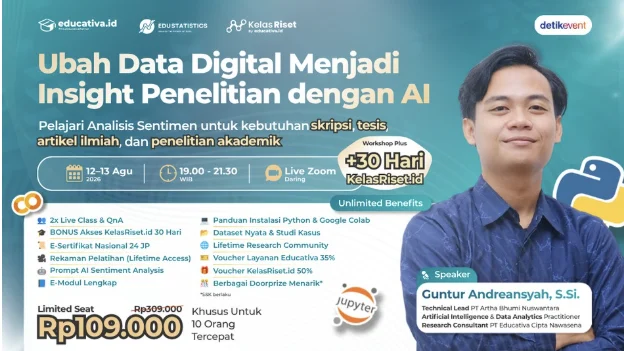
To address this critical disparity, a specialized program titled "EXCLUSIVE Workshop Sentiment Analysis: Transforming Digital Data into Research Insights with AI" has been announced. This initiative is strategically designed to provide a bridge for students and academics, offering a comprehensive pathway from basic data literacy to advanced AI-supported analysis. The program is tailored for individuals ranging from undergraduate (S1) to doctoral (S3) levels, as well as professional researchers, ensuring that participants can effectively process digital data into valid research insights regardless of their prior coding experience.
The Evolution of Research Methodologies and the Rise of Big Data
The shift toward AI-driven research is not merely a trend but a response to the explosion of digital information. According to global data trends, the amount of data generated daily is growing exponentially, with social media platforms serving as a primary repository for human sentiment, political discourse, and social behavior. For an academic in 2026, the ability to analyze a dataset of 100,000 tweets or 50,000 news comments is no longer a luxury—it is a necessity for achieving methodological rigor.
In the past, qualitative research might have involved interviewing twenty subjects to understand a social phenomenon. While this remains valuable, modern reviewers at prestigious journals often look for "triangulation," where qualitative findings are supported by large-scale quantitative sentiment analysis. This dual approach provides a more holistic view of the subject matter, increasing the likelihood of acceptance in journals indexed by Scopus or Web of Science. The upcoming workshop acknowledges this shift, positioning itself as a vital resource for those looking to upgrade their methodological toolkit.
Workshop Chronology and Structured Learning Path
The workshop is scheduled to take place over two intensive sessions in mid-August 2026. This timing allows participants to prepare for the upcoming academic semester, providing them with new skills to apply to their theses, dissertations, or faculty research projects.
The first session is set for Wednesday, August 12, 2026, from 19:00 to 21:30 WIB. This opening session will focus on the foundational elements of AI-based sentiment analysis. Participants will be introduced to the theoretical framework of Natural Language Processing (NLP) and how AI models "read" and "understand" human emotion in text. Understanding the logic behind the algorithms is crucial for researchers, as it allows them to justify their methodology in the "Methods" section of their academic papers.
The second session will follow on Thursday, August 13, 2026, during the same time slot. This session is dedicated entirely to practical application and the interpretation of results. Moving beyond theory, participants will engage in hands-on exercises using Python and Google Colab. The focus here is on the "Zero to Hero" approach, where the instructors guide participants through the process of writing basic code, cleaning datasets, running sentiment models, and, most importantly, interpreting the output. In research, a graph or a percentage is meaningless without the context of scholarly interpretation; this workshop emphasizes how to turn raw numbers into a compelling academic narrative.
Bridging the Technical Gap with Practical Resources
One of the primary criticisms of online tutorials is that they often lack context or use "clean" datasets that do not reflect the messy reality of actual research. The EXCLUSIVE Workshop addresses this by providing participants with real-world datasets and case studies based on viral issues. By working with data that reflects current social or political events, participants can better understand the nuances of sentiment—such as sarcasm, slang, and cultural context—which are often the biggest challenges in AI-driven analysis.
Furthermore, the organizers have recognized that a two-session workshop, no matter how intensive, may not be enough for everyone to master a new skill. To ensure long-term retention and mastery, several support layers have been integrated into the program:
- Extended Platform Access: Participants receive 30 days of access to KelasRiset.id, an online repository of research resources. This allows them to revisit the concepts and practice at their own pace following the live sessions.
- Lifetime Recordings: All sessions are recorded, and participants are granted lifetime access. This is particularly beneficial for researchers who may need to refresh their knowledge months later when they are in the middle of writing their data analysis chapters.
- Community Support: A "lifetime" research community is established for participants, fostering a network where lecturers and students can discuss ongoing projects, troubleshoot code, and potentially collaborate on multi-disciplinary research.
- National Certification: Upon completion, participants receive a national e-certificate totaling 24 JP (Jam Pelajaran or Lesson Hours). In the Indonesian academic system, these credits are essential for lecturers’ professional development records and can significantly bolster a student’s academic portfolio.
Implications for Indonesian Higher Education and Global Competitiveness
The broader implications of such training programs extend to the national level of Indonesian higher education. As the Ministry of Education, Culture, Research, and Technology continues to push for higher standards in scientific publication, the ability of Indonesian scholars to utilize advanced technology becomes a matter of national academic pride and practical necessity.
Data from various ranking agencies suggest that universities with high output in "Computational Social Science" and "Data-Driven Humanities" tend to rise faster in global rankings. By democratizing access to AI tools, workshops like this empower researchers from various backgrounds—not just those in elite, well-funded departments—to produce high-quality work that can compete on the international stage.
Moreover, the shift toward AI in research mirrors the demands of the modern workforce. Students who learn sentiment analysis for their thesis are also gaining a skill that is highly sought after in the private sector, particularly in digital marketing, public relations, and political consultancy. This dual benefit enhances the "link and match" between academia and industry, a key goal of contemporary educational policy.
Technical Analysis of Sentiment Analysis in Modern Research
Sentiment analysis, at its core, involves the use of machine learning algorithms to categorize text into various emotional polarities, such as positive, negative, or neutral. Advanced models can even detect specific emotions like anger, joy, or sadness. For a researcher, this allows for the objective measurement of public opinion on a scale that was previously impossible.
For instance, a political scientist studying public reaction to a new government policy can use these tools to analyze millions of social media posts in real-time. A sociologist can track the shift in public discourse regarding social justice issues over a decade by analyzing news archives. The workshop focuses on these practical applications, ensuring that the "AI" being discussed is not a vague concept but a tangible tool that produces verifiable data.
The use of Google Colab is a strategic choice for this workshop. As a cloud-based platform, it eliminates the need for participants to have high-end hardware. As long as a researcher has an internet connection and a browser, they can run complex machine learning models. This lowers the economic barrier to high-level research, making it accessible to students and faculty across the Indonesian archipelago.
Conclusion and Registration Details
As the competition for scientific publication becomes increasingly fierce, the window of opportunity to adopt these new technologies is narrowing. Researchers who continue to rely solely on outdated methods may find it increasingly difficult to publish in top-tier journals or secure research grants. The transition to AI-driven data analysis is not just an upgrade; it is a fundamental evolution of the scientific method in the digital age.
The "EXCLUSIVE Workshop: Transforming Digital Data into Research Insights with AI" represents a timely intervention for the Indonesian academic community. By combining theoretical depth with practical, hands-on training and long-term support, the program aims to turn the "daunting" task of coding into a manageable and powerful research asset.
Prospective participants are encouraged to view this as a strategic investment in their academic and professional futures. Detailed information regarding the curriculum, speaker profiles, and registration procedures can be accessed through the official detikEvent portal. As the dates of August 12 and 13, 2026, approach, the academic community stands at a crossroads between traditional constraints and the expansive possibilities of AI-driven insight.
