
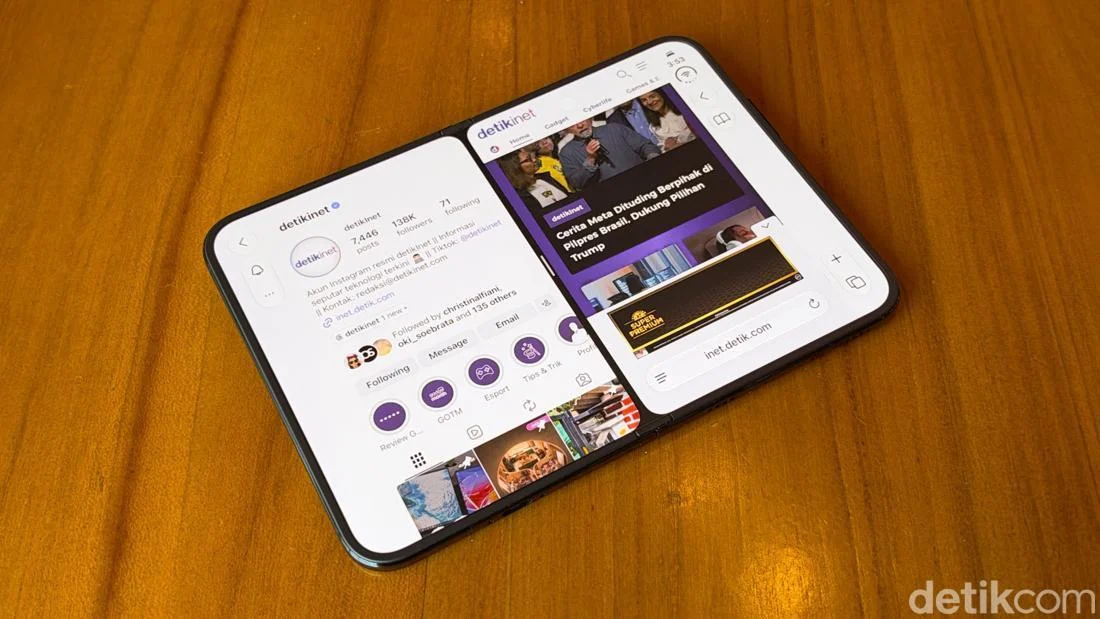
The introduction of the Apple iPhone Duo, the tech giant’s highly anticipated foray into the foldable smartphone market, has presented a significant technical challenge for third-party developers, most notably the team behind Instagram. Adam Mosseri, the head of Instagram, recently acknowledged that the process of tailoring the social media platform’s interface to suit the unique form factor of the iPhone Duo has been far more complex than initial projections suggested. Despite the device being marketed as a premium experience with the “Made for iPhone Duo” certification, the physical layout of the phone’s hardware—specifically the placement of navigation buttons on the outer screen—has created persistent software conflicts that engineers are still struggling to rectify.
The core of the issue lies in the iPhone Duo’s unconventional hardware design. Unlike traditional iPhone models, which utilize a standard vertical display ratio, the Duo employs a foldable architecture that forces a shift in UI/UX paradigms. When the device is closed, the navigation elements are positioned along the right-hand edge of the outer screen. This specific placement directly interferes with Instagram’s native Reels interface, where the interactive buttons for “Like,” “Comment,” and “Share” are also located. Consequently, users have reported that the UI elements overlap, leading to frequent accidental inputs and a fragmented user experience.
A Chronology of Hardware and Software Friction
The trajectory of the iPhone Duo’s release and the subsequent software adaptations can be traced back to the device’s unveiling in early November 2026. Upon launch, early adopters were quick to point out that Instagram was not optimized for the device’s unique screen real estate. When unfolded, the application appeared as a centered, narrow column with significant “letterboxing” or black bars on either side, failing to utilize the expansive display area.
Furthermore, the orientation-sensing software proved inconsistent. Users reported that when rotating the device, the UI elements would jump erratically: control buttons migrated to the top-left corner, while the Stories interface failed to scale, leaving the content improperly cropped. These initial grievances prompted a swift response from Apple, which urged developers to leverage the latest iOS 27.1 Software Development Kit (SDK) to address the lack of full-screen support.
By mid-November, the situation began to shift. On November 16, Greg Joswiak, Apple’s Senior Vice President of Worldwide Marketing, announced a significant milestone in the device’s ecosystem. He revealed that over 200,000 applications had been updated to support the iPhone Duo’s specifications, doubling the number of optimized apps from just two weeks prior. This rapid expansion in compatible software suggests that while the transition has been difficult, Apple is providing the necessary tools to force a shift in how developers approach mobile layouts.
Technical Challenges of the Foldable Interface
The primary hurdle for developers like Instagram is the lack of a standardized design language for foldable devices. In a traditional smartphone environment, the layout is static and predictable. With the iPhone Duo, developers must now create “adaptive” interfaces that can instantly reconfigure themselves based on the state of the hinge.
For Instagram, this has necessitated a complete overhaul of their application architecture. The most recent update, rolled out to address these specific complaints, introduces a multi-column layout when the device is in its fully expanded state. In this mode, the primary feed stretches to accommodate the wider aspect ratio, while the Reels player is relegated to one side of the screen, leaving the other side open for a persistent comment stream. This allows for simultaneous consumption of media and interaction, a feature that was previously impossible on standard iPhone models.
However, the “folded” state remains the primary point of contention. Because the outer display utilizes the edge-mounted navigation buttons, the app is forced to reconcile its own vertical feed with the hardware-level system controls. Mosseri’s admission on the Threads platform highlighted that while the “unfolded” experience is now stable, the “folded” state requires a different UI logic that is currently under development. This implies that the Instagram team is essentially building two separate apps within one container to satisfy the requirements of the iPhone Duo’s distinct usage scenarios.
The Broader Implications for App Developers
The challenges faced by Instagram are representative of a larger industry-wide shift. As foldables move from niche experimental devices to mainstream flagships, the pressure on developers to maintain “parity” across different hardware versions is increasing. This creates a significant financial and operational burden. Maintaining separate codebases or highly complex adaptive code for every device variation can slow down the deployment of new features, as seen with the delays in the Instagram update.
Industry analysts suggest that the iPhone Duo represents a “fragmentation crisis” for iOS. For years, the strength of the Apple ecosystem was its consistency; developers could build an app for one screen size and have it function perfectly on all others. The introduction of the Duo, with its folding screen and non-standard button placements, breaks this paradigm. If developers cannot easily bridge the gap between standard iPhone displays and the Duo’s foldable surface, it may limit the device’s long-term appeal to power users and creative professionals who rely on these applications for their daily workflows.
Apple’s Ecosystem Strategy
Apple’s strategy, as outlined by Greg Joswiak, relies on the rapid adoption of the iOS 27.1 SDK. This SDK includes specific libraries for handling “fold state” changes and “hinge detection,” which essentially tell the app exactly how much of the screen is visible at any given moment. By making these tools available, Apple is attempting to automate as much of the transition as possible, though the Instagram case proves that automation is not a substitute for thoughtful interface design.
For now, the Instagram experience on the iPhone Duo remains a work in progress. While the update has resolved the major issues with the unfolded view, the persistence of the “button clash” in the folded mode indicates that the hardware-software marriage is still in its infancy. Users can expect further iterative updates from Instagram in the coming months as they continue to refine the touch targets and UI hierarchies to prevent the overlapping that plagued the initial launch.
Analysis of Future Prospects
Looking ahead, the success of the iPhone Duo will depend heavily on whether industry giants like Meta (Instagram’s parent company) can successfully master the foldable interface. If Instagram—one of the most used apps in the world—cannot provide a seamless experience, it discourages casual consumers from upgrading to the more expensive, complex foldable hardware.
Furthermore, the data regarding the 200,000 optimized apps suggests that while progress is being made, the quality of these optimizations varies. Many developers are likely taking the “minimum viable product” approach, simply resizing their apps rather than reimagining the user experience to take advantage of the larger display. Instagram’s attempt to create a unique side-by-side feed is a positive sign that some developers are looking beyond simple scaling, aiming instead for a truly “tablet-like” experience that fits in a pocket.
In conclusion, the difficulties articulated by Adam Mosseri regarding the iPhone Duo are a reflection of a broader technical paradigm shift. As Apple continues to iterate on its hardware, the burden of adaptation will fall squarely on the software development community. While the current friction between the iPhone Duo’s side-mounted navigation and Instagram’s UI is a hurdle, it is also a catalyst for innovation in mobile interface design. As the ecosystem matures and developers become more accustomed to the complexities of foldables, the “unnatural” feel of these early devices is expected to dissipate, giving way to a more fluid, multi-purpose mobile computing experience. Until then, users will have to navigate the growing pains of a platform that is still learning how to balance its innovative hardware with the established habits of its millions of users. The coming quarters will be critical for Apple and its partners as they prove that the foldable form factor is not just a novelty, but a functional evolution of the modern smartphone.

