
The landscape of global cybersecurity has experienced a dramatic escalation following a synchronized wave of digital incursions targeting some of the world’s most prominent financial institutions, technology conglomerates, and industrial giants. In an alarming development that highlights the vulnerabilities of modern interconnected corporate networks, multinational payment processor Visa and investment banking powerhouse JPMorgan Chase emerged as the primary targets of an aggressive ransomware syndicate. These high-profile incidents are part of a broader, systemic surge in cybercrime throughout late 2026, signaling an urgent need for enhanced digital defenses across critical global industries.
The Emergence of the n0n Ransomware Syndicate and the Financial Sector Targets
The recent wave of extortion attempts was spearheaded by a relatively new and aggressive threat actor operating under the moniker "n0n." Emerging onto the global cybercrime radar in September 2026, the n0n ransomware group quickly established a reputation for targeting high-value corporate networks and threatening to dump proprietary, sensitive data onto public leak sites if exorbitant financial demands are not met.
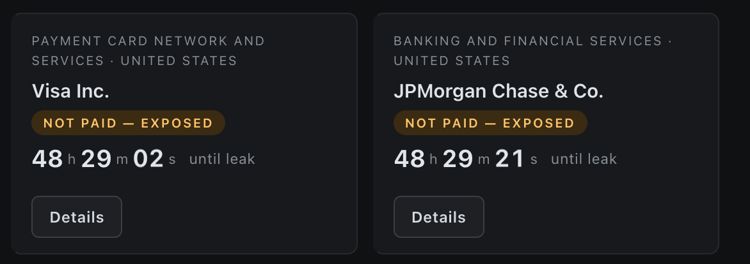
In mid-November 2026, the syndicate escalated its operations by publishing claims that it had successfully breached the digital perimeters of both Visa and JPMorgan Chase. To pressure the corporate giants, the hackers issued a rigid 48-hour ultimatum, demanding negotiations before the publication of alleged stolen records on their dark web leak portal. This tactic is designed to leverage corporate fear of regulatory penalties, reputational damage, and the loss of consumer trust.
Despite the gravity of the claims, the targeted institutions moved swiftly to contain the narrative and assess the structural integrity of their proprietary networks. Visa acknowledged that it had indeed encountered a security incident, though the breach was traced back to a third-party service provider operating within the Asia-Pacific region rather than Visa’s own core infrastructure.
In an official statement released to cybersecurity media, a Visa spokesperson clarified the scope of the incident: "System Visa is not involved and not impacted. There is no indication that payment data, such as card numbers, has been affected." The company maintained a strict firewall between its internal systems and the compromised vendor, though it refrained from publicly naming the specific third-party provider or quantifying the exact number of individuals whose data might have been exposed through the vendor’s compromised portal.
Concurrently, JPMorgan Chase faced similar public scrutiny as its name appeared prominently on the n0n group’s list of victims. However, the investment bank firmly refuted any connection between the hackers’ claims and its operational status. Representatives for JPMorgan Chase stated unequivocally that there was no evidence linking any recent service disruptions to a malicious cyberattack. Instead, the bank attributed minor technical hiccups to routine internal software malfunctions.
Independent cybersecurity analysts noted that while the n0n group is adept at publicizing its alleged conquests for maximum psychological and financial leverage, there has been no independent verification that the syndicate successfully penetrated JPMorgan Chase’s heavily fortified core servers. Nevertheless, the mere association with such a high-profile threat group underscores the persistent vulnerability of major financial institutions to peripheral supply chain compromises.
A Broader Epidemic: Escalating Cyber Threats Across Global Industries
The incidents involving Visa and JPMorgan Chase do not represent isolated occurrences; rather, they form part of a sweeping epidemic of cyberattacks that rippled through multiple critical industries throughout November 2026. The expansive nature of these attacks demonstrates that malicious actors are increasingly diversifying their portfolios, targeting not only financial services but also semiconductor manufacturing, maritime logistics, and the global energy sector.
In the semiconductor industry, Taiwanese manufacturing giant TSMC confirmed a significant data security breach involving employee information. Sensitive records belonging to both active and former personnel surfaced on internet forums and dark web marketplaces. Preliminary investigations indicate that the data leak originated from a compromised third-party cloud service provider. A malicious actor claimed to possess an archive totaling approximately 6.9 gigabytes, containing tens of thousands of detailed employee records. In response, TSMC issued a reassuring statement clarifying that its proprietary manufacturing systems, core internal networks, and confidential customer operational data remained entirely uncompromised, isolating the breach strictly to the external vendor’s repository.
Simultaneously, the global supply chain felt the shockwaves of modern cyber extortion. Danish shipping and logistics conglomerate Maersk acknowledged that it had suffered an unauthorized access incident resulting in the extraction of proprietary data. The breach targeted a legacy system that Maersk had acquired through a previous corporate acquisition. A separate cyber extortion group known as "WhiteArmor" claimed responsibility for the raid, boasting the theft of roughly 100 gigabytes of data and issuing a ransom demand of $5 million. Maersk managed to compartmentalize the threat, assuring stakeholders and clients that the security event was entirely isolated and caused zero disruption to customer-facing logistics and maritime operations.
The energy sector also proved vulnerable to the relentless tide of digital aggression. Equinor, the Norwegian multinational energy corporation specializing in oil and gas production, reported a sophisticated cyberattack that compromised a portion of its corporate information technology infrastructure. Given the critical nature of energy infrastructure, the incident triggered immediate concern among European regulators. However, Equinor’s swift containment protocols ensured that industrial control systems remained untouched, confirming that oil and gas exploration, extraction, and refining activities continued without interruption, with no evidence of data exfiltration.
Quantifying the Threat: Data Insights from Visa’s Fall 2026 Biannual Threats Report
To contextualize these disparate attacks, industry data released during the same period provides a chilling mathematical overview of the escalating threat landscape. On November 17, 2026, Visa published its comprehensive Fall 2026 Biannual Threats Report, offering an empirical look at the shifting dynamics of global digital crime.
The report revealed a startling 62% year-over-year increase in security incidents involving third-party service providers compared to the preceding six-month cycle. Furthermore, third-party vendors were directly linked to approximately 56% of all compromised payment credentials identified during the observation window spanning January through June 2026. This data underscores a fundamental structural weakness in the modern corporate ecosystem: as enterprises increasingly outsource non-core operations to specialized vendors and cloud providers, they inadvertently expand their attack surfaces, creating decentralized vulnerabilities that sophisticated hackers are eager to exploit.
In addition to third-party vulnerabilities, the report documented a relentless surge in ransomware operations. Ransomware incidents climbed by 19% over the previous six-month period. When viewed against a longer historical timeline, the growth is staggering: ransomware attacks have surged by an astronomical 312% since 2021. This exponential rise reflects the increasing commercialization of cybercrime through Ransomware-as-a-Service (RaaS) models, which lower the technical barrier to entry for malicious syndicates.
The Artificial Intelligence Multiplier Effect
Perhaps the most alarming trend highlighted in the Fall 2026 report is the integration of Artificial Intelligence into the operational arsenals of cybercriminal organizations. While AI has been widely adopted by corporate security teams for threat detection and automated incident response, threat actors are aggressively leveraging machine learning and generative AI to supercharge their offensive capabilities.
According to Visa’s analysis, AI is primarily being utilized by hackers to accelerate the execution phases of attacks, broaden the scope and precision of social engineering campaigns, and obfuscate malicious code to evade traditional endpoint detection systems. Threat actors are deploying large language models to draft highly convincing, personalized phishing communications that lack the grammatical errors and structural anomalies typical of older fraud attempts. Furthermore, AI tools are being used to automate reconnaissance, map out corporate networks at unprecedented speeds, and mimic organizational identities to deceive employees into granting unauthorized access.
"AI does not necessarily create entirely new categories of fraud," the report noted, emphasizing that the underlying mechanics of deception remain fundamentally human. Instead, the technology acts as a powerful force multiplier, enabling criminals to execute traditional methodologies with exponentially greater speed, scale, and operational precision.
Implications and Strategic Imperatives for Global Enterprise Security
The convergence of aggressive ransomware syndicates, expanding third-party vulnerabilities, and AI-driven attack vectors carries profound implications for enterprises worldwide. The events of November 2026 serve as a stark reminder that robust internal security perimeters are no longer sufficient to guarantee corporate safety.
For Chief Information Security Officers (CISOs) and corporate risk management boards, the shifting threat paradigm necessitates a fundamental pivot toward comprehensive supply chain risk management. Organizations must demand rigorous security compliance audits from every vendor, cloud partner, and logistics provider with access to their corporate ecosystem. A single unpatched vulnerability in an auxiliary software provider can completely neutralize millions of dollars spent on enterprise-grade internal security.
As threat actors continue to professionalize their operations and adopt advanced automation tools, the global business community faces an ongoing technological arms race. Mitigating these systemic risks will require unprecedented levels of international cooperation, real-time threat intelligence sharing between the public and private sectors, and continuous innovation in AI-powered defensive security architectures. Only through a holistic, ecosystem-wide approach to digital resilience can institutions hope to stay ahead of an increasingly sophisticated and relentless adversary.

