
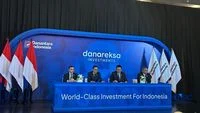
Jakarta, Indonesia — In a monumental strategic pivot for Indonesia’s state-owned enterprise (SOE) sector, the shareholders of PT Danareksa (Persero) have officially sanctioned a corporate metamorphosis, renaming the venerable institution as PT Kawasan Industri Indonesia (Persero). The resolution, formally ratified on November 9, 2026, marks the definitive end of Danareksa’s legacy as a multi-sector state-owned holding entity. Moving forward, the corporation will streamline its vast operational portfolio to focus exclusively on the strategic management, governance, and large-scale development of industrial estates nationwide.
This sweeping corporate overhaul is designed to optimize state assets, consolidate industrial zone management under a single, highly specialized command structure, and sharpen Indonesia’s competitive edge in attracting foreign and domestic direct investment. Alongside the historic rebranding, the company has announced a transitional executive leadership team tasked with steering the newly minted entity through its next phase of national and regional expansion.
Strategic Restructuring and Leadership Transition
Concurrent with the corporate renaming, the newly designated PT Kawasan Industri Indonesia (Persero)—operating through its investment management arm—has established a comprehensive new board of directors. The newly appointed executive lineup brings together seasoned professionals tasked with navigating complex regulatory environments, financial operations, and market expansion strategies.
According to the official corporate disclosures, Hardiyanto Pilia has been appointed to the dual role of Director of Finance and Operations, while simultaneously assuming responsibilities as the Acting (Plt.) President Director. Pilia’s immediate mandate involves overseeing the delicate operational transition from a multi-sector holding structure to an industrial-estate-focused powerhouse, ensuring that financial integrity and operational continuity remain uncompromised during the shift.
Supporting the executive office is Arief Budiman, who has been named Director of Marketing and Products. Budiman will spearhead initiatives to enhance the value proposition of Indonesia’s state-managed industrial zones, targeting high-tech manufacturers, green energy transition industries, and global supply chain operators looking to establish footprints in Southeast Asia’s largest economy.
Risk governance and regulatory compliance will be directed by Ade Santoso Djajanegara, who assumes the role of Director of Risk Management and Compliance. Given the capital-intensive nature of industrial estate development—which frequently involves complex environmental impact assessments, land acquisition protocols, and cross-border commercial agreements—Djajanegara’s portfolio will play a foundational role in maintaining institutional transparency and risk mitigation.
Rounding out the executive board is Ari Adil, who has been assigned the position of Director of Investments. Adil’s strategic focus will center on identifying capital deployment opportunities, securing project financing, and fostering public-private partnerships to accelerate the expansion of industrial infrastructure.
Corporate governance protocols dictate that the appointments of these newly designated executives will become formally and legally effective pending the successful completion and clearance of the Fit and Proper Test administered by the Financial Services Authority (Otoritas Jasa Keuangan – OJK).
The official executive composition of the newly rebranded entity is structured as follows:
- Acting (Plt.) President Director: Hardiyanto Pilia
- Director of Finance and Operations: Hardiyanto Pilia
- Director of Marketing and Products: Arief Budiman
- Director of Investments: Ari Adil (Pending final OJK Fit and Proper Test clearance)
- Director of Risk Management and Compliance: Ade Santoso Djajanegara
Continuity of Legal Status and Contractual Obligations
To maintain market confidence and ensure stability across its vast operational network, corporate legal counsel has confirmed that the rebranding initiative does not alter the underlying legal entity status of the corporation. PT Kawasan Industri Indonesia (Persero) remains the direct legal successor to PT Danareksa (Persero) in all capacities.
Consequently, all existing rights, statutory obligations, ongoing commercial agreements, and legal contracts established with business partners, third-party vendors, financial institutions, and internal personnel remain fully valid and enforceable. The corporate transition is designed to be seamless, ensuring that ongoing infrastructure projects, lease agreements, and tenancy arrangements within the managed zones experience zero disruption.
Portfolio Footprint: Scale and Economic Impact
The newly focused industrial holding entity inherits a formidable real estate and infrastructure portfolio. Currently, the corporation oversees seven major industrial estates spanning a combined area of 7,706 hectares. These strategic assets are geographically diversified across five key provinces, stretching from Sumatra and Java to Sulawesi, thereby positioning the enterprise as a vital anchor for regional economic development and equitable growth.
This expansive footprint is not merely a matter of acreage; it represents a critical pillar of Indonesia’s industrial ecosystem. Within these seven managed estates, more than 1,200 manufacturing, logistics, and technology enterprises—representing capital investments originating from 25 different countries—conduct their daily commercial operations. Together, these tenants generate over 300,000 direct and indirect employment opportunities, serving as a primary driver of local livelihoods, skills transfer, and socioeconomic advancement in their respective regions.
Background Context and Chronology of the Transformation
To understand the magnitude of the November 9, 2026 restructuring, it is necessary to examine the historical trajectory of Danareksa. Established originally in the 1970s as a state-owned financial institution aimed at developing the Indonesian capital market, Danareksa evolved over subsequent decades into a sprawling multi-sector holding company. It accumulated diverse portfolios ranging from financial services and capital market investments to construction, media, and infrastructure assets.
However, in recent years, the Ministry of State-Owned Enterprises (SOE Ministry) embarked on an aggressive rationalization campaign. The overarching policy objective of the ministry has been to eliminate redundancies, reduce conglomerate bloat across state portfolios, and compel SOEs to specialize in core competencies. The consolidation of state-owned industrial estates—which were previously managed under fragmented entities—began taking shape years prior, as the government recognized the urgent need to create a unified national champion capable of competing directly with private sector industrial developers and regional neighbors such as Vietnam, Thailand, and Malaysia.
The culmination of this long-term policy vision materialized on November 9, 2026, when shareholders formally voted to strip away non-core mandates and officially rebrand the parent holding company as PT Kawasan Industri Indonesia (Persero). This chronological progression underscores a deliberate policy shift from a generalized investment holding model to a focused, asset-backed industrial infrastructure specialist.
Strategic Implications and Market Analysis
Financial analysts and industrial real estate experts have largely welcomed the restructuring, viewing the shift as a necessary and timely evolution. By shedding its multi-sector holding identity, the company can now direct 100% of its managerial focus, capital allocation, and strategic planning toward the burgeoning demands of modern industrial real estate.
Key implications of this corporate transformation include:
- Streamlined Decision-Making and Capital Allocation: Without the distraction of managing disparate financial and commercial subsidiaries outside its core expertise, the executive board can concentrate capital expenditure on upgrading infrastructure, expanding land banks, and implementing smart-factory ecosystems within its estates.
- Enhanced Attractiveness for Foreign Direct Investment (FDI): Global multinational corporations seeking "China+1" supply chain diversification increasingly demand high-specification, sustainable, and digitally integrated industrial parks. A dedicated national champion focused exclusively on industrial estate management is better positioned to market Indonesia as a premier destination for high-value manufacturing.
- Synergy and Economies of Scale: Operating seven industrial zones across five provinces allows the company to standardize operational excellence, negotiate bulk infrastructure procurement (such as power and water supply), and share best practices in environmental management and labor relations across all sites.
- Alignment with National Decarbonization Goals: Modern industrial estates are no longer judged solely by square footage and logistical connectivity, but also by their environmental credentials. The specialized holding company is now structurally aligned to fast-track the integration of renewable energy sources, waste-to-energy circular economies, and green building certifications across its 7,706-hectare portfolio.
Forward Outlook and Commitments
Looking ahead, the leadership of PT Kawasan Industri Indonesia (Persero) has articulated a clear, forward-looking agenda. The corporate strategy centers on deepening structural synergies among its geographically diverse industrial zones, continuously reducing administrative friction to improve the ease of doing business for foreign and domestic tenants, and pioneering the development of next-generation, sustainable industrial hubs.
As Acting President Director Hardiyanto Pilia and his newly appointed executive team prepare to finalize their regulatory clearances with the OJK, the company stands at a critical juncture. With a massive asset base, a proven tenant ecosystem supporting over 300,000 workers, and a streamlined mandate, PT Kawasan Industri Indonesia (Persero) is well-positioned to serve as a cornerstone of Indonesia’s industrialization strategy for the decades to come.
