
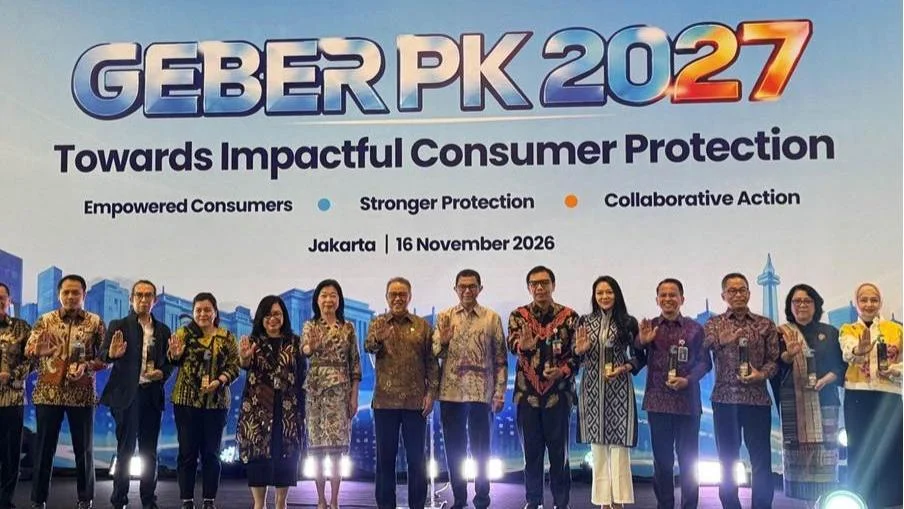
The architectural framework governing Indonesia’s digital financial landscape underwent a significant fortification as Bank Indonesia (BI) and the Financial Services Authority (OJK) officially cemented a landmark synergy aimed at tightening cross-sectoral oversight and consumer safeguarding mechanisms. The formalization took place via the signing of a Joint Implementation Guideline (Petunjuk Pelaksanaan Bersama) regarding the operationalization of the Financial Sector Alternative Dispute Resolution Agency, widely known in the jurisdiction as LAPS-SK. This high-profile accord was formally unveiled to the public and industry stakeholders during the grand inauguration of the Kick-Off Gerakan Bersama Pelindungan Konsumen (GEBER PK) 2027, hosted in the nation’s capital of Jakarta.
This collaborative masterstroke arrives at a critical juncture for Southeast Asia’s largest economy, where the acceleration of digital transformation, e-commerce integration, and instantaneous payment rails has fundamentally reshaped consumer behavior. By bridging the operational gap between banking oversight, capital market regulation, and digital payment systems, the initiative seeks to guarantee that the unprecedented expansion of the national digital economy remains firmly anchored in the foundational pillars of robust security, procedural fairness, uncompromising transparency, and sustainable public trust.
The Exponential Rise of Digital Transactions and the Fragility of Public Trust
Providing keynote insights during the inauguration, Bank Indonesia Deputy Governor Filianingsih Hendarta emphasized that the dizzying pace of digital transaction adoption must be matched step-for-step by an equally resilient, proactive, and dependable consumer protection architecture. This imperative is underscored by the meteoric rise of the Quick Response Code Indonesian Standard (QRIS), a homegrown payment breakthrough that has successfully penetrated the farthest reaches of the archipelago. Recent operational metrics reveal that QRIS has surpassed a staggering milestone of 70 million active individual users and over 49 million registered merchants, driving a cumulative transaction volume that has decisively breached the 20 billion mark.
Filianingsih articulated a profound perspective regarding the psychological and structural economics of the digital age, characterizing consumer trust as an invisible yet irreplaceable infrastructure underpinning all modern financial activities. "Membangun kepercayaan membutuhkan waktu bertahun-tahun, tetapi menghancurkannya hanya membutuhkan beberapa detik, dan memperbaikinya membutuhkan waktu yang sangat lama," Filianingsih stated, capturing the delicate equilibrium required to maintain ecosystem integrity in an era defined by instantaneous connectivity and cyber-enabled financial interactions.
Despite the undeniably progressive trajectory of financial inclusion, empirical gauges reveal underlying vulnerabilities that necessitate immediate, targeted regulatory interventions. According to the comprehensive findings of the 2026 National Payment System Consumer Empowerment Survey, known locally as the Survei Nasional Pelindungan Konsumen Sistem Pembayaran (IKK-SP), the National Consumer Empowerment Index currently stands at 77.03 percent. While this figure marks a notable and encouraging upward revision of 12.36 points compared to the baseline metrics recorded in 2023, structural analysts and consumer advocates emphasize that this score still hovers precariously within the critical category. This classification signals that while consumers are increasingly engaging with digital platforms, their operational literacy, risk awareness, and navigational capabilities regarding dispute resolution require significantly sharper, highly targeted educational campaigns and protective frameworks.
Streamlining Redress: The Expansion and Operational Mechanics of LAPS-SK
To address the friction points inherent in modern financial disputes, the integration of LAPS-SK serves as a critical institutional bridge. Sally Marintan Hutapea, Head of BI’s Department of Payment System Surveillance and Consumer Protection (DSPK), elaborated on the operational scope of the newly expanded framework, noting its design to seamlessly harmonize civil dispute resolution mechanisms across the entire spectrum of financial services and payment systems outside the traditional, often protracted, judicial court system.
"Kami telah melakukan penguatan kerangka PBI dan PADG Pelindungan Konsumen Bank Indonesia untuk mengantisipasi risiko baru dan juga mencakup penyelesaian sistem pembayaran melalui LAPS SJK yang akan menjadi momentum penting untuk menghubungkan edukasi, pencegahan, penanganan pengaduan, hingga penyelesaian," Sally explained, highlighting how the updated Bank Indonesia Regulation (PBI) and Member of the Board of Governors Regulation (PADG) proactively anticipate emerging technological and operational risks.
Under the optimized mechanics of LAPS-SK, civil complaints and commercial disagreements that fail to reach an amicable resolution or satisfactory settlement during the primary internal grievance phase—formally classified as Internal Dispute Resolution (IDR) managed directly by financial service providers—can now be escalated to an independent, binding, and efficient alternative forum. This pathway bypasses the cumbersome backlog of conventional civil courts, saving both consumers and institutional providers valuable time and capital while ensuring equitable outcomes.
The Three Strategic Pillars of GEBER PK 2027 and the Imperative of Preventive Defense
Operating under the overarching theme "Towards Impactful Consumer Protection," the GEBER PK 2027 initiative is methodically structured around three robust and mutually reinforcing strategic pillars designed to transform consumer behavior and industry accountability from the ground up:
1. Empowered Consumers (Konsumen Berdaya)
This foundational pillar is dedicated to systematically elevating the operational competence and risk awareness of everyday citizens. By fostering an environment where consumers possess the innate ability to accurately recognize sophisticated financial risks, execute safe transactional behaviors, and fully understand their legal rights and institutional recourse channels, the initiative aims to build a human firewall against fraud. Central to this pillar is the aggressive optimization of preventive public awareness campaigns anchored by the intuitive, highly memorable anti-fraud slogan: "Kalau Ragu, Stop Dulu" (If in doubt, stop right there). This simple yet potent cognitive speed bump is deployed across national media channels to inoculate the populace against social engineering tactics, phishing schemes, and complex digital fraud models.
2. Stronger Protection (Pelindungan Semakin Kuat)
Shifting the burden of responsibility squarely onto corporate actors, this pillar demands uncompromising accountability from all Payment System Service Providers (Penyelenggara Jasa Sistem Pembayaran / PJSP) and Financial Service Business Actors (Pelaku Usaha Jasa Keuangan / PUJK). Financial institutions are legally and operationally mandated to embed rigorous consumer protection principles directly into the foundational lifecycle of product design, technological deployment, algorithm transparency, and the end-to-end management of customer grievances. Compliance is no longer viewed as a peripheral checklist item but as a core metric of institutional viability.
3. Collaborative Action (Ekosistem Berkolaborasi)
Recognizing that systemic financial fraud and consumer vulnerability cannot be combated by regulatory fiat alone, this pillar fosters multi-sectoral synergy. It unites a diverse array of stakeholders, including cross-ministerial government bodies, independent regulatory agencies, prominent industry associations such as the Indonesian Payment Systems Association (ASPI), the Indonesian National Banks Association (Perbanas), and the Indonesian Fintech Association (AFTECH), alongside academic institutions, mainstream media organizations, and regional municipal governance bodies.
Confronting the Cybercrime Epidemic: Data Insights from the Indonesia Anti-Scam Center
The urgency driving the synchronized deployment of GEBER PK 2027 is powerfully substantiated by stark empirical realities regarding contemporary digital financial crime. Statistical tracking compiled by the Indonesia Anti-Scam Center (IASC) as of October 2026 reveals a staggering volume of illicit activities plaguing the financial ecosystem. The center recorded over 702,000 distinct formal reports detailing fraudulent financial transactions, highlighting the pervasive and systemic nature of cyber-enabled economic offenses targeting Indonesian citizens.
In response to these pervasive threats, coordinated inter-institutional interventions have demonstrated tangible efficacy. Operational freezing mechanisms executed through the IASC successfully intercepted and blocked illicit financial flows totaling an impressive Rp825 billion. Furthermore, proactive recovery operations successfully repatriated and restored Rp207 billion in stolen funds back to verified victims. However, the sheer magnitude of unrecovered losses underscores the reality that reactive containment, while vital, is inherently insufficient.
Dicky Kartikoyono, Head of Executive Supervision for Financial Service Business Actor Behavior, Education, and Consumer Protection, as well as a Member of the OJK Board of Commissioners, emphasized that the philosophical paradigm of regulatory oversight must pivot definitively away from post-crisis damage control toward aggressive, preemptive containment.
"Pengaduan adalah titik ketika konsumen sudah mengalami masalah, itu terlambat. Pelindungan yang efektif itu bekerja jauh sebelum itu, harus lebih proaktif di depan," Dicky asserted, drawing a sharp operational line between old-world compliance and modern proactive governance. He further underscored that safeguarding the financial consumer base cannot be outsourced to regulators alone, but demands an unyielding, synchronized collective commitment from corporate boardrooms, operational executives, and supervisory authorities alike.
Analytical Implications: Toward a Resilient and Inclusive Digital Future
The formalization of the BI-OJK operational synergy and the robust rollout of GEBER PK 2027 carry profound implications for the trajectory of Indonesia’s macroeconomic development and digital maturity. As the nation aggressively pursues its broader national digital transformation agenda, maintaining public confidence is the singular variable that will determine whether financial inclusion translates into genuine economic empowerment or exposes vulnerable demographics to predatory exploitation.
By standardizing alternative dispute resolution through LAPS-SK, institutionalizing the ‘Kalau Ragu, Stop Dulu’ behavioral safety mantra, and forcing financial institutions to internalize consumer protection costs from product inception, Indonesian authorities are constructing a resilient regulatory fortress. If executed with the sustained vigor promised at the Jakarta kick-off event, these synchronized measures will likely serve as a regulatory benchmark for emerging digital economies across the Global South, proving that rapid financial technological innovation and uncompromising consumer protection can—and must—coexist harmoniously.
