
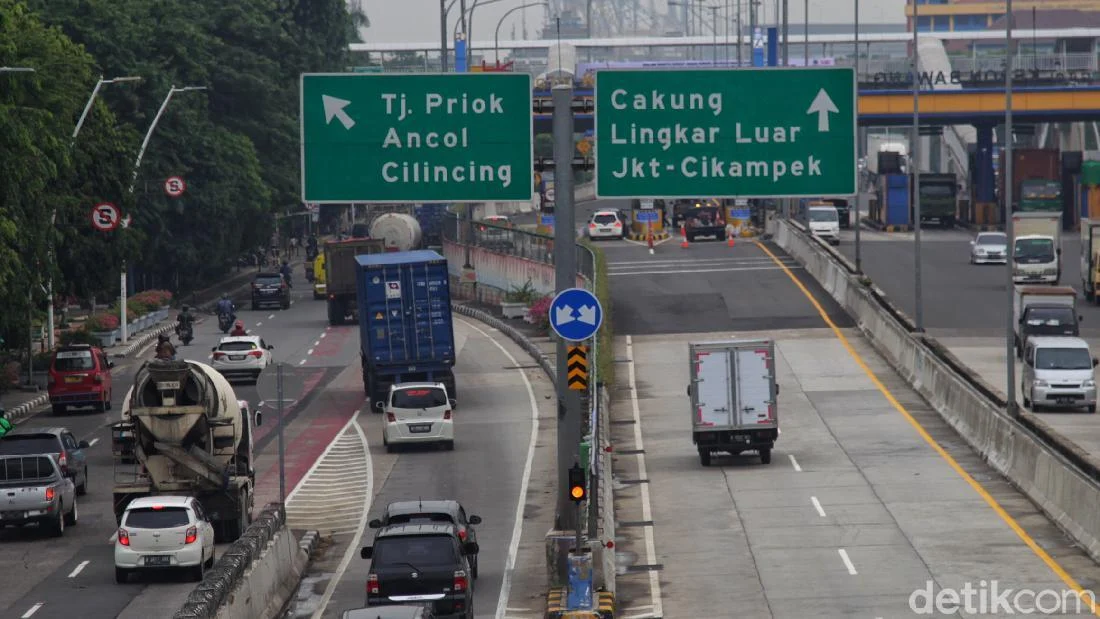
Jakarta – The prospect of implementing an integrated toll tariff system across the Greater Jakarta (Jabodetabek) region has garnered overwhelming public backing, particularly from logistics operators and daily commuters who rely heavily on highway networks for their economic activities. Recent findings from an online survey conducted by the Indonesian Empowered Consumer Forum (FKBI) reveal that a significant 74.1% of respondents strongly support the consolidation and harmonization of toll tariffs within the capital’s sprawling metropolitan area. This overwhelming endorsement underscores a widespread public consensus that the current fragmented toll system requires structural reform to alleviate mounting traffic congestion and streamline transportation costs.
The central challenge facing policymakers and infrastructure stakeholders moving forward lies in engineering a comprehensive tariff scheme that concurrently achieves three critical objectives: facilitating smoother vehicular movement, maintaining affordable cost structures for end-users, and optimizing freight access to vital industrial corridors and major maritime gateways. As logistical demands grow alongside urban expansion, the Indonesian government is actively refining the regulatory frameworks necessary to accelerate the execution of this long-awaited toll road integration project.
Current Regulatory Progress and Government Stance
Ministry of Public Works officials are currently working to finalize the regulatory groundwork required to expedite the nationwide and regional toll road integration policies. Sony Sulaksono Wibowo, a member of the Toll Road Regulatory Agency (BPJT) operating under the Ministry of Public Works, emphasized the urgency of completing the administrative harmonization process.
"The expectation is that the harmonization will be finalized swiftly and the ministerial regulation can be signed immediately so that the toll road integration can be implemented promptly. The ultimate goal is to smoothen traffic flows through a more balanced distribution of vehicles and optimize interconnected road segments," Sony stated in an official release.
A cornerstone of this integration strategy involves critical logistics corridors, specifically the alignment of tariffs across the Cibitung-Cilincing Toll Road, the Jakarta-Cikampek Toll Road, and the Tanjung Priok Access (ATP) Toll Road. By harmonizing pricing structures across these vital arteries, the government anticipates a substantial improvement in the seamless flow of freight from sprawling manufacturing hubs directly into the Port of Tanjung Priok, Indonesia’s busiest maritime logistics nexus.
Evolution of the National Toll Road Network
The foundational planning for these integration efforts traces back to the broader vision outlined in the National Toll Road Network General Plan for 2020–2040, which formally conceptualized individual toll segments as a unified, cohesive transportation system rather than isolated commercial corridors. However, the practical realization of this network-wide vision has historically been encumbered by several systemic hurdles.
Disparities in development timelines, unexpected delays in the construction of supporting feeder routes, and wide variations in pricing structures have collectively created structural imbalances. Consequently, certain toll segments experience severe chronic congestion, while alternative routes remain critically underutilized by motorists and freight operators alike.
Integration aims to correct these infrastructural imbalances by ensuring that interconnected segments functionally support one another as a single, harmonious transit organism. By distributing traffic more equitably across the entire regional grid, urban planners hope to mitigate bottlenecks that currently plague key commuter and commercial pathways.
The Logistics Perspective: Balancing Costs and Efficiency
While passenger vehicle commuters stand to benefit from streamlined travel times and simplified payment structures, the logistics sector views the integration initiative through a more complex lens of operational expenditure and razor-thin profit margins. Ahmad Sugiono, a representative of the Indonesian Logistics and Forwarder Association (ALFI) Jakarta chapter, pointed out that total logistics costs are shaped by a multitude of intersecting economic variables, with toll tariffs serving as a major cost component capable of severely compressing business margins in an intensely competitive market.
In standard freight contracting and fixed-travel-allowance arrangements, shaving an hour or two off a journey via a toll road does not automatically incentivize drivers to abandon arterial roads if the total financial outlay for the trip increases disproportionately. Sugiono stressed that the utility of toll roads must be evaluated within the broader context of the entire logistics ecosystem. This includes accounting for pre-toll congestion bottlenecks, route flexibility, trip frequencies, and the economic viability of securing return loads.
"The use of toll roads needs to be viewed from the perspective of the overall logistics ecosystem, including congestion before entering the toll road, route flexibility, trip frequency, and the opportunity to obtain return cargo. Therefore, the calculation is not solely based on travel time," Sugiono explained.
Strategic Function and Pricing Disparities
Echoing the necessity for a nuanced approach, Gibran Sesunan, Executive Director of the Center for Strategic Infrastructure Studies (PUKIS), argued that the formulation of toll tariffs must fundamentally reflect the distinct functions and primary socio-economic objectives of individual road segments. A generalized, one-size-fits-all tariff categorization based purely on vehicle axles is insufficient to address the vastly different operational realities between passenger-heavy commuter routes and dedicated freight corridors.
Sesunan emphasized that tariff frameworks should incorporate strategic functionality, distinct traffic characteristics, and the broader socio-economic utility of each specific corridor. Ensuring that tariff rates remain affordable is seen as a vital catalyst for compelling both the general public and commercial enterprises to maximize their utilization of high-speed infrastructure.
"For segments constructed specifically as logistics routes, freight transport should ideally receive more affordable tariffs to encourage their utilization. Tariff policies must take into account the function and service objectives of each respective segment," Sesunan asserted.
Operational Realities for Freight Drivers
Adding to the industry critique, Sugi Purnoto, a Senior Consultant at Supply Chain Indonesia, highlighted that route selection by heavy vehicle operators is ultimately dictated by the adequacy of the travel allowances provided to drivers. These operational funds must cover a wide array of immediate financial necessities, including driver compensation, daily subsistence, fuel expenses, toll fees, and cargo loading and unloading costs.
Preliminary operational simulations conducted by industry analysts reveal that toll fees on currently utilized routes typically consume between 7% and 14% of a driver’s total travel allowance. However, under certain proposed configurations or specific logistics-focused toll alignments, that financial burden could spike dramatically, consuming up to 28% to 40% of the allocated funds. Such a sharp increase in fixed transit costs would severely restrict the financial flexibility needed to cover other essential operational requirements.
"Physical connectivity must be supported by tariffs that allow drivers to meet their operational needs. If the financial burden increases significantly, drivers may continue to choose existing arterial routes despite facing severe congestion or heightened safety risks," Sugi warned.
Implications and Future Outlook
The ongoing discourse surrounding the Jabodetabek toll tariff integration highlights a critical juncture in Indonesia’s urban and economic infrastructure development. While the high level of public support—reaching over 74%—demonstrates a clear demand for administrative and structural reform, the success of the policy will heavily depend on the government’s ability to balance macroeconomic efficiency with micro-level operational realities.
As the Ministry of Public Works and the BPJT move closer to formalizing the necessary ministerial regulations, policymakers face the delicate task of crafting a pricing architecture that bridges the gap between commuter convenience and commercial viability. If successfully executed, an integrated Jabodetabek toll system has the potential to transform regional mobility, reduce logistics friction, and bolster Indonesia’s broader economic competitiveness. However, failing to address the legitimate cost concerns of the logistics and freight sectors risks undermining the very efficiencies the integration policy seeks to achieve.
