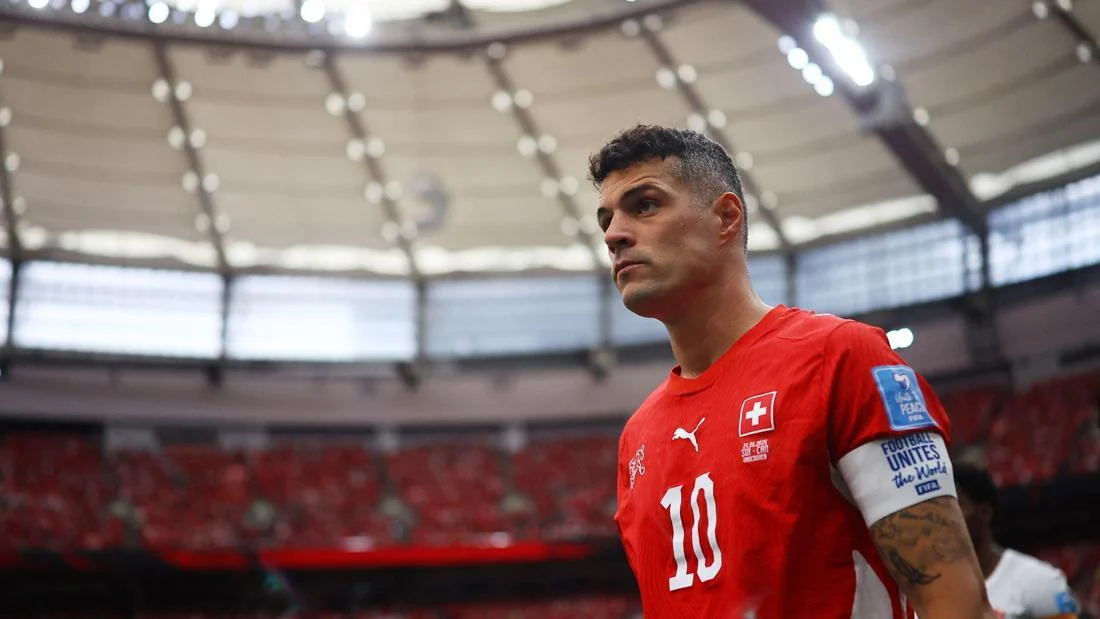
The world of international football has been rocked by an unexpected legal and ethical controversy involving one of its most recognizable figures. Granit Xhaka, the experienced captain of the Switzerland national team and current midfielder for English club Sunderland, is facing a formal investigation by the Public Prosecutor’s Office in Lucerne, Switzerland. The inquiry centers on the acquisition and use of a fraudulent COVID-19 vaccination certificate during the height of the global pandemic.
The revelation has sent shockwaves through the Swiss football federation, temporarily halting Xhaka’s illustrious international career as he steps away from upcoming UEFA Nations League fixtures against North Macedonia, Scotland, and Slovenia. For a player who has long served as the heartbeat and moral compass of La Nati on the pitch, this scandal marks a dramatic departure from his usual leadership image, forcing the 33-year-old midfielder to confront the legal and public relations fallout of a decision made under duress and skepticism years prior.
The Chronology of Skepticism and Deception
To understand how a veteran professional athlete found himself embroiled in a criminal investigation, it is necessary to examine the timeline of events that began during the peak years of the global health crisis.
In 2022, Granit Xhaka contracted COVID-19, an experience that heightened his personal anxieties surrounding the virus and the rapid deployment of medical countermeasures. Despite widespread public health campaigns and strict international travel mandates enforced by governments and sports governing bodies alike, Xhaka harbored deep-seated doubts regarding the safety and efficacy of the vaccines then available.
As global restrictions tightened and international football fixtures resumed, possessing official proof of vaccination—frequently referred to colloquially as a "sacred document"—became an unavoidable prerequisite for travel, border crossings, and entry into various sporting venues across Europe. Rather than consulting medical professionals, epidemiologists, or team doctors associated with his clubs or the Swiss Football Association, Xhaka allowed fear and emotional distress to dictate his actions.
Approximately one year after his initial infection, in 2023, the midfielder obtained a COVID-19 vaccination certificate. However, instead of receiving the immunization through official health channels, the document was acquired fraudulently. For a period, the fake certificate allowed him to bypass travel restrictions, but lingering administrative and forensic checks by Swiss authorities ultimately flagged the document as counterfeit, initiating the ongoing probe by the Lucerne public prosecutor.
Public Confession and Full Accountability
Faced with mounting scrutiny and the inevitability of a formal legal inquiry, Xhaka chose to address the allegations directly, releasing a transparent and remorseful statement via his social media channels. Rather than evading the issue or issuing defensive denials, the veteran midfielder owned up to his actions without reservation.
"In recent days, there has been media coverage regarding my situation, and I want to clear it up myself," Xhaka stated publicly. Reflecting on his mindset during the pandemic, he added, "Regarding the COVID-19 vaccine, I had doubts at the time and thought twice about it. I did not trust the vaccine and was clouded by worry and fear."
Admitting that he sought a shortcut during a period of emotional vulnerability, Xhaka continued, "When my emotions were unstable, I chose to purchase that certificate rather than asking the experts. Today, I realize that action was completely wrong. It was a huge mistake, and I deeply regret it."
Crucially, the Sunderland player emphasized his commitment to cooperating fully with the legal authorities handling his case in his home country. "I am ready to take responsibility for my decision. I am fully committed to undergoing the investigation and will cooperate completely with the relevant authorities," the 33-year-old affirmed.
The Immediate Sporting Implications for Switzerland and Sunderland
The immediate consequence of the investigation is a significant sporting blow to both the Swiss national team and Sunderland. Xhaka’s absence from upcoming fixtures in the UEFA Nations League leaves a massive void in the heart of the Swiss midfield.
Switzerland manager and technical staff now face the arduous task of rearranging their tactical blueprint without their captain and emotional anchor. Xhaka’s leadership has been a cornerstone of Swiss success on the international stage for over a decade. His absence against competitive opponents such as North Macedonia, Scotland, and Slovenia forces the team to test its depth and resilience during a crucial competitive cycle.
At the club level, Sunderland is monitoring the situation closely. Having signed the veteran midfielder to bolster their squad with elite Premier League and international experience, the club expects its players to adhere to legal and ethical standards both on and off the pitch. While the alleged offense occurred prior to his tenure with Sunderland and relates to pandemic-era regulations rather than current club operations, the reputational implications of a criminal investigation involving a high-profile captain require careful navigation by club management.
A Storied International Career Overshadowed
The unfolding legal drama threatens to temporarily overshadow what has otherwise been an exemplary international career. Granit Xhaka holds a legendary status within Swiss football history, having accumulated 153 international caps and scored 18 goals for La Nati.
His leadership was most recently on display during Switzerland’s impressive campaign at the 2026 FIFA World Cup, where his tactical intelligence, engine-room work rate, and inspirational captaincy propelled the team to a highly respectable quarterfinal finish. Throughout his career, Xhaka has represented some of Europe’s biggest clubs, including Borussia Mönchengladbach, Arsenal, and Bayer Leverkusen, earning a reputation as a fierce competitor and a natural leader.
However, legal experts note that document falsification—even when tied to pandemic-era health mandates—carries serious legal repercussions under Swiss law. Depending on the findings of the Lucerne Public Prosecutor’s Office, Xhaka could face financial penalties or other legal sanctions, though his immediate cooperation and public remorse are factors that prosecutors typically weigh when determining the severity of penalties.
Broader Impact and Ethical Precedents in Modern Football
The case of Granit Xhaka highlights a broader, uncomfortable chapter in the intersection of professional sports, public health, and the law during the COVID-19 pandemic. Elite athletes, despite their extraordinary physical conditioning and access to elite medical staffs, were not immune to the misinformation, fear, and psychological pressures that characterized the global health crisis.
During the pandemic, numerous sports organizations instituted strict vaccination mandates to protect athletes, staff, and the public. In response, a shadow market for counterfeit health documentation emerged across Europe, catching several public figures, influencers, and athletes in its net. Law enforcement agencies in Switzerland and across the continent have systematically investigated such fraud, treating forged health certificates as serious offenses due to the public health risks they posed at the time.
For football administrators, the incident serves as a stark reminder of the importance of continuous player education and psychological support. When athletes experience profound anxiety or skepticism regarding medical interventions, the failure to provide trustworthy, transparent guidance can lead individuals toward reckless and illegal decisions.
Conclusion and Outlook
As the investigation in Lucerne proceeds, Granit Xhaka finds himself at a critical juncture in his professional life. By choosing transparency and accepting full accountability, the Swiss captain has attempted to mitigate the long-term damage to his reputation, but the legal process must still run its course.
Whether Xhaka will return to the international fold following the conclusion of the inquiry remains to be seen, pending decisions from both the Swiss Football Association and the legal system. For now, one of modern European football’s most enduring leaders must step away from the pitch to answer for a mistake born of pandemic-era fear—a sobering reminder that even the game’s greatest captains are ultimately accountable to the law.