
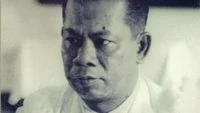
The early days of the Indonesian Republic were marked by fervent hope, fierce struggle, and profound tragedy. Among the most enigmatic and sorrowful chapters is the disappearance of Otto Iskandar Dinata, a prominent nationalist and one of the newly appointed State Ministers, who was abducted by an armed group and vanished without a trace in December 1945. His fate remains an unsolved mystery, a stark reminder of the volatile and dangerous environment in which Indonesia forged its independence. This historical event, fraught with foreign intrigue and internal strife, underscores the critical importance of national unity and vigilance against divisive forces, a lesson that resonates through the annals of history, much like the imperative for disaster mitigation in the face of natural calamities.
A National Hero’s Ascent: From Teacher to Nationalist Leader
Born in Bojongsoang, Bandung, West Java, on March 31, 1897, Otto Iskandar Dinata was destined for a path of service and leadership. His early education at the Hollandsch-Inlandsche School (HIS) in Bandung and later at the Kweekschool (teacher’s college) in Purworejo, Central Java, laid the foundation for a career initially rooted in education. He began teaching at a HIS in Banjarnegara, then moved to Bandung, but his intellectual curiosity and burgeoning nationalist sentiment soon drew him into the burgeoning Indonesian independence movement.
Otto quickly established himself as a fervent advocate for national self-determination. In the 1920s, he became actively involved with Boedi Oetomo, one of Indonesia’s earliest nationalist organizations. Founded in 1908, Boedi Oetomo initially focused on cultural and educational advancement for Javanese people, but gradually evolved to embrace broader political aspirations for an independent Indonesia. Otto’s eloquence and organizational skills quickly propelled him to prominence within the organization, where he served on its central board. His commitment to social justice and political reform was evident in his consistent critiques of Dutch colonial policies, particularly those that perpetuated inequality and suppressed indigenous voices.
His reputation as a courageous and outspoken leader earned him the moniker "Si Jalak Harupat," a Sundanese term referring to a brave fighting cock, symbolizing his unwavering spirit and resilience in the face of colonial oppression. This nickname, later immortalized as the name of a stadium in Bandung, became synonymous with his fierce dedication to the Indonesian cause.
As the nationalist movement gained momentum, Otto’s influence grew. He became a member of the Volksraad (People’s Council), a semi-legislative body established by the Dutch colonial government, intended to provide a limited forum for Indonesian representation. While often criticized as a mere façade for colonial rule, many nationalists, including Otto, used it as a platform to voice their demands for greater autonomy and eventually, independence. His tenure in the Volksraad saw him consistently advocating for Indonesian rights, pushing for educational reforms, and challenging discriminatory practices.
With the approach of Japan’s defeat in World War II, the opportunity for Indonesian independence became palpable. Otto was appointed as a member of the Badan Penyelidik Usaha-usaha Persiapan Kemerdekaan Indonesia (BPUPKI) or the Investigating Committee for Preparatory Work for Indonesian Independence, established by the Japanese in March 1945. This body was tasked with formulating the philosophical basis and constitutional framework for a future independent Indonesia. Otto’s contributions to the BPUPKI were significant, particularly in discussions concerning state ideology and the structure of government. Following the BPUPKI’s work, he was also selected as a member of the Panitia Persiapan Kemerdekaan Indonesia (PPKI) or the Preparatory Committee for Indonesian Independence, formed in August 1945. The PPKI was responsible for finalizing the constitution and formally proclaiming independence, which it did on August 17, 1945, with Sukarno and Hatta declaring Indonesia’s freedom. Otto’s presence in these crucial bodies underscored his pivotal role in the nation’s founding moments.
Post-Independence Turmoil and the Ministerial Role
The proclamation of independence on August 17, 1945, did not immediately usher in an era of peace and stability. Instead, Indonesia plunged into a chaotic and perilous period known as the Indonesian National Revolution (1945-1949). The nascent republic faced immense challenges: the returning Dutch colonial forces, the lingering presence of Japanese troops, and a myriad of internal armed groups with diverse loyalties and objectives.
Recognizing Otto Iskandar Dinata’s invaluable experience, leadership qualities, and unwavering patriotism, President Sukarno appointed him as one of the first State Ministers in the newly formed government. His portfolio was not specifically defined but broadly encompassed assisting in the crucial task of state-building, particularly the organization of a national military force. This was a monumental undertaking. The fledgling government inherited no unified armed forces. Instead, various paramilitary groups, often formed spontaneously or with Japanese training, existed across the archipelago. These included former members of the Pembela Tanah Air (PETA) and Heiho (Japanese-trained Indonesian auxiliary forces), as well as ex-soldiers from the Koninklijk Nederlands Indisch Leger (KNIL), the Dutch colonial army, who had defected to the Indonesian side.
The challenge was to consolidate these disparate elements – some loyal to Sukarno, others to local leaders, and still others driven by personal agendas or radical ideologies – into a cohesive national army. This process was fraught with difficulties, as each group harbored its own interests, operational methods, and loyalties, often leading to internal conflicts and power struggles. The lack of a central command structure, combined with limited resources and widespread communication breakdowns, made Otto’s task incredibly complex and dangerous.
The Web of Intrigue: Foreign Interference and Internal Strife
The chaos of the post-independence period provided fertile ground for external powers to sow discord. The Netherlands Indies Civil Administration (NICA), the Dutch military and civil administration attempting to re-establish colonial rule, actively sought to undermine the new Indonesian Republic. NICA’s strategy involved not only military incursions but also extensive propaganda and intelligence operations aimed at discrediting Indonesian leaders and fracturing national unity.
According to Iip D. Yahya, author of "Oto Iskandar di Nata: The Untold Stories" (2017), Otto Iskandar Dinata became a target of NICA’s insidious propaganda. False rumors were deliberately spread, accusing Otto of being a "Dutch spy." This accusation was particularly damaging given Otto’s prominent role in establishing the new government and his efforts to unify the armed forces. The aim was clear: to remove a key figure capable of strengthening the nascent nation’s cohesion and military might. By painting him as a traitor, NICA hoped to erode public trust in the revolutionary leadership and exacerbate existing internal divisions.
Adding another layer of complexity were the various irregular armed groups, or "laskar," that operated with varying degrees of autonomy. While many laskar groups genuinely fought for independence, some were opportunistic, driven by local power struggles, or susceptible to manipulation. One such group, the Laskar Hitam (Black Militia), played a central role in Otto’s tragic fate. These groups, often lacking formal military training or strict command structures, could be exploited by external forces or succumb to internal grievances.
Iip D. Yahya’s research also highlights another fabricated accusation leveled against Otto by elements within the Laskar Hitam: that he had absconded with one million Dutch gulden. This sum, a considerable fortune at the time, was allegedly war spoils seized from the Japanese. The accusation was used to further demonize Otto, portraying him as corrupt and allied with the former colonial power, even though the gulden was simply the prevailing currency and the funds were intended for the revolutionary cause. This demonstrates how easily misinformation and personal greed could intertwine during a period of immense instability, leading to tragic consequences for those caught in the crossfire.
The Fateful Disappearance: December 1945
The culmination of this volatile environment and targeted disinformation campaigns came on December 19, 1945. Otto Iskandar Dinata was in Tangerang, a region west of Jakarta, which was a hotbed of revolutionary activity and internal conflicts between various laskar groups. The exact circumstances leading to his presence there are still debated, but it is believed he was engaged in efforts to consolidate or mediate between armed factions.
On that fateful day, Otto was abducted by members of the Laskar Hitam. He was subsequently taken to the coastal area of Pantai Mauk, also in Tangerang. The details of his last moments are shrouded in mystery, with no definitive eyewitness accounts or concrete evidence ever emerging. After December 19, 1945, Otto Iskandar Dinata was never seen again.
The disappearance sent shockwaves through the nascent government, further highlighting the fragility of the new republic and the extreme dangers faced by its leaders. The chaos of the revolution meant that any immediate, organized search or investigation was severely hampered, if not impossible. The government was preoccupied with defending against Dutch military advances and consolidating its own authority, leaving little capacity for a thorough inquiry into the abduction of one of its own ministers.
The Unraveling Mystery and Lasting Legacy
In the immediate aftermath, rumors abounded, but no concrete evidence surfaced regarding Otto’s fate. The prevailing theory, widely accepted by historians and the Indonesian government, is that he was murdered by his captors and his body disposed of at sea. However, without a body or definitive proof, the exact circumstances of his death remain speculative.
Due to the absence of any certainty regarding his whereabouts or survival, the Indonesian government officially declared December 20, 1945, as the date of Otto Iskandar Dinata’s death. This decision, made in the years following the event, provided a necessary closure, albeit symbolic, for the nation and his family.
Seven years after his disappearance, in 1952, the Indonesian government held a symbolic funeral in Bandung. A coffin, containing not his physical remains but rather sand and seawater collected from Pantai Mauk, was interred at what is now Monumen Pasir Pahlawan (Monument of Hero’s Sand). This poignant gesture served as a powerful tribute to a hero who vanished in the service of his nation, his sacrifice commemorated even in the absence of a grave. The monument stands today as a testament to his enduring legacy and the unresolved mystery surrounding his demise.
In recognition of his immense contributions to the struggle for independence and his ultimate sacrifice, Otto Iskandar Dinata was posthumously declared a National Hero of Indonesia (Pahlawan Nasional Indonesia) by presidential decree on November 6, 1973. This official recognition cemented his place in the pantheon of Indonesian freedom fighters, ensuring that his name and story would be remembered by future generations.
Implications for a Nascent Nation
Otto Iskandar Dinata’s abduction and presumed death had profound implications for the nascent Indonesian Republic. Firstly, it underscored the extreme fragility of the new state and the immense personal risks undertaken by its leaders. The incident served as a stark reminder that even those at the highest echelons of government were vulnerable to the brutal realities of the revolution, where rule of law was still embryonic and armed groups wielded significant, often unchecked, power.
Secondly, the event highlighted the destructive power of misinformation and foreign interference. NICA’s propaganda, coupled with internal opportunism and lack of discipline among certain armed groups, created an environment where a respected national leader could be targeted and eliminated. This serves as a critical historical lesson about the dangers of allowing external forces to exploit internal divisions, a vulnerability that many developing nations have faced throughout history.
Thirdly, Otto’s disappearance contributed to the complex narrative of heroism and sacrifice that defines Indonesia’s revolutionary period. His unsolved fate adds a layer of tragic grandeur to his story, making him a symbol of the ultimate sacrifice made for national freedom. The symbolic burial, without a body, speaks volumes about the collective grief and the determination to honor those whose lives were consumed by the fires of revolution.
Finally, the enduring mystery surrounding Otto Iskandar Dinata’s disappearance continues to fascinate historians and the public. It prompts reflection on the chaotic nature of revolutions, where truth can be obscured, and justice can be elusive. The legacy of "Si Jalak Harupat" is not just about his achievements but also about the enduring questions surrounding his final moments, a testament to the turbulent birth of a nation. His story serves as a powerful historical analogue, reminding future generations that just as natural disasters necessitate preparedness and mitigation strategies, so too do political and social upheavals demand vigilance against the forces of division and misinformation that can undermine the very foundations of a nation. His sacrifice underscores the permanent need to safeguard national unity and maintain a strong, cohesive national identity against all forms of internal and external threats.

