
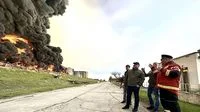
The geopolitical landscape of the ongoing Russia-Ukraine conflict witnessed a significant escalation this weekend, as a coordinated wave of drone strikes paralyzed critical infrastructure in the occupied Crimean Peninsula. The assault, which occurred on Saturday, October 24, resulted in widespread disruptions to electricity and water supplies, underscoring the increasing vulnerability of Russian-held territories to long-range aerial incursions. This development is part of a broader, synchronized campaign of drone warfare that has seen both nations exchange hundreds of unmanned aerial vehicles (UAVs) in a single night, marking a sharp uptick in the intensity of hostilities.
Sergei Aksyonov, the Russian-appointed head of the Crimean administration, confirmed the severity of the situation via his official Telegram channel. He acknowledged that the damage to key power transmission lines located outside the peninsula was a direct result of "enemy drone attacks." Consequently, regional authorities were forced to implement emergency rationing measures for both electricity and water to stabilize the grid. While Aksyonov did not provide an exact headcount of the households affected, the logistical strain on a region home to more than 2.5 million people is considerable. The disruption highlights a strategic shift in Ukraine’s military approach, moving beyond tactical battlefield engagements toward the systematic targeting of infrastructure that supports the Russian occupation.
Chronology of the Escalation
The events of October 24 represent a culmination of several months of escalating drone warfare. Since the onset of the full-scale invasion in February 2022, Crimea has served as a critical logistical hub for Russian forces, facilitating troop movements and the storage of naval assets.
- 2014-2021: Following the annexation of Crimea, Russia integrated the peninsula into its national power grid through the construction of the "Energy Bridge," reducing reliance on mainland Ukrainian electricity.
- Early 2024: Ukraine began prioritizing the neutralization of Russian air defense systems and fuel depots within the peninsula, utilizing Western-supplied and domestically produced long-range drones.
- October 24, 2024 (Overnight): Russian Ministry of Defense officials reported an unprecedented volume of activity, claiming that their air defense units successfully intercepted 616 Ukrainian drones across more than 20 Russian regions.
- October 24, 2024 (Morning): Reports emerged from Togliatti, an industrial city situated on the Volga River, detailing significant damage to industrial infrastructure caused by secondary drone strikes.
- October 24, 2024 (Concurrent): Simultaneously, the Ukrainian Air Force reported a massive retaliatory strike by Russia, which launched approximately 126 drones. Kyiv successfully intercepted 101 of these, though debris caused injuries and fires within the capital.
The Scale of Aerial Warfare
The figures provided by the Russian Ministry of Defense regarding the interception of 616 drones, while not independently verified, suggest a level of aerial saturation previously unseen in the conflict. Such an immense number of UAVs—ranging from low-cost FPV (First Person View) drones to sophisticated long-range strike platforms—indicates that both sides have effectively industrialized their drone production chains.
In Togliatti, the damage to industrial facilities is particularly concerning for the Russian economy. Togliatti is a vital hub for the automotive and chemical industries. By extending the reach of their drone program to cities hundreds of kilometers from the frontline, Ukrainian forces are signaling that no industrial center within Russia is beyond the reach of their asymmetric warfare capabilities.
Conversely, the Russian response—a strike package of 126 drones—demonstrates that Moscow maintains a robust capacity for retaliatory action. The incident in Kyiv, where two individuals were injured, reflects the grim reality for civilians living in Ukrainian urban centers, who remain under the constant threat of overnight bombardment targeting the nation’s energy grid as winter approaches.
Strategic Implications for the Conflict
The targeting of Crimean infrastructure serves several strategic purposes for Kyiv. First, it serves to erode the sense of normalcy that the Russian administration has attempted to cultivate in the occupied territory since 2014. By destabilizing power and water, Ukraine is demonstrating the fragility of the Russian occupation. Second, it forces the Russian military to divert air defense resources away from the front lines in the Donbas region to protect rear-echelon assets, thereby thinning the defensive umbrella protecting active Russian combat units.
Military analysts suggest that these strikes are part of a "degradation strategy." By creating constant anxiety within the Russian logistics chain, Ukraine aims to force Moscow into an untenable position: either accept the destruction of its infrastructure or exhaust its inventory of expensive surface-to-air interceptors on cheap, expendable drones.
Humanitarian and Economic Impact
For the 2.5 million residents of Crimea, the weekend’s events serve as a harsh reminder of the ongoing nature of the war. Electricity rationing, particularly as autumn transitions into winter, carries significant risks for heating and healthcare infrastructure. While the Russian authorities have promised rapid repairs, the difficulty of securing spare parts for high-voltage transmission lines under sanctions makes long-term stability uncertain.
In mainland Russia, the strike on Togliatti marks a psychological blow. The regional government has attempted to downplay the economic impact, focusing on the swift containment of fires, but the vulnerability of industrial hubs far from the border creates a perception of insecurity that challenges the narrative of a "special military operation" that does not touch the average citizen’s life.
Official Responses and International Observation
The Russian Ministry of Defense maintains that its defensive posture remains effective, citing the high interception rates as proof of the capabilities of their S-400 and Pantsir-S1 air defense systems. However, the recurring damage to critical infrastructure belies these claims.
The Ukrainian government, while rarely commenting on the specifics of individual drone operations, has maintained that all Russian military-linked infrastructure is a legitimate target. President Volodymyr Zelenskyy has repeatedly stated that Ukraine must demonstrate the ability to take the fight to the aggressor’s soil, ensuring that the cost of the war is felt by the Russian leadership.
International observers, including representatives from NATO and the United Nations, continue to monitor the escalation. There is growing concern that the shift toward large-scale, automated drone warfare increases the risk of collateral damage to civilian populations. The reliance on drone swarms, which are often prone to electronic interference and malfunctions, significantly elevates the risk of unintended civilian casualties.
Looking Ahead: The Drone Arms Race
The events of October 24 signify that the war has entered a new phase characterized by high-volume, low-cost attrition. As both nations continue to iterate on their drone designs, the focus is shifting toward "swarming" technologies—drones that can communicate with one another to bypass defensive patterns.
The sustainability of these campaigns remains an open question. Ukraine is heavily reliant on international partners for the components required for high-tech drone production, while Russia has increasingly turned to imports and partnerships with other nations to replenish its stocks. The ability to outproduce the opponent in terms of drone volume, while simultaneously developing better electronic warfare (EW) countermeasures to disable incoming enemy drones, will likely dictate the operational success of both sides in the coming months.
Ultimately, the disruption in Crimea is a microcosm of the wider war. It is a conflict that has become increasingly defined not by traditional artillery duels, but by the silent, lethal flight of drones over vast distances. As the cold weather settles over the region, the stability of power grids and the protection of industrial assets will remain the primary metrics by which the efficacy of both nations’ military strategies will be measured. For now, the residents of Crimea and the industrial workers of Togliatti are caught in the crossfire of a technological arms race that shows no signs of abating.

