
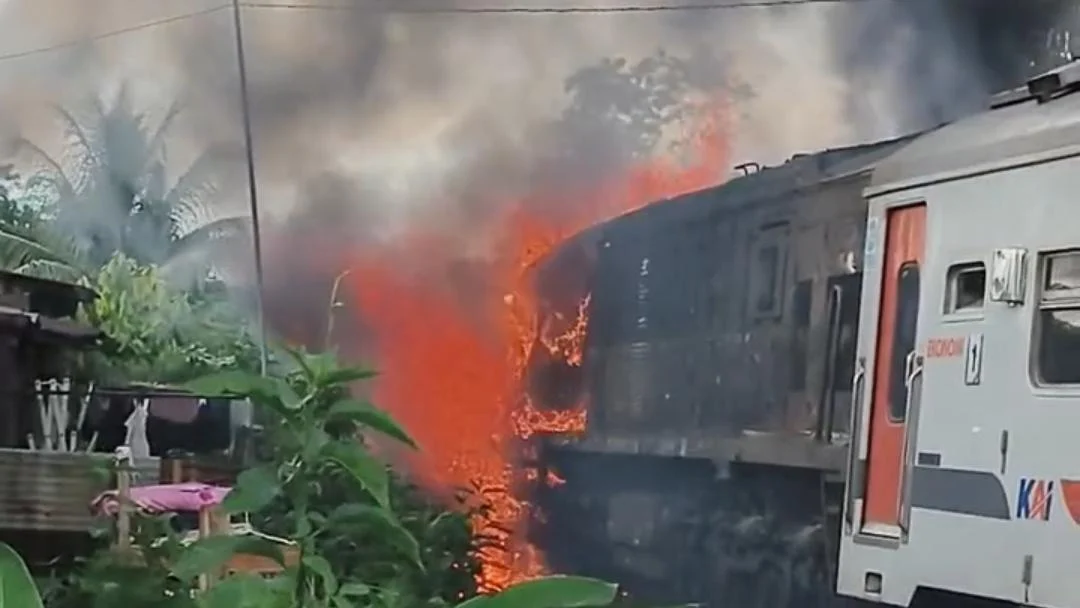
A tragic collision between the Siantar Ekspres passenger train operating on the Pematangsiantar-Medan route and a Sinar Tani minibus has ignited a broader national conversation regarding railway crossing safety, legal liability, and infrastructural negligence in Indonesia. The catastrophic crash, which occurred on Friday, November 20, 2026, resulted in the immediate death of the minibus driver and left three on-duty railway personnel severely injured with burn wounds. The impact triggered a massive fire that completely engulfed both the locomotive and the commercial vehicle, drawing widespread public shock and outrage as video footage of the aftermath circulated rapidly across various social media platforms.
This fatal incident in Sinaksak village, Tapian Dolok sub-district, Simalungun Regency, North Sumatra, serves as a grim reminder of the persistent dangers associated with unstaffed and illegal railway crossings. Despite continuous safety campaigns by transportation authorities, unauthorized level crossings remain an unmitigated hazard across the archipelago, functioning as ticking time bombs where inadequate surveillance, non-existent safety barriers, and a lack of proper signage frequently intersect with human error and driver recklessness.
As investigators piece together the sequence of events, the incident has prompted complex legal and ethical questions regarding accountability. When a fatal collision occurs at an unprotected intersection, determining who bears the ultimate responsibility involves a careful examination of statutory laws, investigative findings, and the fundamental duties incumbent upon both motorists and rail operators.
Chronology and Sequence of Events
The fateful morning began like any other for the crew of the Siantar Ekspres, which was transporting 264 passengers from Pematangsiantar toward Medan. As the locomotive approached the level crossing in Kelurahan Sinaksak, the operating conditions appeared routine until the Sinar Tani minibus entered the tracks. Despite the audible warnings and the train’s attempts to decelerate, the collision was unavoidable due to the short braking distance required by heavy rail transport.
Upon impact, the front of the train struck the minibus with tremendous force, dragging the vehicle a significant distance before coming to a complete halt. The violent friction and rupture of fuel lines instantly sparked a ferocious fire that engulfed the minibus and severely damaged the locomotive. Local residents and emergency responders rushed to the scene, managing to evacuate all 264 passengers safely before the flames could spread to the passenger cars. However, the intensity of the blaze trapped the minibus driver, who perished at the scene, and caused severe thermal burns to three railway crew members who were trapped inside the burning cab before being rescued by fellow workers and local volunteers.
Legal Framework and Driver Liability
Addressing the question of liability, transportation experts emphasize that legal responsibility must be established through strict adherence to prevailing traffic laws and objective investigative reports. Joni Martinus, a railway expert and the Head of the Railway Division for the Indonesian Transportation Society (MTI) in South Sumatra, elaborated on the legal standing of motorists at level crossings.
According to Law Number 22 of 2009 concerning Road Traffic and Transportation, specifically Article 114, vehicle drivers are legally mandated to exercise extreme caution when approaching and crossing railway tracks. The statute explicitly requires motorists to halt their vehicles when warning signals sound, when crossing gates begin to close, or when other clear warnings are present. Furthermore, drivers must prioritize oncoming trains and yield the absolute right-of-way to rail traffic, which inherently requires vast stopping distances compared to rubber-tired vehicles.
Martinus noted that motorists who bypass crossing barriers or ignore auditory and visual warnings are legally deemed negligent and in direct violation of traffic regulations. "Because of this negligence, the primary responsibility for the accident rests with the vehicle driver," Martinus explained. Motorists who survive such infractions face severe criminal penalties, including imprisonment and substantial fines. Conversely, PT Kereta Api Indonesia (KAI), the national railway operator, is generally exonerated from liability for the deaths of motorists who unlawfully breach crossings, provided that subsequent investigations reveal no operational negligence or regulatory breaches by the railway company itself.
Responsibilities Toward Injured Railway Personnel and Passengers
While the primary fault for the collision has been attributed to the motorist’s intrusion, the incident triggered immediate corporate and legal obligations concerning the welfare of the railway workers and passengers onboard.
PT KAI bore immediate responsibility for the medical treatment and psychological rehabilitation of the three crew members who sustained severe burn injuries while executing their professional duties. Under Indonesian labor laws and occupational health regulations, employers are strictly accountable for providing comprehensive medical care, compensation, and workplace accident protection for employees injured during active operations.
Simultaneously, the operator faces stringent statutory obligations toward the fare-paying passengers under Law Number 23 of 2007 on Railways. This legislation dictates that railway transport providers are legally liable for passenger safety and any losses incurred during transit. This encompassing duty of care requires PT KAI to cover all medical expenses for injured passengers, provide financial compensation to the families of any fatalities—had there been passenger casualties—and reimburse passengers for lost or damaged luggage resulting from operational accidents.
Broader Socio-Economic Impacts and the Threat of Illegal Crossings
While the 264 passengers onboard the Siantar Ekspres escaped physical harm, transportation analysts warn against trivializing the tragic loss of life. The death of the minibus driver and the grievous injuries sustained by the crew highlight a systemic crisis that extends far beyond a single isolated accident.
The crossing in Sinaksak where the tragedy occurred is classified as an illegal or unmanaged level crossing—a makeshift pathway created by local convenience without official authorization, safety gates, warning bells, or adequate lighting. Experts categorize these unauthorized crossings as dangerous loopholes in national transport infrastructure. Without immediate intervention, these unregulated intersections remain constant hazards capable of triggering catastrophic multi-fatality disasters.
Industry experts and community leaders have strongly urged the regional government of Simalungun Regency, PT KAI, and the Directorate General of Railways (DJKA) under the Ministry of Transportation to abandon passive monitoring in favor of decisive structural and administrative action.
Three Core Demands and Strategic Solutions
In the wake of the Simalungun disaster, transportation stakeholders have outlined a comprehensive three-point demand aimed at local and national authorities to prevent future tragedies across North Sumatra and the broader Indonesian rail network:
- Immediate closure and auditing of unauthorized crossings: Local authorities, in coordination with PT KAI and the DJKA, must systematically identify, seal, and close all illegal level crossings, starting with the perilous site in Sinaksak, alongside a comprehensive safety audit of all rural and urban level crossings across the province.
- Rigorous and unyielding law enforcement: Traffic authorities must enforce strict penalties against motorists, commercial transport operators, and pedestrians who flout safety signs, bypass closing gates, or attempt to outrun approaching locomotives at operational crossings.
- Sustained public education campaigns: Government agencies and railway operators must launch aggressive, community-wide educational initiatives to instill a culture of defensive driving, emphasizing the fundamental rule of stopping, looking both ways, and listening for train horns before crossing any railway line.
To address the macro-level challenge of level crossing safety, transportation planners have proposed three foundational pillars of remediation: infrastructural enhancement through grade separation (building flyovers and underpasses, despite their high cost and land acquisition hurdles); strict legal deterrence; and a cultural shift toward self-discipline among road users.
National Statistics on Level Crossing Accidents
The urgency of these measures is underscored by empirical data compiled over recent years, which reveals a persistently high volume of accidents and fatalities at unstaffed level crossings across Indonesia.
According to official transportation safety records, the four-year period leading up to the Sinaksak incident demonstrates alarming trends:
- In 2022, national transport authorities recorded 245 distinct accidents at unmanaged level crossings, resulting in 110 fatalities.
- In 2023, the number of accidents rose to 274 incidents, claiming 94 lives.
- In 2024, safety monitors documented 213 collisions, which tragically caused 123 deaths.
- In 2025, approximately 171 accidents occurred, leading to 106 fatalities.
These sobering statistics illustrate that level crossing accidents are not anomalous occurrences, but rather a persistent structural crisis claiming hundreds of lives annually. Experts emphasize that reducing these figures requires synchronized cooperation between federal regulators, regional administrations, railway operators, and individual citizens. As the investigation into the Siantar Ekspres and Sinar Tani collision continues, the tragedy stands as a solemn reminder that railway safety is a shared public responsibility where complacency carries a fatal price.

