
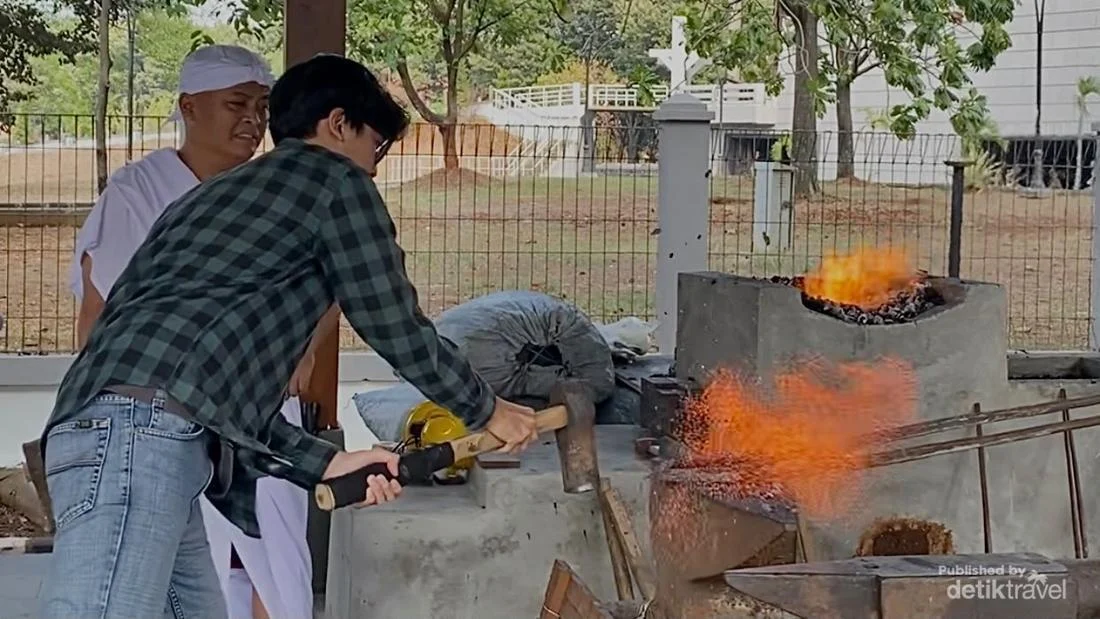
Jakarta — Seeking an unconventional weekend excursion that bridges Indonesia’s rich heritage with interactive tourism, visitors to the capital are increasingly turning their attention toward the cultural treasures housed within Taman Mini Indonesia Indah (TMII). Among the myriad pavilions and exhibitions scattered across the sprawling cultural park, the Museum Keris Indonesia offers a rare, immersive experience that transports participants back to the zenith of the archipelago’s ancient kingdoms. Far from being a passive gallery of static artifacts, the museum grounds have become a living classroom where both domestic and international travelers can step into a traditional forge and attempt the intricate craft of traditional blacksmithing without incurring any additional fees beyond standard park admission.
On a recent Sunday afternoon, the besalen—the traditional Javanese forge situated directly adjacent to the main museum building—bustled with a high level of activity. Dozens of visitors gathered with a palpable sense of anticipation, eager to witness the fiery spectacle and patiently waiting for their turn to wield a heavy smithing hammer. Guiding the crowd through this centuries-old craft was Didik Sudaryanto, an official educator at the Museum Keris Indonesia, whose detailed explanations and hands-on demonstrations provided a vital bridge between modern spectators and ancestral craftsmanship.
Unpacking the Ancestral Arsenal: Tools of the Master Smith
Before any physical labor begins in the besalen, the educational segment of the program establishes a foundational understanding of the specialized equipment required to shape molten metal into the sacred blade known as the keris. Didik meticulously introduces participants to the essential apparatus of the traditional smithy. Among these is the paron, a heavy anvil that serves as the unyielding foundation upon which white-hot iron is beaten into submission. Alongside the anvil stands the ububan, the traditional apparatus responsible for generating and sustaining the intense heat required to make iron malleable.
In contemporary operations, the traditional mechanism of the ububan has seen modernization through the integration of electric blowers. Historically, master smiths, known as empu, relied entirely on manual pump systems—often utilizing large wooden pistons packed with feathers or leather seals—to force continuous airflow into the charcoal hearth and maintain the precise temperatures necessary for metallurgical work. By contrasting these historical methods with modern adaptations, the educational program highlights how technological advancements have marginally eased the physical demands of the craft while preserving its core traditional integrity.
Once the equipment has been thoroughly explained, the demonstration transitions into the active phase of metalworking. Raw iron is placed within the hearth until it reaches a glowing, incandescent state. Once sufficiently heated, the glowing metal is rapidly transferred to the paron, where vigorous hammer strikes alter its physical form according to the demands of the design. Didik explains that the forging process is far from a singular, linear event. Instead, it involves a rigorous sequence of folding the metal—known as the tempa lipat technique—which ensures the homogenous distribution of carbon and creates the characteristic patterned layers, or pamor, that define a high-status keris. Following the repeated folding and hammering, the iron undergoes penyepuhan, a critical quenching process where the metal is plunged directly into a vessel filled with water and sacred floral offerings to lock in its structural temper.
"The metal is heated, forged, subjected to folded forging, and then immersed right here in the quenching phase," Didik detailed during a live demonstration at the TMII besalen, illustrating the cyclical nature of the craft.
The Physical Reality of the Forge: A Visitor Perspective
The apex of the program arrives when participants are invited to step up to the anvil and take their turn at the forge. Trading the role of a passive observer for that of an active participant, visitors are handed the traditional forging hammer to strike the incandescent iron under the watchful eye of the museum staff.
The transition from observation to execution reveals a stark reality: the physical exertion required to shape traditional steel is immense. The hammers utilized in the forge are deceptively heavy, demanding not only raw muscular strength but also acute physical balance and unwavering concentration with every downward arc. A misplaced strike or an uneven distribution of force can compromise the structural alignment of the metal, underscoring the high level of physical conditioning once required of historical armorers and weapon makers.
Despite the physical demands, the museum explicitly structures the activity to be accessible to all skill levels. Participants are not expected to forge a complete, finished weapon—an artistic feat requiring years of specialized apprenticeship—but rather to experience the visceral sensation of the primary shaping techniques.
"The goal is for visitors to experience the pure sensation of striking and forging metal, allowing them to witness firsthand what the process entails," Didik elaborated. "Historically, the general public rarely had the opportunity to observe these sacred metallurgical processes up close."
Safety, however, remains a paramount concern within the active workspace. Given the presence of open flames, extreme temperatures, and heavy flying sparks, museum educators enforce strict safety protocols. Participants are continuously reminded to maintain a safe operational perimeter around the forge and are strictly required to wear closed-toe shoes throughout the duration of the activity to mitigate the risk of industrial accidents.
The Temporal Scale of Traditional Metallurgy: From Minutes to Months
While a visitor’s stint at the besalen spans a matter of minutes, it serves as a microscopic glimpse into a macrocosm of patient, methodical labor. The brief hammering session experienced by tourists represents merely the opening chapter of a lengthy, meditative journey that defines authentic keris production.
According to institutional insights provided by museum staff, the creation of an authentic, high-grade keris by a master empu is an undertaking that demands extraordinary patience, often stretching across a timeline of seven to eight months. This extended duration accounts for the meticulous selection of raw ores, the complex layering and folding of the metal to achieve intricate pamor motifs, the careful carving of the wooden hilt (warangka and gandar), and the spiritual rituals traditionally accompanying the forging process. Even for simpler blades involving less complex folding structures and minimal decorative etching, completion typically requires a sustained period of two to three months of dedicated craftsmanship.
This stark contrast between instant modern gratification and the prolonged, meditative creation of heritage art provides a profound psychological takeaway for modern travelers. By engaging directly with the foundational steps of the craft, participants gain a renewed appreciation for the socio-cultural value embedded within traditional Indonesian weaponry—an art form recognized by UNESCO as a Masterpiece of the Oral and Intangible Heritage of Humanity.
Program Logistics and Strategic Implications for Cultural Tourism
For travelers wishing to incorporate this unique experience into their weekend itineraries, the Museum Keris Indonesia has structured the program for maximum accessibility. The live forging demonstrations and interactive sessions are held exclusively on Saturdays and Sundays. To accommodate visitor flow, the activities are divided into two distinct afternoon sessions: the first running from 15:00 to 15:30 Western Indonesia Time (WIB), and the second scheduled from 16:00 to 16:30 WIB.
Crucially, the activity is offered entirely free of charge to all registered park attendees, with no hidden fees or special workshop tickets required beyond the standard admission fee for entering Taman Mini Indonesia Indah. This inclusive pricing model aligns with broader national tourism initiatives aimed at democratizing access to historical education and encouraging domestic travelers to engage more deeply with intangible cultural heritage.
Industry analysts note that experiential tourism models of this nature are becoming increasingly vital for the sustained relevance of traditional museums. In an era where digital entertainment and passive sightseeing often dominate leisure time, interactive living-history exhibits successfully bridge generational divides, capturing the interest of younger demographics who prioritize participatory travel over traditional observation. By transforming the museum from a static repository of relics into an active, breathing community workshop, institutions like the Museum Keris Indonesia not only safeguard ancestral knowledge from fading into obscurity but also elevate the overall quality and depth of the Indonesian cultural tourism sector.

