
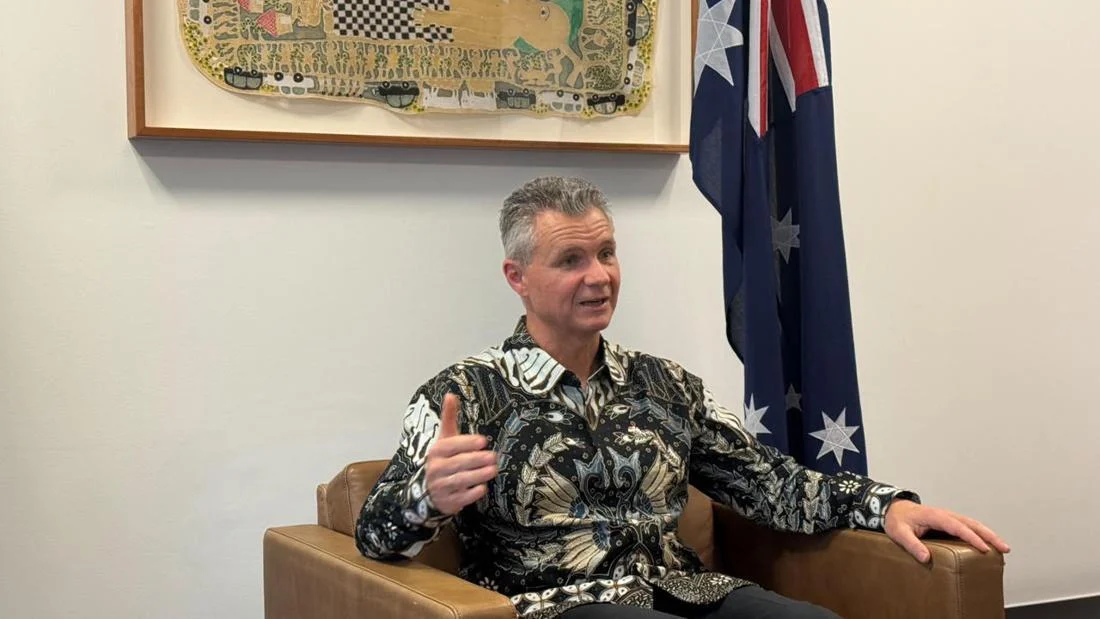
The diplomatic and educational landscape between Australia and Indonesia is poised for a significant evolution as both nations look toward 2027 with a renewed focus on human capital development and streamlined mobility. During an official visit to Jakarta on July 15, 2026, Australia’s Assistant Minister for Foreign Affairs and Trade, Matt Thistlethwaite, provided comprehensive clarity on the future of the Australia Awards scholarships, the burgeoning sector of transnational education, and critical updates regarding visa fee structures and the Working Holiday Visa (WHV) program.
As the two neighbors navigate a period of heightened geopolitical and economic cooperation, education has emerged not merely as a service export but as the foundational pillar of the Indonesia-Australia Comprehensive Strategic Partnership (CSP). With over 200,000 Indonesian alumni of Australian institutions since the mid-20th century, the relationship is entering a phase where the physical location of the classroom is becoming increasingly secondary to the quality and accreditation of the degree itself.
Education as a Pillar of Bilateral Relations
In his address at the Australian Embassy in Jakarta, Minister Thistlethwaite underscored that the social and economic bonds between the two nations are inextricably linked to educational exchange. Currently, approximately 25,000 Indonesian students are enrolled in Australian institutions. According to the Minister, these individuals represent the next generation of Indonesian leadership in both the private and public sectors.
The Minister emphasized that the value of studying in Australia extends beyond academic qualifications; it facilitates the creation of lifelong professional and personal networks. These connections are viewed as a "soft power" asset that ensures long-term economic collaboration. When Indonesian students study alongside their Australian counterparts, they build the trust necessary for future business partnerships and diplomatic cooperation. The Australian government remains deeply committed to fostering this environment, viewing it as a prerequisite for regional stability and shared prosperity.
The Australia Awards: A Legacy of Seven Decades
The Australia Awards program, which has been operational since the 1950s (originally under the Colombo Plan), has reached a milestone of 200,000 Indonesian alumni. The significance of this program is perhaps most visible in the current Indonesian government. Minister Thistlethwaite noted that 16 members of President Prabowo Subianto’s cabinet are Australian alumni, with six of them having specifically received the Australia Awards. This serves as a testament to the program’s ability to identify and nurture high-potential leaders.
Regarding the 2027 outlook for the Australia Awards, the Minister clarified that while there are no plans to drastically increase the numerical quota, the program remains robust and highly prioritized. Indonesia continues to hold one of the largest allocations of Australia Awards globally. The focus for 2027 will remain on maintaining the high quality of the scholarship experience and ensuring that the sectors of study align with Indonesia’s national development goals, such as green energy transition, digital economy, and public health.
The Australian government encourages a diverse range of applicants from across the Indonesian archipelago, including those from marginalized backgrounds and remote provinces, to apply for the 2027 cycle. The goal is to ensure that the leadership benefits of an Australian education are felt throughout the entirety of Indonesia.
Transnational Education and the Role of TEQSA
A major shift in the bilateral education strategy is the expansion of transnational education (TNE). Rather than requiring all students to travel to Australia, the Australian government is supporting its universities to establish physical campuses within Indonesia. Institutions such as Monash University and Deakin University have already led the way, offering Australian-accredited degrees on Indonesian soil.
To address concerns regarding the consistency of education quality, Minister Thistlethwaite highlighted the role of the Tertiary Education Quality and Standards Agency (TEQSA). TEQSA is Australia’s independent national quality assurance and regulatory agency for higher education. The Minister assured that the standards applied to Australian universities operating in Jakarta or Surabaya are identical to those applied in Melbourne or Sydney.
This regulatory oversight ensures that a student graduating from an Australian campus in Indonesia receives the same curriculum, assessment rigor, and degree recognition as they would if they had studied in Australia. This model not only reduces the financial burden on Indonesian families but also allows for more flexible "dual-degree" and "joint-degree" programs that combine the strengths of both Indonesian and Australian academic traditions.
Clarification on Student Visa Fees for Indonesian Applicants
One of the most pressing issues addressed during the Minister’s visit was the recent change in Australian visa pricing. Reports had circulated suggesting that student visa fees would see a blanket increase to AUD 2,500 (approximately IDR 31.5 million) for all international applicants starting in mid-2026. Minister Thistlethwaite categorically denied that this high rate would apply to Indonesian students.
Acknowledging the "special relationship" between Australia and Indonesia, as well as the broader ASEAN region, the Minister explained that Indonesia has been exempted from the steepest fee hikes. While there is a minor annual adjustment based on the Consumer Price Index (CPI)—a standard practice for all visa categories—the fee for Indonesian students will be set at AUD 2,050 (approximately IDR 25.9 million).
This policy decision reflects Australia’s strategic intent to remain an accessible and attractive destination for Indonesian talent. By decoupling Indonesia from the general international fee increase, the Australian government is signaling that it prioritizes the bilateral educational pipeline over short-term fiscal gains from visa processing.
Revolutionizing the Working Holiday Visa: The Lottery System
The Working Holiday Visa (WHV) program, which allows young Indonesians to work and travel in Australia for up to a year, is also undergoing a major structural overhaul. Currently, the program is capped at 5,000 places annually for Indonesian citizens—a quota equivalent to that of China.
Historically, one of the primary hurdles for Indonesian applicants has been the requirement for a "Letter of Support" (SDUWHV) from the Indonesian government. In a move to increase fairness and transparency, the Australian government has accepted a proposal from the Indonesian Directorate General of Immigration to implement a lottery (ballot) system.
The lottery system, which will be managed electronically, aims to eliminate the need for the Letter of Support and reduce the administrative bottlenecks that have plagued the application process in the past. Under this new system, every applicant will have an equal statistical chance of being selected for one of the 5,000 spots. Minister Thistlethwaite confirmed that while the technical implementation of this electronic system is currently underway, a specific launch date will be announced once the infrastructure is finalized. This shift is expected to democratize access to the WHV, allowing a broader demographic of young Indonesians to experience Australian culture and gain international work experience.
Economic Synergy and the Katalis 2.0 Initiative
The educational and mobility updates are set against the backdrop of the "Invested: Southeast Asia Economic Strategy to 2040," a report authored by Nicholas Moore that outlines how Australia can increase its economic footprint in the region. A key component of this strategy is the "Katalis" program, a government-backed initiative designed to maximize the benefits of the Indonesia-Australia Comprehensive Economic Partnership Agreement (IA-CEPA).
The Minister announced the launch of Katalis 2.0, which focuses on strengthening business-to-business (B2B) ties. This program works in tandem with the educational sector by identifying the skills gaps in the Indonesian market and aligning Australian training and education providers to fill them. Furthermore, to facilitate easier business travel, Australia has introduced a new five-year business visa specifically for Indonesians, allowing for multiple entries and shorter stay durations suitable for corporate meetings and trade negotiations.
Strategic Implications and Future Outlook
The comprehensive updates provided by Minister Thistlethwaite suggest a transition toward a more integrated and reciprocal relationship. By maintaining scholarship quotas, exempting Indonesia from visa fee hikes, and modernizing the WHV process, Australia is positioning itself as Indonesia’s primary partner in human capital development.
The broader impact of these policies is expected to be felt in Indonesia’s "Golden Indonesia 2045" vision. As the nation seeks to escape the middle-income trap, the influx of Australian-trained professionals and the presence of Australian campuses in Indonesia will provide the technical expertise required for high-value industries.
Minister Thistlethwaite concluded his visit by noting the deep cultural affinity between the two nations, citing the 1.5 million Australians who visit Bali annually. However, he emphasized that the future of the relationship lies in moving beyond tourism toward a partnership based on shared knowledge, professional mobility, and institutional trust. As the 2027 scholarship cycle approaches and the new visa systems go live, the focus remains on ensuring that the "educational bridge" between Australia and Indonesia remains the strongest link in their bilateral chain.

