
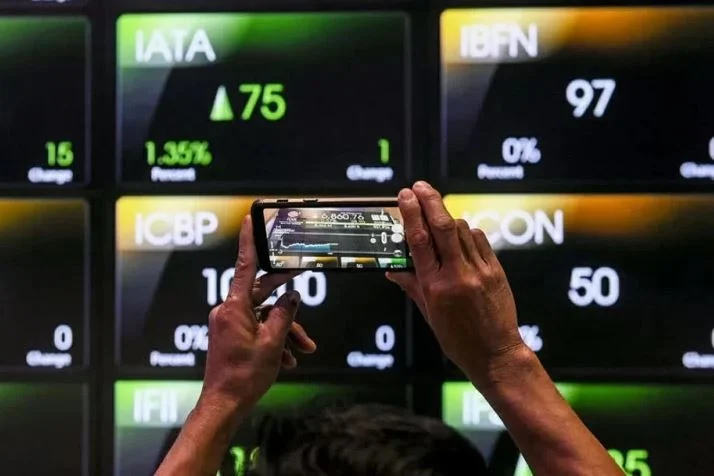
The Indonesian Composite Stock Price Index (IHSG) is projected to experience a potential strengthening today, July 24, 2026, with analysts anticipating a test of the 6,470-6,667 range, which also encompasses a significant "gap area" on its technical chart. This outlook comes despite a slight correction observed in the previous trading session, prompting investors to closely monitor key support and resistance levels. According to research from MNC Sekuritas, while upward momentum is expected, a crucial correction zone between 6,146 and 6,219 should be carefully watched by market participants.
On Thursday, July 23, 2026, the IHSG concluded its trading day with a 0.30 percent decline, settling at 6,315. This downward movement was notably accompanied by an increase in selling pressure, indicating a cautious sentiment among some investors. Technical analysis conducted by MNC Sekuritas suggests that the current trajectory of the IHSG is positioned within "wave iv of wave (c) of wave [iv]," a designation derived from the Elliott Wave Principle, which is a common tool used by technical analysts to forecast market trends by identifying repetitive long-term price patterns and investor psychology. This specific wave configuration often implies a corrective phase within a larger trend, hinting at potential volatility before a clearer direction emerges.
Understanding the Technical Landscape: Gaps, Support, and Resistance
The concept of a "gap" in technical analysis refers to a break in price action where a security’s price moves sharply up or down with no trades occurring in between. When a gap is "tested" or "closed," it often signifies a significant technical event, potentially acting as a magnet for price action. The identified range of 6,470-6,667 as a gap area suggests that historical price movements left a void, and the market now has a tendency to revisit these levels. A successful test and closure of this gap could reinforce bullish sentiment.
Conversely, "support" levels are price points where buying interest is expected to overcome selling pressure, preventing further declines. MNC Sekuritas has pinpointed critical support levels for the IHSG at 6,226 and 6,111. Should the index fall below these levels, it could signal a deeper correction. "Resistance" levels, on the other hand, are price points where selling pressure is anticipated to outweigh buying interest, hindering further upward movement. For the upcoming session, the resistance levels are identified at 6,599 and 6,705. A decisive break above these resistance points would be a strong bullish indicator, confirming the potential for sustained gains.
The daily analysis provided by MNC Sekuritas serves as a vital guide for traders and investors, offering insights into potential price movements based on technical indicators and proprietary models. Their detailed breakdown of wave theory, combined with clear support and resistance levels, allows market participants to formulate their trading strategies with greater precision.
Market Performance Leading Up to July 24, 2026: A Chronological Snapshot
The IHSG’s performance in the days and weeks leading up to July 24, 2026, provides essential context for today’s predictions. The previous day’s 0.30 percent correction, while modest, underscores the prevailing cautious sentiment that can quickly escalate or dissipate. This particular dip, characterized by increased selling pressure, could be a natural profit-taking event after a period of gains or a reaction to specific macroeconomic news, either domestic or international.
Looking at the broader trajectory, the Indonesian market, like many emerging markets, has been influenced by a confluence of global and domestic factors throughout 2026. Global interest rate decisions by major central banks, particularly the U.S. Federal Reserve, have had a ripple effect on capital flows into emerging economies. If global liquidity conditions were tightening, it could lead to outflows from riskier assets, including Indonesian equities. Conversely, expectations of easing monetary policies could attract foreign capital, bolstering the IHSG.
Domestically, Indonesia’s economic performance, including its Gross Domestic Product (GDP) growth rates, inflation figures, and government spending on infrastructure, has been a primary driver. Investor confidence often hinges on the stability of the rupiah against major currencies, the country’s trade balance, and the health of its key export sectors, such as commodities (palm oil, coal, nickel). Any significant policy announcements from the government or Bank Indonesia, particularly concerning fiscal stimulus, subsidies, or regulatory changes, would have directly impacted market sentiment and the IHSG’s movements in the preceding period. The mid-2026 period often sees companies releasing half-year financial results, which can also trigger sector-specific or market-wide reactions depending on the overall earnings picture.
Key Macroeconomic Influences on the IHSG in Mid-2026
The Indonesian economy in mid-2026 likely navigates a complex global landscape. Several macroeconomic factors would be pivotal in shaping the IHSG’s direction:
- Global Economic Growth: A robust global economy generally translates to higher demand for Indonesian exports and improved corporate earnings. Conversely, a slowdown in major trading partners like China or the US could dampen investor enthusiasm.
- Inflation and Monetary Policy: Bank Indonesia’s stance on interest rates, influenced by domestic inflation and global monetary tightening/easing cycles, directly impacts borrowing costs for companies and consumer spending, thus affecting corporate profitability and market valuations. Stable and predictable monetary policy fosters investor confidence.
- Commodity Prices: As a major commodity exporter, Indonesia’s economy and corporate sector are highly sensitive to fluctuations in global commodity prices. Strong prices for coal, palm oil, and nickel typically boost national income and the performance of related sectors on the stock exchange.
- Foreign Direct Investment (FDI) and Portfolio Flows: Attracting sustained FDI and foreign portfolio investment is crucial for market liquidity and growth. Policies promoting ease of doing business, political stability, and attractive valuations play a significant role.
- Domestic Consumption: Indonesia’s large domestic market means consumer spending is a significant component of GDP. Factors like employment rates, wage growth, and consumer confidence indices directly influence the performance of consumer-related stocks.
- Government Policies and Infrastructure Development: The Indonesian government’s commitment to infrastructure projects, regulatory reforms, and investment incentives can create long-term growth opportunities for various sectors, driving investor interest.
An economist from a leading regional bank, speaking on condition of anonymity due to internal policy, might have commented, "Indonesia’s resilience has been a consistent theme, underpinned by its strong domestic consumption and rich natural resources. However, global headwinds, particularly evolving interest rate expectations and geopolitical developments, always warrant caution. The IHSG’s movements reflect a delicate balance between these internal strengths and external pressures."
Spotlight on Strategic Stock Picks: PT Bank Rakyat Indonesia (BBRI)
Among the stock recommendations highlighted by MNC Sekuritas for Friday, July 24, 2026, is PT Bank Rakyat Indonesia (Persero) Tbk (BBRI). BBRI, one of Indonesia’s largest state-owned banks, is a bellwether stock for the Indonesian economy, particularly known for its strong focus on micro, small, and medium-sized enterprises (MSMEs).

On the previous day, BBRI shares experienced a 0.99 percent correction, closing at Rp2,990. This decline was primarily driven by selling pressure, mirroring the broader market sentiment. However, a critical technical observation made by MNC Sekuritas is that BBRI’s share price "still managed to stay above MA60." The 60-day Moving Average (MA60) is a widely used technical indicator that smooths out price data to create a trend-following line. Staying above the MA60 is generally considered a bullish sign, indicating that despite recent selling, the stock’s intermediate-term trend remains upward. This suggests that the correction might be temporary and not a reversal of its underlying strength.
MNC Sekuritas’ analysis places BBRI in "wave (iii) of wave [c]," again using the Elliott Wave Principle. This specific wave count often implies that the stock is in a strong, impulsive move, even if it’s within a larger corrective pattern. The recommendation for BBRI is "Buy on Weakness," a strategy where investors look to purchase shares when their price has temporarily dipped, expecting a rebound.
The specific parameters for this strategy are:
- Buy on Weakness Range: Rp2,910-Rp2,950
- Target Price: Rp3,120, Rp3,180
- Stop Loss: Below Rp2,890
These levels provide clear entry, target, and exit points for traders. The target prices suggest a potential upside of approximately 4.3% to 7.2% from the current closing price of Rp2,990, if bought within the specified range. The stop-loss level is crucial for risk management, limiting potential losses if the stock’s price action deviates negatively from the prediction.
The prominence of BBRI in MNC Sekuritas’ recommendations underscores the banking sector’s importance in the Indonesian market. Banking stocks often represent a significant portion of the IHSG’s capitalization and are considered proxies for the health of the broader economy. BBRI’s consistent performance, extensive branch network, and focus on the resilient MSME sector typically make it a favored choice among both domestic and international institutional investors. Any corporate news related to BBRI, such as its latest quarterly earnings reports, dividend policies, or strategic acquisitions, would have been closely scrutinized by investors leading up to this analysis. Strong earnings growth and prudent risk management by BBRI would naturally contribute to positive market sentiment for the stock.
Broader Market Sentiment and Expert Commentary
The prevailing market sentiment on July 24, 2026, appears to be one of cautious optimism. While the IHSG is predicted to strengthen, the acknowledgement of a correction area and increased selling pressure from the previous day indicates that investors are not entirely without apprehension. This mixed sentiment is typical in markets influenced by both strong fundamental tailwinds and potential external uncertainties.
A senior market analyst from a local investment firm, preferring to remain unnamed, might have remarked, "The IHSG’s ability to test critical resistance and gap levels will be a strong indicator of underlying investor confidence. However, the increased selling volume yesterday reminds us that profit-taking remains a significant factor, especially after periods of sustained gains. Investors should remain agile, balancing growth opportunities with robust risk management." This perspective aligns with MNC Sekuritas’ dual outlook of potential gains coupled with a watchful eye on correction zones.
Regulators, such as the Financial Services Authority (OJK) and the Indonesia Stock Exchange (IDX), continuously monitor market activity to ensure fair and orderly trading. Their statements, while generally not making specific market predictions, often emphasize the importance of investor protection, market transparency, and the overall stability of the financial system. Such overarching regulatory assurances contribute to a foundational level of confidence for both domestic and foreign investors.
Implications for Investors and Economic Outlook
For individual and institutional investors, the current IHSG forecast presents a nuanced picture. The potential for the index to test higher levels offers opportunities for capital appreciation, particularly in strategically chosen stocks like BBRI. However, the identified correction zone and the previous day’s selling pressure serve as important reminders of market volatility and the need for prudent risk management.
- Risk Management: Investors should consider setting stop-loss orders for their positions and diversifying their portfolios to mitigate risks associated with market fluctuations.
- Sectoral Focus: While banking stocks like BBRI are often considered defensive due to their essential role, investors might also look into other sectors that could benefit from the predicted market strengthening, such as consumer cyclicals, infrastructure, or technology, depending on the specific drivers of the rally.
- Long-Term Perspective: For long-term investors, short-term corrections might present attractive entry points for fundamentally sound companies.
From a broader economic perspective, a strengthening IHSG often reflects positive investor sentiment regarding Indonesia’s economic trajectory. It can facilitate capital raising for corporations through IPOs and rights issues, supporting business expansion and job creation. A buoyant stock market can also have a wealth effect, boosting consumer confidence and spending. Conversely, a prolonged period of market weakness could signal underlying economic concerns, potentially impacting investment and consumption.
Navigating Potential Risks and Opportunities
While the technical analysis points to potential upside, several risks could derail the IHSG’s upward momentum. These include:
- Global Economic Downturn: A sharp slowdown in global growth, particularly in major economies, could reduce demand for Indonesian exports and impact corporate earnings.
- Inflationary Pressures: Persistent high inflation, both domestically and globally, could force central banks to maintain or even tighten monetary policy, potentially stifling economic growth and making equities less attractive compared to fixed-income assets.
- Geopolitical Instability: Any escalation of geopolitical tensions globally could trigger risk-off sentiment, leading to capital outflows from emerging markets.
- Domestic Political Uncertainty: Major political events or unexpected policy shifts in Indonesia could create uncertainty and deter investment.
- Commodity Price Volatility: A significant drop in key commodity prices would negatively impact Indonesia’s export revenues and the performance of commodity-linked stocks.
Despite these risks, opportunities remain. Indonesia’s large and growing middle class, ongoing infrastructure development, and digital transformation initiatives continue to offer compelling long-term investment themes. Companies that are well-positioned to capitalize on these trends, coupled with strong fundamentals and prudent management, are likely to perform well in the medium to long term, irrespective of short-term market fluctuations.
In conclusion, as the Indonesian stock market gears up for trading on Friday, July 24, 2026, the IHSG stands at a pivotal juncture. The technical analysis by MNC Sekuritas, forecasting a potential test of the 6,470-6,667 range and a significant gap area, offers a bullish outlook, albeit with a crucial cautionary note on the identified correction zone. The detailed recommendation for BBRI underscores the strategic importance of key banking stocks. Investors will be keenly observing how the market navigates these technical levels, weighing the optimistic projections against broader macroeconomic conditions and potential risk factors to make informed decisions. The day’s trading will provide further clarity on whether the IHSG can successfully confirm its upward trajectory or if it will consolidate within its corrective phase.

