
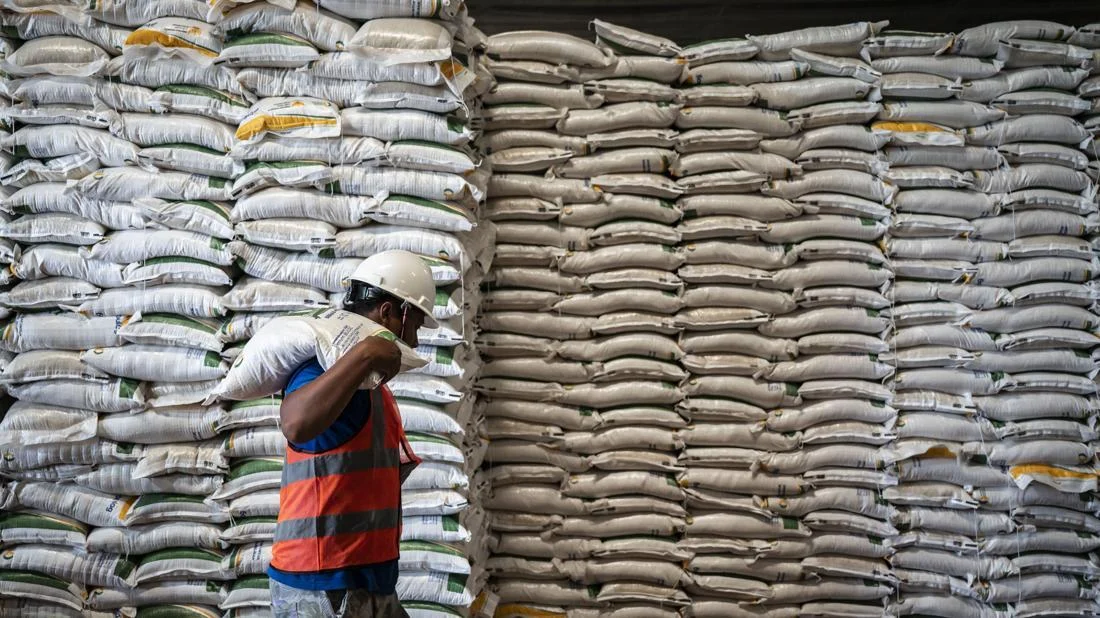
JAKARTA — Indonesia’s national food security posture has received a significant reinforcement as state logistics agency Perum Bulog announced that national rice reserves under its management have reached an unprecedented level of 4.8 million tons. This robust stockpile is projected to comfortably fulfill domestic consumption needs, stabilize market prices, and sustain ongoing government social assistance programs through the conclusion of 2026.
The announcement was made by Perum Bulog President Director Ahmad Rizal Ramdhani during a strategic briefing, highlighting the government’s proactive measures to mitigate potential weather anomalies, global supply chain volatility, and seasonal harvest fluctuations. The substantial volume of grain currently secured within the state logistics framework reflects a coordinated effort among various agricultural ministries, state-owned enterprises, and private storage providers to safeguard the nation’s primary staple food.
With the current volume standing at 4.8 million tons, public officials have expressed high confidence that domestic market stability will remain resilient despite lingering global economic uncertainties. The strategic management of these reserves underscores the administration’s commitment to maintaining price predictability for consumers while simultaneously protecting farmers from extreme price volatility during transitional weather seasons.
Logistical Challenges and the Expansion of Storage Infrastructure
The accumulation of 4.8 million tons of rice has presented a unique operational challenge for Perum Bulog: spatial capacity constraints. Historically, the state logistics agency relied exclusively on its own network of warehouses distributed across Indonesia’s major agricultural hubs and consumption centers. However, the sheer volume of the current harvest procurement has outpaced the physical capacity of these traditional facilities.
To accommodate the surplus grain safely and prevent post-harvest losses, Bulog has executed a comprehensive logistics expansion strategy by leasing extensive private storage facilities across multiple provinces. Ahmad explained that utilizing third-party commercial warehouses was an unavoidable necessity to ensure that every ton of procured rice is stored under optimal conditions, protecting the commodity from moisture, pests, and structural degradation.
"Bulog’s own warehouses are completely at full capacity and can no longer accommodate the incoming volume of state-owned rice reserves," Ahmad stated. "Consequently, we have had to rent private warehouses to store these strategic supplies properly. This cooperative approach between state and private logistics infrastructure ensures that our national stockpile remains fully protected and accounted for."
This hybrid warehousing model demonstrates a high degree of operational flexibility within Indonesia’s food supply chain management. By partnering with private warehouse owners, Bulog has not only solved an immediate spatial crisis but has also stimulated regional logistics economies by engaging commercial storage providers.
Targeted Social Assistance and the Distribution Roadmap
The massive stockpile is not merely being held as a passive reserve; it forms the backbone of a comprehensive distribution roadmap designed to protect vulnerable socioeconomic groups during the final quarter of 2026. A primary allocation of these reserves has been designated for the government’s expanded food assistance program, which targets 33.2 million registered beneficiary families across the archipelago.
Scheduled to run intensively from October through December 2026, this targeted aid initiative aims to cushion lower-income households against inflationary pressures and potential seasonal price spikes. Each eligible beneficiary family is set to receive regular distributions of high-quality rice directly managed and inspected by Bulog officials.
In tandem with the direct family food assistance, Perum Bulog is preparing to flood domestic markets with an additional 1 million tons of rice through the Food Supply and Price Stabilization program, widely known as SPHP. The SPHP initiative has historically served as a critical market intervention tool, enabling traditional markets, modern retail outlets, and neighborhood distribution points to offer rice at government-regulated, affordable price ceilings.
Ahmad emphasized that even after deploying these massive volumes for social assistance and market stabilization, the agency projects that the national rice reserve will maintain a healthy baseline of approximately 3.2 million tons by the close of December 2026. This projected year-end buffer provides an exceptionally safe margin, ensuring that Indonesia enters the subsequent agricultural cycle with strong carryover stocks.
Macroeconomic Implications and Price Stability Analysis
The maintenance of a 4.8 million-ton rice reserve carries profound macroeconomic implications for Indonesia, particularly in the realm of inflation control. Rice holds the single largest weighting in the calculation of the Consumer Price Index (CPI) basket within the country. Consequently, any significant fluctuation in the price of rice immediately reverberates through the broader economy, influencing headline inflation rates and consumer purchasing power.
Economic analysts have noted that Bulog’s aggressive procurement strategy throughout the year has successfully anchored inflationary expectations. By stepping up domestic purchases during peak harvest seasons and releasing targeted volumes during lean periods, the agency has flattened traditional price volatility curves. This proactive posture prevents speculative hoarding by private traders and reassures both urban and rural consumers of a steady, reliable supply.
Furthermore, the robust reserve level acts as an effective shield against external geopolitical shocks and climate phenomena such as El Niño or La Niña, which frequently disrupt agricultural production in major exporting nations across Southeast Asia and South Asia. By maintaining self-reliance through substantial domestic reserves and judicious supplementary procurement, Indonesia insulates its domestic food economy from international price surges and export restrictions imposed by producer nations.
Collaboration Among Stakeholders and Future Outlook
The successful management and preservation of 4.8 million tons of rice require seamless synchronization among multiple state institutions, including the Ministry of Agriculture, the National Food Agency (Bapanas), state logistics operators, and local regional governments. Coordination meetings focus on monitoring regional supply deficits, streamlining transportation logistics across maritime routes, and ensuring strict quality control standards for all stored grain.
Agricultural economists and supply chain experts have praised the current administrative coordination, noting that transparent communication regarding reserve volumes helps maintain market confidence. When commercial millers, distributors, and retailers are fully aware that the state possesses a multi-million-ton buffer, speculative market behavior is heavily suppressed.
Looking ahead toward the transition into 2027, Perum Bulog remains focused on modernizing its inventory management systems, upgrading regional warehouse infrastructure, and optimizing distribution networks to minimize transit times. The ongoing integration of digital inventory tracking allows central administrators to monitor stock levels in real-time across hundreds of facilities, ensuring rapid response capabilities in the event of localized weather emergencies or distribution bottlenecks.
Ultimately, the announcement of the 4.8 million-ton reserve serves as a reassuring testament to Indonesia’s food sovereignty framework. Through meticulous planning, expanded logistical partnerships, and targeted social safety net interventions, the government has solidified a stable foundation that guarantees nutritional security and market calm for millions of citizens through the end of 2026 and beyond.

