
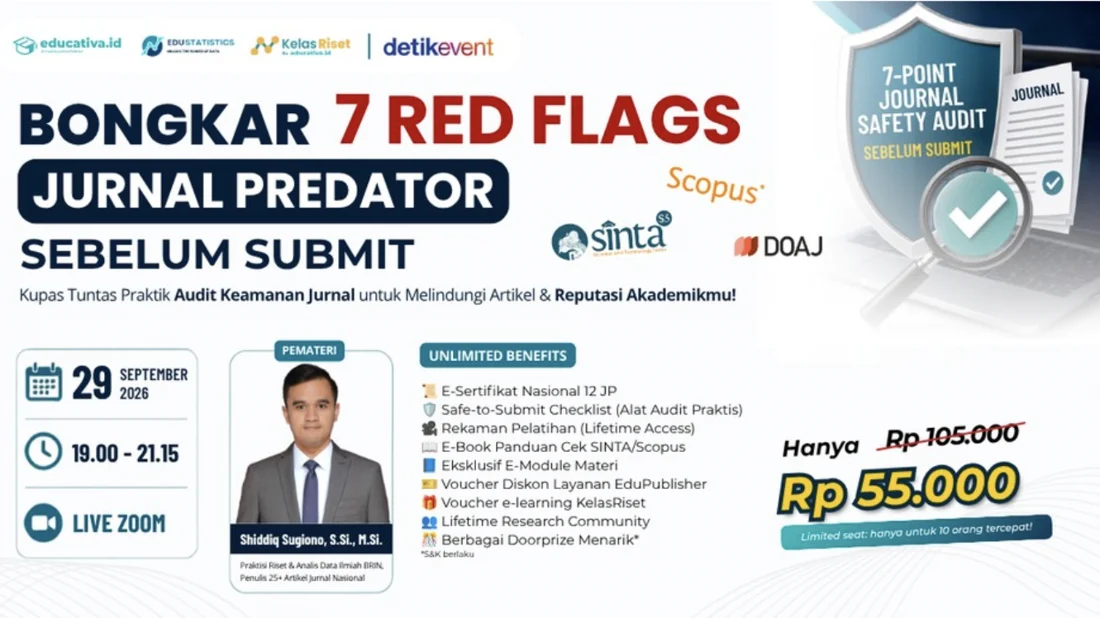
The academic landscape in the modern era of higher education is increasingly marred by a pervasive and costly phenomenon: the proliferation of predatory publishing. For researchers, lecturers, and postgraduate students striving to meet institutional publishing requirements, the pursuit of career advancement and academic dissemination often intersects with deceptive practices designed to exploit the pressure to publish. Too often, academics realize their chosen publication venue is illegitimate only after investing months in research, enduring the manuscript submission process, and rendering substantial publication fees, commonly known as Article Processing Charges (APCs). In response to this pressing academic vulnerability, the scientific community is moving toward proactive educational initiatives. A prominent example is the upcoming premium webinar titled Bongkar 7 Red Flags Jurnal Predator Sebelum Submit, scheduled for Tuesday, September 29, 2026. This intensive session is designed to equip scholars with the critical evaluative tools necessary to identify and avoid fraudulent journal operators before committing their intellectual property and financial resources.
The Threat of Predatory Publishing in Contemporary Academia
Predatory journals have evolved from crude, mass-email solicitations into sophisticated operations that mimic legitimate, peer-reviewed academic publications. These predatory entities exploit the open-access business model, prioritizing financial gain over rigorous peer review and editorial oversight. For academic institutions, the consequences are severe, leading to the contamination of scientific literature, the misallocation of research funding, and the potential tarnishing of a researcher’s professional reputation.
A particularly deceptive tactic employed by these malicious actors involves the misrepresentation of indexing status. Many predatory or discontinued journals continue to display prestigious logos such as SINTA (Science and Technology Index) or Scopus on their landing pages. Unsuspecting authors, failing to conduct cross-verification against official databases, trust these visual cues at face value. Consequently, papers are submitted to platforms that have long been discontinued from international indexing databases due to ethical breaches or failure to maintain publication standards. This systemic deception creates an urgent need for standardized, systematic pre-submission auditing among early-career researchers and seasoned academics alike.
Expert Guidance and Event Chronology
To combat these deceptive practices, the upcoming webinar features comprehensive instruction by Shiddiq Sugiono, S.Sc., M.Sc., a respected research practitioner and scientific data analyst at the National Research and Innovation Agency (BRIN). With a prolific publishing background encompassing over 25 articles in national and international journals, Sugiono brings a wealth of practical experience to the digital podium.
The live educational event is scheduled to take place on Tuesday, September 29, 2026, delivered via a live Zoom session designed to maximize interactive engagement. Unlike conventional academic seminars that remain mired in abstract theory, this program emphasizes a pragmatic approach known as the Pre-Submission Journal Safety Audit. The curriculum is structured to guide participants through real-time application, ensuring that attendees can immediately translate acquired knowledge into everyday research habits.
Comprehensive Curriculum and Practical Methodology
The structure of the webinar bridges theoretical foundations with hands-on practice, addressing the multifaceted nature of modern academic publishing. The curriculum is meticulously divided into several core components, beginning with the foundational definitions and differentiations of publishing ecosystems. Participants will explore the nuances of legitimate open-access, hybrid, and subscription models versus predatory entities.
A core focus of the session is the anatomy of fake indexing claims. Attendees will be trained to recognize the discrepancies between what a journal claims on its homepage and its actual status in official registries. Furthermore, the curriculum outlines a rigorous workflow for cross-source verification. Participants will learn how to independently navigate and interrogate authoritative databases and verification portals, including:
- SINTA (Science and Technology Index) for Indonesian national accreditations.
- Scopus Sources and the SCImago Journal & Country Rank (SJR) for international citation metrics.
- The ISSN Portal to verify the legitimacy of International Standard Serial Numbers.
- The Directory of Open Access Journals (DOAJ) for validated open-access compliance.
- Think.Check.Submit, a cross-industry initiative designed to help researchers identify trusted journals.
Following the multi-source verification training, participants will be introduced to the Safe-to-Submit Checklist. This standardized evaluation tool provides a step-by-step framework that researchers can apply autonomously to any target publication.
Live Audit and Red Flags Analysis
One of the most anticipated segments of the webinar is the Live Audit session. During this segment, the speaker will dissect real-world journal websites in real time, exposing the seven critical red flags that typically signal a predatory operation.
These red flags encompass a wide range of operational anomalies, starting with suspiciously rapid peer-review timelines. Legitimate peer review requires adequate time for expert evaluators to scrutinize methodology, data integrity, and theoretical contributions; promises of publication within days or weeks almost invariably indicate a lack of genuine editorial oversight. Other warning signs include opaque or non-transparent publishing fees, shifting or ambiguous editorial board credentials (such as listing researchers without their consent or inventing fictitious editors), poor website localization with broken links and grammatical errors, and aggressive solicitation campaigns urging immediate manuscript submission.
By dissecting these indicators through live case studies, participants will develop a sharp, analytical eye capable of spotting deceptive practices that easily escape the notice of uninitiated authors.
Broader Implications and Institutional Impact
The implications of this educational initiative extend far beyond individual researchers, addressing broader systemic issues within the academic ecosystem. As universities and research institutions increasingly tie graduation requirements, promotion criteria, and grant disbursements to publication output, the pressure on scholars intensifies. This pressure creates fertile ground for predatory publishers.
By empowering researchers with systematic auditing skills, initiatives like this BRIN-backed webinar contribute directly to the safeguarding of national and international scientific integrity. When researchers successfully avoid predatory traps, they protect their institution’s academic standing, ensure the efficient use of limited research budgets (which are frequently burdened by exorbitant and unjustified APCs), and preserve the reliability of the global scholarly record. Furthermore, training postgraduate students early in their academic journeys instills a culture of rigorous journal selection that will benefit their entire professional trajectories.
Participant Benefits and Registration Details
To ensure that the impact of the webinar extends well beyond the live broadcast, organizers have prepared an extensive suite of supplementary resources for all registered attendees. Participants will receive an official National E-Certificate worth 12 JP (Hours of Lesson), a downloadable copy of the Safe-to-Submit Checklist, lifetime access to the event recording, comprehensive e-books, and exclusive e-modules.
In addition to educational materials, attendees will gain access to specialized perks, including service vouchers from Educativa and KelasRiset, entry into an active professional research community network, and various doorprizes provided as added bonuses.
The webinar is tailored specifically for university lecturers, active researchers, postgraduate students, and any scholar preparing a manuscript for submission to scientific periodicals. Registration is currently open to the public. Interested parties can secure their virtual seats and access comprehensive event details by visiting the official registration portal via detikevent through the dedicated booking link. Through proactive education and rigorous cross-verification methodologies, the academic community can systematically close the door on predatory publishing and uphold the highest standards of scientific communication.
