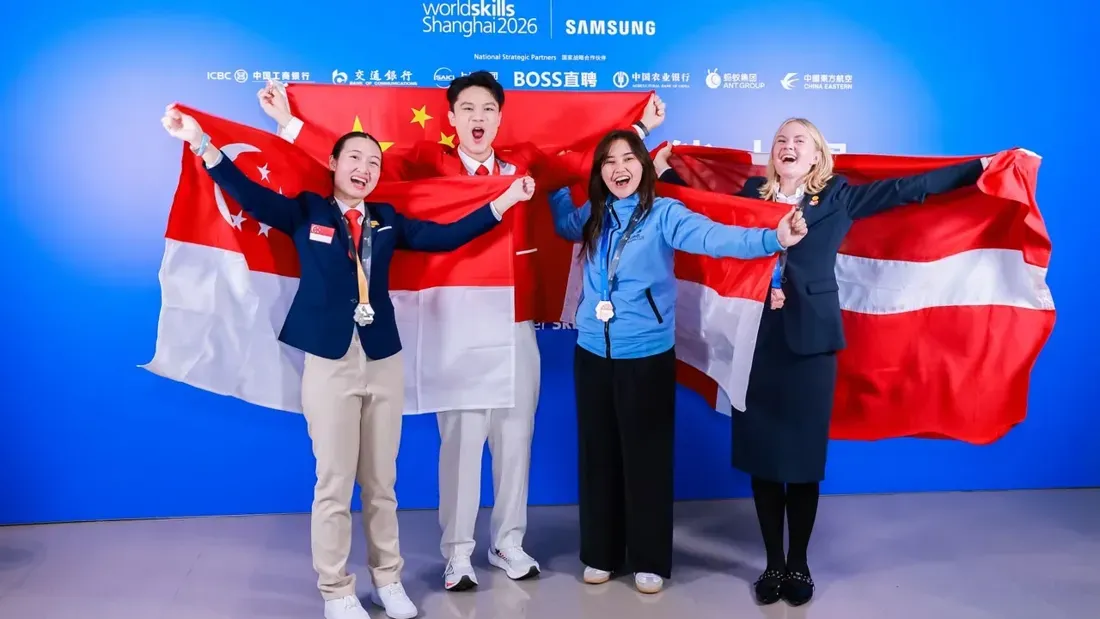
The global stage of vocational excellence witnessed a remarkable achievement as Fatima Rani Al Husna Prameswara, a young Indonesian student, secured a bronze medal at the prestigious WorldSkills Shanghai 2026. Competing in the highly demanding Restaurant Service category, Fatima stood shoulder-to-shoulder with top-tier global professionals, bringing immense pride to her home country and validating the rigorous standards of Indonesia’s vocational education system. Held in Shanghai, China, from September 22 to 27, 2026, the international competition served as a rigorous test of technical proficiency, composure, and adaptability.
For Fatima, who currently studies Applied Undergraduate Hospitality Management at the Faculty of Vocational Studies, Trisakti Institute of Tourism, this international accolade is the culmination of years of relentless dedication, precise training, and academic perseverance. Guided by her expert mentor and head of study program, Robiatul Adawiyah, Fatima navigated complex modules and high-pressure scenarios that tested every facet of modern restaurant service and hospitality management.
The Chronology of Excellence: From Vocational School to the Global Arena
Fatima’s journey to the podium in Shanghai did not happen overnight; it is anchored in a structured and competitive talent pipeline that begins at the secondary education level in Indonesia. Her competitive career commenced during her time as a student at SMKN 57 Jakarta, where she graduated in the class of 2024. Recognizing her aptitude for hospitality, she entered the internal school selections for the Student Competency Competition (Lomba Kompetensi Siswa, or LKS).
Moving swiftly through the administrative tiers of the competition, Fatima secured first place representing South Jakarta II. She then advanced to the provincial level, capturing another first-place victory to represent the Special Capital Region of Jakarta. Her momentum carried her to the national stage of the LKS, where she went head-to-head with representatives from 30 provinces across Indonesia. Her exceptional performance earned her a gold medal at the national level, a feat that not only validated her technical mastery but also earned her a full academic scholarship to the Trisakti Institute of Tourism.
Following her domestic success, Fatima set her sights on international representation. She triumphed in regional selections to secure first place for the WorldSkills ASEAN 2025 qualifiers, subsequently earning a second-place finish in the national selection process for the ASEAN delegation. At WorldSkills ASEAN 2025, she proudly represented Indonesia alongside a peer from Aceh, another alumnus of the LKS pipeline. Securing a bronze medal at the ASEAN level served as her gateway to the centralized training centers and industry-standard immersion programs required to prepare for the grueling demands of WorldSkills Shanghai 2026.
Facing Global Professionals: Overcoming High-Stakes Challenges
Competing at the WorldSkills competition represents a paradigm shift from national and regional student contests. Unlike localized competitions where participants are primarily peers of similar academic standing, WorldSkills Shanghai 2026 exposed Fatima to an environment dominated by seasoned industry professionals from around the globe.
As a university student still in the process of formal education, entering an arena filled with working practitioners presented a formidable mental and technical hurdle. The stringent standards, combined with the professional experience of her competitors, required Fatima to adapt rapidly to advanced industry workflows. Furthermore, the secrecy surrounding the competition tasks added an extra layer of psychological pressure.
In the Restaurant Service category, competing participants remain in the dark regarding specific modules and test projects until days before the event. For the Shanghai competition, official test project details were released merely two days prior to the commencement of the events. This dynamic required participants to possess absolute mastery over their foundational skills during the training phase, ensuring that execution during the live competition relied on deeply ingrained muscle memory rather than last-minute cramming.
Comprehensive Skillsets and the WorldSkills Test Project
The Restaurant Service category at WorldSkills is far removed from standard front-of-house hospitality duties. It demands a multifaceted mastery of culinary arts, beverage management, customer psychology, and aesthetic presentation. Fatima faced five rigorous core modules, each subdivided into a multitude of complex practical evaluations.
The Test Projects encompassed a wide array of specialized disciplines, including barista operations, bar management, fine dining service, banquet dining, and casual dining. For instance, the fine dining module evaluated candidates not only on their grace, efficiency, and attentiveness in serving guests, but also on intricate practical skills such as fruit carving and the precise preparation of Irish coffee.
To prepare for these diverse demands, Fatima engaged in an intensive, two-and-a-half-year training regimen. Rather than relying solely on immediate preparation, her training strategy involved deep historical analysis. She systematically dissected past WorldSkills test projects—reviewing documentation not only from the Lyon 2024 competition but extending as far back as the 2022 Special Edition, 2019, and 2015 events. By synthesizing these historical datasets, she and her coaching team were able to map out recurring core competencies and accurately forecast potential trends for the Shanghai 2026 challenges.
Adapting to Cultural Nuances: The Tea Service and Chinese Menu Factor
Every host country for the WorldSkills competition introduces unique cultural elements into the technical modules, testing the competitors’ cross-cultural competency and agility. Shanghai 2026 was no exception. Fatima noted that a significant shift in the competition layout involved the integration of traditional Chinese cultural elements into standard service practices.
The inclusion of specialized tea service protocols and an expanded emphasis on authentic Chinese culinary menus presented a distinct hurdle. In high-end hospitality, understanding the precise etiquette, brewing temperatures, service flow, and pairing principles of traditional Chinese tea requires specialized knowledge that falls outside standard Western fine-dining curricula. Fatima’s ability to quickly absorb these cultural nuances, adapt her service techniques, and execute them under the watchful eyes of international judges was a critical factor in her securing the bronze medal.
Institutional Support and the Wider Implications for Indonesian Vocation
The success of Fatima Rani Al Husna Prameswara at WorldSkills Shanghai 2026 highlights the growing efficacy of Indonesia’s vocational education framework. The synergy between secondary vocational schools (SMK), higher education institutions such as the Trisakti Institute of Tourism, and government-backed training initiatives has created a viable talent pipeline capable of producing globally competitive graduates.
Following the arrival of the Indonesian contingent at the Ministry of Primary and Secondary Education offices in Jakarta, stakeholders emphasized the broader economic and educational implications of such achievements. In an era where the global hospitality and tourism industry demands increasingly sophisticated service standards, the presence of internationally recognized young talents positions Indonesia as a rising hub for skilled vocational labor.
Experts note that success in vocational competitions serves multiple strategic functions. First, it validates curriculum adjustments that align domestic educational standards with international industry benchmarks. Second, it serves as a powerful motivational tool for millions of students currently enrolled in vocational schools across the archipelago, demonstrating that technical and vocational education and training (TVET) pathways can lead to global recognition and career mobility.
Future Outlook: Knowledge Transfer and Academic Ambitions
Having achieved international recognition, Fatima remains grounded and focused on the future. Her primary objective moving forward is to give back to the educational ecosystem that nurtured her talent. She expressed a firm commitment to mentoring students in vocational schools and tertiary institutes, intending to share the specialized techniques, insights, and global standards she acquired during her time at WorldSkills.
Her career trajectory bridges practical industry experience with academic aspirations. In the near term, Fatima plans to build a robust career within the global hospitality industry, deepening her operational expertise. In the long term, she aims to transition into academia as a lecturer in restaurant service, driven by a deep-seated passion for the discipline. By combining hands-on industry mastery with pedagogical instruction, she hopes to inspire the next generation of Indonesian hospitality professionals to step onto the world stage and prove that young domestic talents can excel at the highest international levels.