
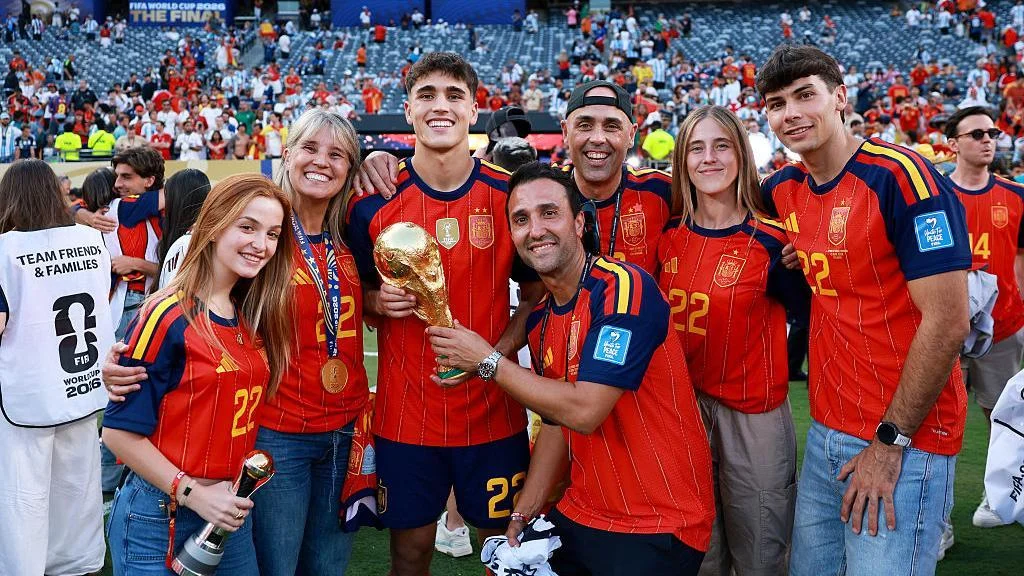
New York – Polish football icon Robert Lewandowski shared his elation following Spain’s triumphant victory in the 2026 FIFA World Cup, expressing a strong belief in the current Spanish squad’s potential to achieve further global success. The striker, a two-time FIFA Best Player awardee, witnessed Spain clinch their second World Cup title in a hard-fought final against the 2022 champions, Argentina, at a packed stadium in New Jersey. Spain’s decisive 1-0 victory was secured in extra time by a goal from Ferran Torres, a testament to their disciplined defensive performance that largely stifled the Argentine attack.
A Tactical Masterclass in a Challenging Final
While acknowledging the match wasn’t the most aesthetically pleasing spectacle, Lewandowski commented on the challenging playing conditions. "The pitch was slow, so it wasn’t the best way to play the game," he remarked, referring to the quality of the playing surface which may have impacted the free-flowing, attacking style often associated with both Spain and Argentina. Despite these conditions, Lewandowski was effusive in his praise for Spain’s overall performance. "Spain was superior and could have won the match earlier or with more goals. They dominated throughout the game and always kept possession," he stated, highlighting La Furia Roja’s consistent control and tactical discipline.
The victory for the Spanish national team marks a significant milestone, achieving a remarkable double by holding both the World Cup and the European Championship titles, the latter of which they secured two years prior. Lewandowski, a prominent figure in global football, was present in the stands, personally observing Spain’s triumph. His presence in New Jersey underscored his connection to the sport and his keen interest in witnessing elite competition.
Personal Ties and Future Ambitions
Lewandowski’s support for Spain stemmed from his significant tenure at FC Barcelona, a club where he has formed numerous friendships and professional relationships. "I supported Spain because I spent several years in Barcelona and I have many friends there, so I really supported them," he explained. This personal connection provided a clear motivation for his allegiance in the final. He also acknowledged his initial support for Argentina, specifically for Lionel Messi, who had led them to victory in the previous World Cup. However, with Messi having already achieved his ultimate international dream, Lewandowski’s focus shifted to a team he felt deserved the global acclaim. "From Argentina, I only supported Messi, but he won the World Cup before, so that’s why I wanted Spain to win," he added, elaborating on his nuanced loyalties.
The 38-year-old Polish star was particularly impressed by the youthful core of the Spanish squad. He noted that with a team comprised of many young talents, Spain possesses the potential to defend their title in the upcoming 2030 FIFA World Cup. "They are a very young team and can still win other World Cups. I enjoyed their game and Spain’s victory," Lewandowski concluded, offering a positive outlook on the future of Spanish football. His sentiments were echoed by many observers who recognized the blend of experience and emerging talent within Luis de la Fuente’s squad.
Spain’s Journey to 2026 Glory
The road to the 2026 World Cup title for Spain was a testament to their strategic development and consistent performance over several years. After their disappointing group-stage exit in the 2022 World Cup, the Spanish Football Federation (RFEF) and the coaching staff embarked on a process of rejuvenation. The focus shifted towards integrating a new generation of exceptionally talented young players, many of whom had excelled in Spain’s youth academies and had already made significant impacts in top European leagues.
The Euro 2024 victory served as a crucial stepping stone, providing invaluable tournament experience and building crucial team cohesion. This triumph instilled a renewed sense of confidence and belief within the squad, signaling their readiness to compete on the global stage once more. Manager Luis de la Fuente, who took over the senior team in 2022, has been instrumental in this transition. He has cultivated an environment that fosters attacking flair while maintaining the historical Spanish emphasis on possession-based football and defensive solidity.
Key Moments and Players in the 2026 Campaign
Spain’s campaign in the 2026 World Cup was marked by a series of dominant performances. They navigated their group stage with relative ease, showcasing a potent attacking force led by emerging stars alongside seasoned veterans. Throughout the knockout stages, their tactical flexibility and defensive resilience proved formidable. They overcame strong opposition with disciplined performances, often controlling the tempo of the game and limiting their opponents’ opportunities.
The semi-final clash, a tense affair against a resurgent Brazil, saw Spain emerge victorious after a penalty shootout, demonstrating their mental fortitude under pressure. This victory set up the highly anticipated final against Argentina, a rematch of the 2022 final and a clash of two footballing giants. The final itself, as Lewandowski noted, was a testament to Spain’s strategic approach. They meticulously executed their game plan, nullifying Argentina’s attacking threats, particularly Lionel Messi, who, despite his immense talent, found it challenging to break down the Spanish defense. The decisive moment came in extra time when a swift attacking move culminated in Ferran Torres’s clinical finish, sending the Spanish contingent into raptures.
Statistical Overview of Spain’s Dominance
Spain’s statistical performance throughout the 2026 World Cup was impressive. They led the tournament in average possession, consistently maintaining control of the ball and dictating the pace of play. Their passing accuracy remained exceptionally high, a hallmark of their tiki-taka-inspired style. Defensively, they conceded the fewest goals in the tournament, a testament to their organized backline and the exceptional goalkeeping of Unai Simón.
Key statistics that underscored their success included:
- Goals Scored: While not the highest-scoring team in every match, their efficiency in front of goal, particularly in crucial moments, was notable. Ferran Torres, with his decisive final goal, became a national hero.
- Goals Conceded: Averaging less than 0.5 goals per game, their defensive record was the best in the competition.
- Possession Statistics: Consistently dominating possession, often exceeding 65% in their matches.
- Passing Accuracy: Maintaining a passing accuracy rate above 90% throughout the tournament.
- Key Passes and Chances Created: While not always reflected in the scoreline, their ability to create scoring opportunities was evident in their consistent attacking pressure.
The emergence of young talents like Lamine Yamal, who at a remarkably young age played a pivotal role in the midfield, has been particularly noteworthy. His vision, dribbling ability, and composure on the ball have drawn comparisons to some of the game’s greatest playmakers. Alongside him, players like Pedri and Gavi, who were part of the Euro 2024 winning squad, provided a blend of youthful exuberance and tactical intelligence.
Reactions from the Football World
The victory sparked widespread celebration across Spain and garnered praise from football luminaries worldwide. Former Spanish internationals and coaches lauded the team’s achievement, highlighting the successful implementation of a long-term development strategy.
- Luis Enrique, former Spain manager: While not directly involved in the 2026 campaign, former manager Luis Enrique, who led Spain to the Euro 2024 title, expressed his pride. "This is a moment of immense joy for Spanish football. The players and the coaching staff have worked incredibly hard, and they deserve this success. It shows the strength of our youth development and the enduring philosophy of our game," he stated in a televised interview.
- Javier Tebas, La Liga President: "To win the World Cup is the pinnacle of football. This victory will undoubtedly boost the profile of La Liga and inspire a new generation of fans and players. Congratulations to the RFEF and the national team," commented Tebas.
- Argentina Football Association (AFA): The AFA released a statement commending Spain on their victory while acknowledging the valiant effort of their own team. "We congratulate Spain on their World Cup triumph. It was a closely contested final, and we are proud of our players’ dedication and spirit. We look forward to future encounters between these great footballing nations."
Implications for Spanish Football and the Future of the Game
Spain’s 2026 World Cup victory has profound implications for the nation and the broader landscape of international football. Domestically, the triumph is expected to further galvanize support for the sport, encouraging increased participation at grassroots levels and potentially leading to greater investment in football infrastructure. The success of the national team also serves as a powerful marketing tool for La Liga, attracting global attention and enhancing its brand value.
Internationally, Spain’s achievement reinforces the efficacy of a patient, development-focused approach to team building. Their ability to seamlessly integrate young talent into a winning formula offers a blueprint for other national federations. The victory also solidifies Spain’s position as a perennial powerhouse in international football, setting a high benchmark for their competitors.
Furthermore, the 2026 World Cup, co-hosted by the United States, Canada, and Mexico, marked a significant expansion of the tournament format, featuring 48 teams. Spain’s success within this larger, more diverse field underscores their ability to adapt and excel against a wider range of opponents. The continued dominance of a possession-oriented, technically proficient style of play, as demonstrated by Spain, suggests that these principles will remain influential in the evolving tactical trends of the sport. As Robert Lewandowski rightly observed, with a core of young, exceptionally talented players, Spain appears poised to remain a formidable force on the global stage for years to come, potentially adding more silverware to their illustrious trophy cabinet. The future of Spanish football looks exceptionally bright, fueled by this latest global triumph and the promise of its emerging generation.
