
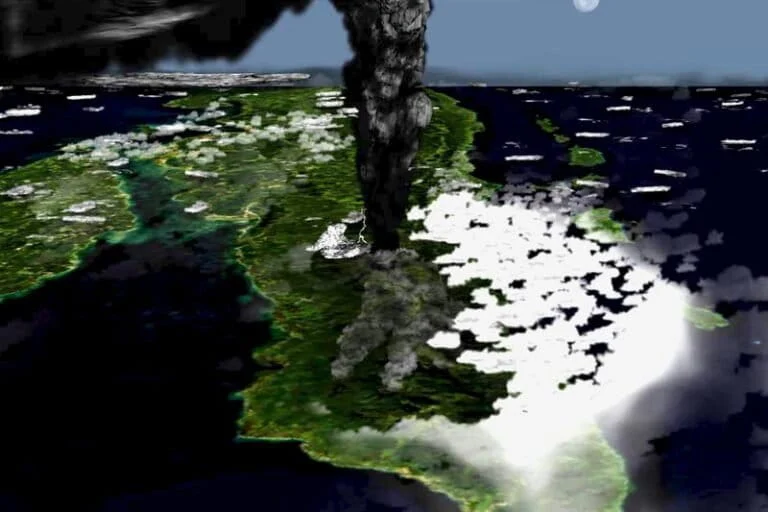
Deep beneath the crystalline waters of the Ryukyu Islands in Japan lies the Kikai caldera, a submerged giant that once unleashed cataclysmic fury upon the ancient world. Approximately 7,300 years ago, this formidable supervolcano produced an eruption so violent it triggered megatsunamis, devastated southern Japan, and blanketed the region—including parts of the Korean Peninsula—in a thick, suffocating layer of volcanic ash. For millennia, this underwater behemoth was largely considered dormant, a relic of a violent past. However, recent scientific breakthroughs and a startling eruption on May 17, 2026, have forced the global geological community to reconsider the lifespan of supervolcanoes.
The 2026 event, which saw Kikai ejecting gas and ash to an altitude of 400 meters, served as a stark reminder that the cessation of surface activity does not equate to the death of a volcanic system. Far from being a spent force, Kikai is currently undergoing a process of internal replenishment, refilling its magma chambers with new molten rock. This development has provided critical, albeit concerning, insights into the behavior of the world’s most dangerous volcanic systems, including the Yellowstone caldera in the United States and the Toba supervolcano in Indonesia.
The Mechanism of Rebirth: Melt Re-injection
A landmark study published in the journal Communications Earth & Environment in March 2026 has shed light on how supervolcanoes maintain their potential for disaster long after their primary eruptions. Researchers identified a phenomenon known as "melt re-injection," where fresh, buoyant magma naturally migrates back into the vast, shallow reservoirs located beneath the caldera.
By utilizing advanced deep-sea seismic refraction surveys—a technique that measures the velocity of seismic waves as they travel through submerged rock—scientists were able to map the subsurface architecture of Kikai with unprecedented clarity. Unlike traditional land-based seismic monitoring or geochemical sampling, which often struggle to penetrate the complex layers of deep-ocean floors, this method successfully tracked the inflow of fresh magma into the very same reservoir that fueled the ancient Kikai-Akahoya eruption.
The findings suggest that the internal "plumbing" of a supervolcano is a dynamic, living system. Rather than cooling into inert rock, the reservoir remains a high-pressure environment where thermal maturity is sustained by the continuous, albeit slow, injection of new melt. This discovery challenges the conventional wisdom that supervolcanoes require a massive, immediate buildup of pressure to remain active, suggesting instead that they can exist in a state of "perpetual potential" for thousands of years.
A Comparative Analysis: The Toba Connection
The implications of the Kikai research extend far beyond the Japanese archipelago, drawing direct parallels to the Toba supervolcano in North Sumatra, Indonesia. Toba, arguably the most infamous supervolcano in human history, is responsible for one of the largest eruptions in the last two million years. Its last major cataclysm occurred approximately 74,000 years ago, ejecting an estimated 5,300 cubic kilometers of volcanic material and creating a massive caldera now filled by the waters of Lake Toba.
The historical impact of Toba’s eruption was global. Climate models suggest that the sheer volume of volcanic aerosols injected into the stratosphere reduced average global temperatures by three to five degrees Celsius for several years, causing significant disruptions to ecosystems and, potentially, the human population of the era.
Data indicate that Toba has experienced at least four major eruptions over the past 1.6 million years. Following the most recent collapse, the internal structure of the volcano underwent a profound transformation; the magma reservoir expanded laterally, evolving into a complex system that remains active to this day. Current estimates suggest that the reservoir, situated between 5 and 11 kilometers beneath the lake’s surface, receives a steady supply of magma at a rate of roughly 0.008 to 0.01 cubic kilometers per year. With a total volume of eruptible material estimated at over 315 cubic kilometers, Toba remains a subject of intense scrutiny for volcanologists who fear that the "thermal maturation" process observed at Kikai could be occurring on a much larger scale at Toba.
The Challenge of Predictive Modeling
The primary dilemma facing modern geophysics is the inherent unpredictability of supereruptions. Traditional indicators of volcanic activity—such as swarms of seismic tremors, ground deformation (uplift or subsidence), anomalous gas emissions, and rapid changes in thermal flux—are often absent in the lead-up to a major supervolcanic event.
In the case of Toba, the silence of the surface is deceptive. The 2026 Kikai event underscores that a supervolcano can remain dormant for thousands of years, only to experience minor surface venting while massive structural changes occur miles below the crust. If "melt re-injection" is indeed a universal pattern for caldera-forming volcanoes, then current monitoring networks are likely inadequate.
"We are essentially looking at a system that hides its growth," noted an expert familiar with the study. "If we rely solely on surface-level indicators, we may miss the subtle, deep-seated shifts in seismic wave velocity that precede a major recharge or a shift in the magma reservoir’s stability."
Global Implications for Volcanic Monitoring
In light of these findings, international scientific bodies are calling for a shift in strategy. The focus is moving toward "multi-parameter, long-term monitoring" that prioritizes deep-crustal seismic imaging over intermittent surface observation. For systems like Yellowstone—where a shallow magma reservoir resides at a depth of 3 to 8 kilometers—this means implementing permanent ocean-bottom-style seismic arrays that can provide real-time data on the state of the reservoir’s melt fraction.
The vulnerability of global infrastructure to a supervolcanic event cannot be overstated. A major eruption at any of these sites would cause unprecedented disruption to global aviation, agriculture, and climate stability. The Kikai discovery provides the scientific community with a new "litmus test" for assessing volcanic risk. By understanding the specific seismic signatures of melt re-injection, researchers hope to move closer to a predictive framework that can distinguish between minor, localized adjustments and the dangerous, long-term accumulation of eruptible material.
Future Perspectives
The 2026 Kikai eruption has acted as a catalyst for renewed research funding and international collaboration. Scientists are now prioritizing the development of high-resolution gravity sensors and satellite-based InSAR (Interferometric Synthetic Aperture Radar) to track microscopic changes in caldera elevation, which could serve as early warning signs of internal pressure changes.
As the scientific community continues to analyze the seismic data from Kikai, the broader takeaway is clear: we inhabit a planet where the most significant threats are often the most quiet. The supervolcanoes that shaped the geological history of the Earth are not static monuments of the past; they are evolving, breathing systems that require constant, diligent observation. The lesson from the depths of the Ryukyu Islands is one of humility—nature’s most powerful forces are often working in the shadows, waiting for the conditions of thermal maturity to align, and it is the responsibility of global science to decode those signals before the next cycle of geologic transformation begins.
As of late 2026, international geological surveys have confirmed that while Kikai’s immediate activity has subsided, the "re-injection" process remains ongoing. This status, characterized as "active but stable," will serve as the baseline for future comparative studies, providing a unique laboratory for understanding the life cycle of the world’s most formidable natural wonders. Whether this knowledge will ultimately allow for precise forecasting remains the ultimate goal of modern volcanology, a field that now finds itself at the edge of a new era in tectonic understanding.
